I wonder if it's a blue dress with black highlights or a green dress with gold highlights.
The blue band COULD be violet, those are two colors that are too close in range for me to make out. I have to carefully look at the blue to see if I can detect any red in it. If so then I know it's violet. If not - it's blue. I don't see any red in the blue. And I CERTAINLY don't see yellow. I see green. But I am "Red/Green deficient" in color perception. Sort of a "Color Blind artist".
While the "E" preferred value lists are the best way to insure one is stocking the optimum number of values for a given tolerance, a word of caution is in order with respect to what is actually available in the marketplace and certain real world practices. For instance, the E48 list is often used as a stock list for 1% resistors for inventory control (48 values per decade rather than 96), but this practice leaves "holes" or gaps in one's stock not covered by tolerance overlap, an undesirable practice in a prototype lab (less of an issue to the digital designer than to an analog circuit designer). The use of the E48 list for inventory control of 1% resistors works out well because every value on the E48 list just happens to also appear on the E96 list; the holes are thus symmetrical and easily filled by acquisition of one of the other 48 values per decade being omitted from stock. However, this is not always the case as can be seen by comparing the E24 and E96 lists. Nevertheless, many manufacturers make every single value on the E24 list in 1% tolerance even though the practice makes little mathematical sense (think about the obvious tolerance overlap between the 120 and 121 values for instance). Stocking only the E24 series in 1% will result in less symmetrical holes in stock than the practice of stocking only the E48 series. In any event, one should be aware of these practices to avoid confusion.
General Relativity?. That would involve Quantum Mechanics and the Heisenberg Uncertainty Principle. The speed of light factor would also be in there somewhere.
Have you measured the damn thing yet?
No, actually. General relativity is not compatible with quantum mechanics. Trying to fix this is one of the most active areas of theoretical physics today.
I don't have any problems with general relativity. All my relatives generally live in other states. I STILL say that resistor is Green / Blue / Black / Black / Black.
I don't have any problems with general relativity. All my relatives generally live in other states. I STILL say that resistor is Green / Blue / Black / Black / Black.
But you KNOW that you are color deficient, so what is the point telling the TS what the colors are when you know that you are almost certainly wrong?
What you might do is use an image editor to pick some pixels in each band and examine what their RGB color values are.
Also, what you perceive, color deficiency aside, is highly impacted by the monitor you are viewing the image on. On my laptop monitor I can talk myself into claiming it's blue instead of violet and can almost claim that the top three color bands might all be black (but not quite). But on an external monitor the second band is clearly more violet than blue and the top two bands are without the slightest down very clearly brown. The bottom is a yellow-green that I could go either direction on, but my experience has been that yellow bands are more likely to look yellow-green than green bands are, particularly on a blue resistor body because if the paint is thin you are getting some blue mixed in with the yellow.
@WBahn I tell you this truthfully - I've made my living as an electronics inspector. Yes, color coded components over 30 years. I can see red. Can see green. Blue and purple presented the biggest challenge to me. I had to look at the blue to see if there was any red in it. If I could see red in the blue then I knew it was purple. I also used lots of light and magnification. If there's enough color I can identify it. Can't do that with pictures on the screen. Honestly, that DOES look like green and blue. Not trying to be the funny kid on the block here.
I HAVE noticed that when I use different monitors (not at home right now to do this) but one monitor will show a green and blue band while another monitor will show the yellow and purple. Maybe that's why so many people argued over that gold and green dress that was blue and black - or whatever color it was supposed to be. I DO see colors. Reds and greens as well. But the red has to really really be red and the green super green. There ARE shades of reds and greens that I really struggle to determine. Like the blue and purple thing. And some times brown gets thrown into the mix and I'm really really hurting to identify what I'm seeing.
On this screen, when I zoom in on the color bands I still see green and blue. I wonder if there's anyone else out here that sees things similar to what I see. But more than anything else, I enjoy the banter.
") <--- that's a smiley face, my own brand. Two beady little eyes and a crooked smile. Click "Italics" and it looks even better.
I don't have any problems with general relativity. All my relatives generally live in other states. I STILL say that resistor is Green / Blue / Black / Black / Black.

 Facebook
 Google
 GitHub
 Linkedin
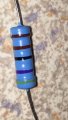 is this 4.7K resistor or 110M?