3 way latching switch (Or "ternary flip-flap-flop")

AnalogKid

Joined Aug 1, 2013
12,173
I checked assorted 37x and 57x datasheets from TI, Fairchild (National), ON (Motorola), NXP, and Toshiba. Lotsa data about how fast the parts can go, nothing about how slow; specifically, nothing about a maximum clock risetime. This is consistent with how a latch works internally. The core mechanism is positive feedback, so while there is no analog hysteresis at the input stage like there is in a 4093, you don't need any for the same reason you don't with a set-reset flipflop made out of 4011's - digital hysteresis. Once the external input voltage gets far enough through the transition region that the first gate's output changes, that very first edge is destined to get through the second gate and show up at the feedback input of the first gate. That locks up the first gate's output, and whatever continues to happen at the active input is ignored. SO, I retract my statement about the clock edge oscillating internally. It doesn't. That was me not remembering what I already knew and having to redo the analysis from scratch (unfortunately becoming increasingly frequent).

Back to a multi-bit latch with a single clock - depending on how the clock input is buffered internally, each stage might latch at a different millivolt value of a slow clock input, and in some circuits that might be a problem when trying to capture rapidly changing data. But in this circuit that is not an issue. KISS.

ak
 

Thread Starter

SimL

Joined Jan 15, 2015
7
hp1729, did you try it in a simulator? Can't get it to work either. It just won't latch... Look at it here (you can click on the "H", they're pushbuttons).

Anyways, just realized that this kind of circuit would need as much (or more) ICs than the other ones proposed... So in the end, it's not simpler than the other ones :D

Alright so I'm not blocked anymore, I've got some leads to follow! I'm gonna read a bit about D Flip-Flops, all circuits you guys proposed have some, and choose a way to fit my project. I'll keep you posted when it's finished, for the curious ones.

Thanks a lot for your help! :)
 

crutschow

Joined Mar 14, 2008
38,555
I checked assorted 37x and 57x datasheets from TI, Fairchild (National), ON (Motorola), NXP, and Toshiba. Lotsa data about how fast the parts can go, nothing about how slow; specifically, nothing about a maximum clock risetime. This is consistent with how a latch works internally. .................

Back to a multi-bit latch with a single clock - depending on how the clock input is buffered internally, each stage might latch at a different millivolt value of a slow clock input, and in some circuits that might be a problem when trying to capture rapidly changing data. But in this circuit that is not an issue. KISS.
See this (under operating conditions), for example.
It shows a maximum transition time for the inputs, as do most flip-flops I've looked at.
Flip-flops are different from simple latches, since they change state during the transition of the clock.
So I think you exceeded the KISS limit, as per Albert E. ;)
 
Last edited:

crutschow

Joined Mar 14, 2008
38,555
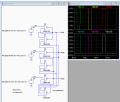
What problem does it show in LTSPICE? It is a pretty simple circuit. ...........
It won't permanently change states for any input change.
All the outputs stay in the low state (see attachment).
The output transitions high when an input goes low but then goes back to the low state as soon as the input returns to high.
A simple circuit doesn't necessarily mean it works. :rolleyes:

RadioPB.PNG
 

hp1729

Joined Nov 23, 2015
2,304
hp1729, did you try it in a simulator? Can't get it to work either. It just won't latch... Look at it here (you can click on the "H", they're pushbuttons).

Anyways, just realized that this kind of circuit would need as much (or more) ICs than the other ones proposed... So in the end, it's not simpler than the other ones :D

Alright so I'm not blocked anymore, I've got some leads to follow! I'm gonna read a bit about D Flip-Flops, all circuits you guys proposed have some, and choose a way to fit my project. I'll keep you posted when it's finished, for the curious ones.

Thanks a lot for your help! :)
 

hp1729

Joined Nov 23, 2015
2,304
Yes, with all highs in there is no way to establish an initial condition.
Yes, the other ideas may be better suited.
 
Top