3 different inputs to trigger one output

crutschow

Joined Mar 14, 2008
38,507
..................
So if I was to use 12v power to the BD139 and BD140, instead of a ground. Would I need to put the 12v to the collector of the NPN and the output would be emitter? Then 12v to the emitter of the PNP and the output would be the collector?
Yes, assuming the bias voltage to the bases are of the correct polarity and voltage.
(Note that the operating base voltage is always within about 0.7V of the emitter voltage).
 

Thread Starter

stillgrowingup

Joined Jul 15, 2015
219
Update.

I got the parts in and soldered it together. Using my 5 amp continuous regulated 12v power supply for testing. All 3 inputs did activate the circuit and seemed to work.

After leaving the circuit on for hours, it started to flicker on and off. I metered my power supply and voltage dropped below 9volts then back up again while the circuit was 'flickering'.

I've came to the quick conclusion that the circuit is shortening out some how. But .... only after being on for 2 hours. I first thought the transistors were over heating, so I grabbed them. I felt no heat on them at all. After shutting the circuit down for 10 minutes and reapplying power to the circuit. The circuit ran fine and continued to do so for 45 minutes, then started to short out again.

While the circuit is flickering. I then removed my 10 amp fuse that goes through the Relay and supplies the power to my Load. The Circuit worked fine again and stopped flickering. I immediately put the 10 amp fuse back in and flickering start up again.

The relay did seem a little warm, but no where near hot. I did meter the amperage that my load is pulling through the relay. It was 4.22 amps.

I'm at a lost on how to fix this.

Tony
 
Last edited:

Thread Starter

stillgrowingup

Joined Jul 15, 2015
219
After thinking about it all day. I want to test my power supply. I turned on my power supply and waited for it to flicker. When it did, I attached my circuit to a car battery. The circuit ran fine on the battery. I then switched back to my power supply and it started flickering again. The power supply was very warm. At this point, I'm thinking the circuit is fine. And my power supply to weak to run my circuit with a load for longer than an hour.

Thank you for all your help.

Tony
 

crutschow

Joined Mar 14, 2008
38,507
I suspect that the heat sink was not adequate for such a long duration, high current load, and that sent the regulator into thermal shutdown. Was the case very hot when this happened?
A small fan blowing on the power supply will likely keep it from doing that.
 

Thread Starter

stillgrowingup

Joined Jul 15, 2015
219
A PNP has the reverse voltage and current polarity of an NPN.
It's easy to remember since the current (conventional current from positive to negative) goes in the same direction as the emitter arrow.
Thus in a NPN the current direction is from collector to emitter and from base to emitter (collector and base positive with respect to the emitter).
In a PNP the current direction is from emitter to collector and from emitter to base (collector and base negative with respect to the emitter).
If you follow that you will see why the PNP needs to be connected as shown in your last schematic.
Crutshow,

Can you please look at my Final drawing in post #15. I'm having 2nd thoughts if the PNP BD140 is drawn correctly for proper function. ... I built a prototype. It works, but I built a 2nd one and the BD140 does not work on the 2nd prototype.

TONY
 

GopherT

Joined Nov 23, 2012
8,009
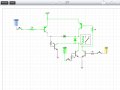
This makes a whole lot more sense than your circuit.

I put switches on each input just to simplify simulation. The 5 and 12 v inputs will be 0 when off. The 0V input will be 12V when off.


image.jpg
 

GopherT

Joined Nov 23, 2012
8,009
You forgot the three resistors to turn off the bjts, the one for 12V pnp bjt, the two for 12V and 5V npn bjts.
As said in the text of my post, the switches are not used in the actual circuit. Each of the sources supplying the base current are either at 0-5V (NPN1), 0 or 12 V (NPN2) or 12V or 0v (PNP). Those sources will pull the base high or low as needed.
 

ScottWang

Joined Aug 23, 2012
7,501
As said in the text of my post, the switches are not used in the actual circuit. Each of the sources supplying the base current are either at 0-5V (NPN1), 0 or 12 V (NPN2) or 12V or 0v (PNP). Those sources will pull the base high or low as needed.
If you know that and don't let the TS misunderstanding, it's ok.
 

GopherT

Joined Nov 23, 2012
8,009
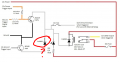
If you stick with the design in Post 15, you need to reverse (or delete) the diode that is circled. Also, make sure the resistor on the PNP base is fairly small - you are using a PNP as a low-side switch so you don't have much potential there to get the current flowing.

upload_2016-2-15_18-13-47.png
 

Thread Starter

stillgrowingup

Joined Jul 15, 2015
219
This makes a whole lot more sense than your circuit.

I put switches on each input just to simplify simulation. The 5 and 12 v inputs will be 0 when off. The 0V input will be 12V when off.
Is this a Latching Circuit? If so, it doesn't have to be. Only one of the 3 inputs would be used at a time. And they are all maintained triggers. So when the input loses signal. The they relay dies.

Also, make sure the resistor on the PNP base is fairly small - you are using a PNP as a low-side switch so you don't have much potential there to get the current flowing.
I have NOT used a resistor at the base for the prototype. Should I have? The prototype does WORK. The 2nd one I built doesn't. The NPN triggers do, but the PNP doesn't. I'm going to look at the diode you mentioned.

Thanks
TONY
 

ScottWang

Joined Aug 23, 2012
7,501
Do you have to using the relay or can be replace with mosfet?
The mosfet has very low Rds as 2.4 mΩ and it can be handle 10A.
 

Thread Starter

stillgrowingup

Joined Jul 15, 2015
219
Do you have to using the relay or can be replace with mosfet?
The mosfet has very low Rds as 2.4 mΩ and it can be handle 10A.
Never thought of Mosfets. Just use to Relays. Don't MOSFetS get hot?

If you stick with the design in Post 15, you need to reverse (or delete) the diode that is circled.
I did correctly install that diode.

Everything is the same on my 2nd built as the 1st prototype. I've came to the conclusion that BD140 is BAD.

TONY
 
Last edited:

ScottWang

Joined Aug 23, 2012
7,501
Some of n type mosfet for reference:
STH260N6F6-2_Nch_60V180A300W_2.4mΩ_Vgs10V
FDP8440_Nch_40V80A306W_Vgs4.5V_2.4mΩ
IRF4110PbF_Nch_100V120A370W_Vgs10V_4.5mΩ
 

GopherT

Joined Nov 23, 2012
8,009
Is this a Latching Circuit? If so, it doesn't have to be. Only one of the 3 inputs would be used at a time. And they are all maintained triggers. So when the input loses signal. The they relay dies.


I have NOT used a resistor at the base for the prototype. Should I have? The prototype does WORK. The 2nd one I built doesn't. The NPN triggers do, but the PNP doesn't. I'm going to look at the diode you mentioned.

Thanks
TONY

No, the circuit I posted is not latching. I actually had to tweak it to make sure it wouldn't try to latch. I tested it, it does work.

You should limit the current into the transistor base for two reasons. 1) there is a limit to how much current a bipolar transistor can handle. 2) the logic device supplying the signal can only source or sink a limited current. Ultimately, not good for the coming or the going. 20 mA is normally about as much current as you should expect from a Microcontroller pin. Some are less, some are more. 20 mA is a good start.


If the relay in your circuit is working, just stick with it for now. We can set you up with a mosfet later if needed.
 
Top