3.3V opto-isolated MOSFET driver

Thread Starter

tepo

Joined Feb 22, 2023
16
What is the purpose of the 115 ohm resistor in series with the 15V supply?

And as noted by Sensacell, pin 5 of the driver should be connected to the 15V negative terminal and the source connection of the MOSFETs.
And obviously the 15V must be an isolated supply.
input current should be 16mA as per spec, that's the value I am having closest to ideal right now, so..
isolated supply..I am planning to use this one for IC's Vcc, but it will be on the same phase as main VAC... might that work
 

Thread Starter

tepo

Joined Feb 22, 2023
16
Since the LTV-3120 requires only a maximum of 3mA to power the output stage, the 15V supply could conceivably be derived using a simple half-wave diode rectifier with a 15V Zener shunt regulator, since the power from the 230Vac would around a watt.
An 18k, 2W resistor in series with a 1N4006 diode to a 15V Zener to common will provide about 5mA (3mA for the load and 2mA for the Zener).

With the circuit common being the junction of the two MOSFET sources, the current path for the supply return current to the AC is through the MOSFET substrate diode.
yeah, I was thinking a lot about using transformless power source for this. I have tried 15V zener with 100K resistor but it was too low (current?) for IC. it was not reacting..
so I thought to use this one as IC supply. common phase with main AC obviously...but can the zenner with 18k resistor be enough in this case you think?

unfortunately I don't complete follow your second half of answer, please explain further.
ty.
 

LowQCab

Joined Nov 6, 2012
5,101
it might supply 20mA but with voltage drop to ~2.6V thats what I found. but my mosfet has saturation voltage around 15V... so..that would need a logic MOSFET and that's quite a compromise
.
MOSFETS don't have a "Saturation-Voltage".
You didn't supply the FET-part-numbers, ( or PDF-Spec-Sheet ),
or state how much Current they will be required to handle, ( and a description of the Load ),
or how fast they will be required to switch, ( Frequency or Time-Period ).

With 20mA from your Micro-Controller,
the FET-Drivers will deliver around ~8-Volts to the FET Gates,
regardless of the Output-Voltage sag of your Micro-Controller.
The FET-Drivers convert Current to Voltage, which is what the FETs need to turn-on.

More LED-Current will make the FET-Drivers switch faster, and develop more Gate-Voltage.

Lower-value Current-Limiting-Resistors can
compensate for the "Voltage-Sag" of the Micro-Controller's Output.
You might even be able to drive the LEDs without a Current-Limiting-Resistor,
because the LEDs are rated for a continuous ~50mA.
What is the "Short-Circuit-Current-Rating" of your M-C Outputs ?
( You may have to really dig deep for these ratings,
many M-C manufacturers don't seem to think that this information is important ).
But, of course, You could just use a high-Current Op-Amp instead of using a M-C.
.
.
.
 

crutschow

Joined Mar 14, 2008
38,503
can the zenner with 18k resistor be enough in this case you think?
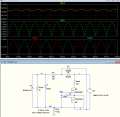
Below is the LTspice simulation of the basic circuit:
It is shown with the MOSFETs off.

Edit: I used two diodes to get a full-wave rectification which allows the use of a smaller filter capacitor for a given ripple voltage.
With that I doubled the resistor value to 36kΩ for the same average current (≈5.3mA)

The V+ voltage (yellow trace) to the GRD point is 15Vdc, as determined by the Zener.

The green trace shows the rectified current through R5.

ROpto simulates the 3mA load of the opto driver, with about 2mA going through the Zener.

The dissipation in R5 is about 1.27W so a 2W resistor should be sufficient.
I don't complete follow your second half of answer, please explain further.
That was to explain the rectified return (GRD) current for the circuit goes through each MOSFET's substrate diode (red trace & blue trace), since that probably is not obvious.
Essentially those two diodes along with D1 and D3 form a bridge rectifier.

1677208078534.png
 
Last edited:

Thread Starter

tepo

Joined Feb 22, 2023
16
.
MOSFETS don't have a "Saturation-Voltage".
You didn't supply the FET-part-numbers, ( or PDF-Spec-Sheet ),
or state how much Current they will be required to handle, ( and a description of the Load ),
or how fast they will be required to switch, ( Frequency or Time-Period ).

With 20mA from your Micro-Controller,
the FET-Drivers will deliver around ~8-Volts to the FET Gates,
regardless of the Output-Voltage sag of your Micro-Controller.
The FET-Drivers convert Current to Voltage, which is what the FETs need to turn-on.

More LED-Current will make the FET-Drivers switch faster, and develop more Gate-Voltage.

Lower-value Current-Limiting-Resistors can
compensate for the "Voltage-Sag" of the Micro-Controller's Output.
You might even be able to drive the LEDs without a Current-Limiting-Resistor,
because the LEDs are rated for a continuous ~50mA.
What is the "Short-Circuit-Current-Rating" of your M-C Outputs ?
( You may have to really dig deep for these ratings,
many M-C manufacturers don't seem to think that this information is important ).
But, of course, You could just use a high-Current Op-Amp instead of using a M-C.
.
.
.
see post #11 please.
 

Thread Starter

tepo

Joined Feb 22, 2023
16
Edit: I used two diodes to get a full-wave rectification which allows the use of a smaller filter capacitor for a given ripple voltage.
With that I doubled the resistor value to 36kΩ for the same average current (≈5.3mA)
that's interesting! I might try that, but in present I have spare bridge rectifiers that I already bought for this...
anyway if 36kΩ 2W resistor should do the trick, I will give it a shot.

Just a note on the capacitor:
they stat in the LTV-3120 spec:
At least a 0.1μF or bigger bypass capacitor must be connected/ closed across pin 8 and pin 5. Failure to provide the
bypass may impair the switching property. Normally, it is recommended to place a 1μF multi-layer ceramic capacitor. To
parallel one larger capacitor (>1μF) to optimize performance is better.

so should I have 0.1μF ceramic in paraller with 229μF rather?

thank you!
 

Thread Starter

tepo

Joined Feb 22, 2023
16
anyway if 36kΩ 2W resistor should do the trick, I will give it a shot.
so I was not able to buy 36kΩ 2W resistor in this town, so I hooked up 3 100kΩ 2W pieces together to get 33kΩ.
I put it in series with 20V zener but LTV-3120 was not reacting to pwn. IC is alright I checked it with 2x 9V batteries and PWM.
I have measured 6.5V drop on IC's Vcc so I put another 5V zener in series with the former one to compensate for it, but nothing changed..

I don't even pretend to know what is going on, but if you can explain like to 5 years old, please ;D
ty.
 
Last edited:

Thread Starter

tepo

Joined Feb 22, 2023
16
So what can you buy?
I can order specific parts, but considering it's Friday today, it'll take some time so I try to experiment with what I have inhouse now.
3x 100kΩ in parallel shoul give me even slightly more current than 36kΩ, no?

forgot to mention I also put 2x 100μF electrolytic capacitors in parallel to come close to 229μF rating that you recommended --that in parallel with zener diode(s) but it's not moving
 

Irving

Joined Jan 30, 2016
5,109
Im not sure what your 1k does.
It slows the gate voltage change down thus heating the MOSFETs at higher PWM frequencies. 10 - 50ohm would be a better value as per LTV3210 datasheet. The 115ohm resistor doesn't help either...

Since the LTV-3120 requires only a maximum of 3mA to power the output stage, the 15V supply could conceivably be derived using a simple half-wave diode rectifier with a 15V Zener shunt regulator, since the power from the 230Vac would around a watt.
An 18k, 2W resistor in series with a 1N4006 diode to a 15V Zener to common will provide about 5mA (3mA for the load and 2mA for the Zener).
Hmmm, but the LTV-3210 is spec'd for a 2.5A gate drive (source and sink), so where's that energy coming from if the supply current it limited to a few mA? The 3mA quoted is the quiescent value with the output unconnected...
 

Attachments

Irving

Joined Jan 30, 2016
5,109
I can order specific parts, but considering it's Friday today, it'll take some time so I try to experiment with what I have inhouse now.
3x 100kΩ in parallel shoul give me even slightly more current than 36kΩ, no?
The 100k isn't needed as the LTV-3210 is an active source AND sink. Your 1k and 115 ohm resistors are the problem...

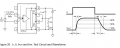
Look at the test circuit below - the 10ohm + 25nF represent the MOSFET gate resistance and capacitance... it needs no other connection. The 100k is only requred if you have a driver that can be tristate ie floating output, then it ensures the MOSFET stays off but that's not the case here.

1677258366936.png
 

crutschow

Joined Mar 14, 2008
38,503
but the LTV-3210 is spec'd for a 2.5A gate drive (source and sink), so where's that energy coming from if the supply current it limited to a few mA? The 3mA quoted is the quiescent value with the output unconnected.
The energy for the peak current comes from the filter cap.
It's the average current, not the peak current that's of interest.
If you calculate the average current needed to provide the gate charge at the 200Hz frequency the TS mentioned, you will find that it is well below a milliamp, even for a large MOSFET with high gate charge, which is usually no more than a few hundred nC.
 
Last edited:

LowQCab

Joined Nov 6, 2012
5,101
"" -switching speed should be <200Hz i think.
-MOSFET load should be around 75W 220VAC rectified to DC /each ........ ""


There has to be a reason for selecting ~200hz ..........

The "Load" is not necessarily the "Peak-Load",
and the Load would be measured in "Peak-Amps" if not using a well filtered DC Power-Supply.

What is the Load ?, is it Inductive ?, maybe a couple of Motors ?, Transformers ?, Light-Bulbs ?

These numbers and specifications must be known so that other
calculations which depend on them can be made with reasonable accuracy.

The IRF730 N-Channel FET can easily be driven hard by a Photo-Voltaic-FET-Driver at ~200hz,
but now, what's so special about ~200hz ?, why has this particular frequency been chosen ?

Why is it "OK" that there is no Filtering of the rectified Mains Voltage ?

All the details matter.

Everybody's just having a field-day, rambling off on various tangents,
but nobody really knows what the actual problem is that needs to be solved.
.
.
.
 

LowQCab

Joined Nov 6, 2012
5,101
Because it's an unnecessary, and substantial, expense, and adds complexity, where none is required.
We still haven't been told the basic purpose of this project.
.
.
.
 

LowQCab

Joined Nov 6, 2012
5,101
I'm not "accusing" anyone of anything,
other than maybe a lack of focus on the Thread-Starters actual problem.

I seems that both coercing detailed information out of Thread-Starters,
and good intentioned people getting distracted off into side discussions,
might as well be considered standard operating procedure here.

It just is what it is ............
And good things certainly do come of it.
I suppose I'm just too impatient at times.
.
.
.
 
Top