2channel single line mixer

crutschow

Joined Mar 14, 2008
38,529
so a 230 to 24 v tranformer a normal bridge rectifier a cap and a lm317 to regulate to 10v should do the trick right
...............
I would go with a 10-12Vac transformer so you don't waste so much power (and heat).
The regulator will dissipate (Vin-Vout)*Iout Watts and must have an adequate heatsink to keep the regulator at an acceptable temperature.
The greater the voltage difference, the larger the heatsink required.
 

crutschow

Joined Mar 14, 2008
38,529
i read that the formula was Vdc= Vac/(sqrt(2))

which one of us is wrong :rolleyes:?
Where did you read that?

A rectifier capacitor filter charges to the peak of the AC waveform minus the rectifier diode drop(s).
Since the peak AC voltage is obviously greater than the RMS voltage, than that formula can't be right for the DC output of a rectifier-filter.
The peak of value of a sinewave is the √2 (1.414) times the RMS value so the correct formula is Vdc = Vac(rms) * √2 - Vd where Vd is the diode(s) drop.
Make sense?
 

Thread Starter

Diogo Ferreira 2

Joined Mar 16, 2017
20
i see
then a Vdc = Vac*(RMS)*√2 - 1.4v(two ideal diodes)
what does RMS mean and stand for?
if i use a 230to12v
i will have vdc = 12*RMS*√2 - 1.4 not counting with the RMS i get
Vdc = 15.57V
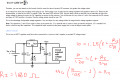
using that with an lm317 i get the following resistors to go along with it and (15.75-10)*Iout Watts for 80mA load will give about 0.46watt which is fairly low i suppose
Am i correct in al this or imensly lost?
lm317 how to.PNG
 

crutschow

Joined Mar 14, 2008
38,529
what does RMS mean and stand for?
The RMS AC voltage value gives the equivalent heating power into a resistor as a DC voltage with the same value.
Thus 12Vrms applied across a resistor will cause it to dissipate the same power as 12Vdc would.
RMS stands for Root-Mean-Square, which is how the RMS of an AC waveform is calculated.
Here's a Wikipedia explanation.
For a sinewave it turns out that the RMS value is 1/√2 times the peak value.

If the AC waveform is not a sinewave, then that relation doesn't hold.
For example, for a sawtooth or triangle wave, the RMS value is 1/√3 times the peak value (perhaps that's where you got that √3 factor).
Am i correct in al this or imensly lost?
You are right on the money.
Both your power and resistor calculations are correct.
And that power won't require a heatsink for any of the LM317 packages.
------------------
Here's an alternate way to do the resistor calculation that I like since it requires no manipulation of equations:

We know that the LM317 operates by keeping the Vout voltage 1.25V higher than the ADJ voltage.
This means the current through R1 must be a constant at 1.25V/240Ω = 5.2mA.

Since the ADJ voltage is 1.25V below Vout, the voltage across R2 for the desired 10V output is thus 10-1.25 = 8.75V.

Essentially all the R1 current also goes through R2 since the ADJ current is very low, therefore, to a close approximation, the value for R2 must be 8.75V/5.2mA = 1.68kΩ, (amazingly the same as you calculated ;)).
 

Thread Starter

Diogo Ferreira 2

Joined Mar 16, 2017
20
i understood your alternate way of calculating but i think i preffer to stick to the formula xD it's simpler forme that way
ok i think i got it all i'll be making a drawing of everything include the power suply and post it here for you to see also.

i've asked something a while ago but you didn't answered:
- when unpluging the headphones the output of the opamp will have no output resistance connected to it thus leaving it floating (i think) will it have any problems like damaging the thing connected to it's inputs?

-do you think making the power suply unit in a separate module better in terms of added noise to the circuit?
 

crutschow

Joined Mar 14, 2008
38,529
when unpluging the headphones the output of the opamp will have no output resistance connected to it thus leaving it floating (i think) will it have any problems like damaging the thing connected to it's inputs?
That will not cause any problems.
An op amp is perfectly happy with no load.
-do you think making the power suply unit in a separate module better in terms of added noise to the circuit?
You don't want a transformer near the circuit as the magnetic field from that can induce hum, so keeping it separate is a good idea.
 

Thread Starter

Diogo Ferreira 2

Joined Mar 16, 2017
20
Hello again

I'm having trouble designing my PCB in proteus 8 i can't seem to fin the opamp and i've tried to search online for it's symbol and no result till now, any ideas?
 

crutschow

Joined Mar 14, 2008
38,529
Hello again

I'm having trouble designing my PCB in proteus 8 i can't seem to fin the opamp and i've tried to search online for it's symbol and no result till now, any ideas?
Just look for the packages the op amp comes in and select.the one you want to use.
They are all standard packages and Proteus should have them in its package outline library.

You may have to modify an opamp symbol already in Proteus for the one you want to use.
 
Top