2channel single line mixer

Thread Starter

Diogo Ferreira 2

Joined Mar 16, 2017
20
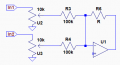
Hello i'm trying to make a circuit that can pick up two audio signals and mix it into one, i'd like to know how input impedance works, what impedance should i use and where to set a volume knob for each independant signal

it's suposed to be heard with 32ohm headphones from what i've read is only needs a gain ratio of 1

this is what i thought so far correct me if i'm wrong plz
 

Attachments

crutschow

Joined Mar 14, 2008
38,508
That circuit won't have an output as shown, as the pot wipers are grounding the signal.

Here's one way to connect the pots, if you want to be able to go from zero to maximum signal out for each channel.

upload_2017-6-28_18-54-57.png

The impedances just need to be some larger than the output impedance of your audio source.
Most modern audio outs have a fairly low impedance.

R6/R3 and R6/R4 determine the maximum gain for each channel.
 

Thread Starter

Diogo Ferreira 2

Joined Mar 16, 2017
20
after posting i saw i had drawn it the wrong way xD
would my drawing work if i fix the drawing (the 2 input potenciometer2)?

my objective is to connect a cellphone and computer for example and ear the two on my headphone and control the volume for each one

Edit: i have one more question are audio signals AC, or for example a sine wave that does not cross the 0v line down basically DC "sine wave"
 
Last edited:

Thread Starter

Diogo Ferreira 2

Joined Mar 16, 2017
20
What other noobie questions?

Do we have a language problem here?
yeah we might, english isn't my native language sry XD

i posted that i had a question which is:

"i have one more question are audio signals AC, or for example a sine wave that does not cross the 0v line down basically DC "sine wave" "
 

crutschow

Joined Mar 14, 2008
38,508
"i have one more question are audio signals AC, or for example a sine wave that does not cross the 0v line down basically DC "sine wave" "
There's been some discussion on this but, my view is that if the AC signal is level shifted by a DC level, its just an AC signal with a DC offset.
Whether it actually crosses some 0V level or not doesn't change that it's still an AC signal.
Thus as an AC signal goes through various amplifier stages it may be at different DC bias levels, but it's still the same AC signal.
i'm not sure about R5 and R6 because of the gain i need to have
As I previously stated, R5 can be removed as it serves no useful purpose.
You already have R3 and R4 to determine the gain.

That is not a good way to connect the Master Volume pot as the op amp will go open loop when the pot wiper is at the bottom of the pot.
Better to remove the pot from ground and connect that end to the op amp (-) input.

How much gain do you need?
 

Thread Starter

Diogo Ferreira 2

Joined Mar 16, 2017
20
That is not a good way to connect the Master Volume pot as the op amp will go open loop when the pot wiper is at the bottom of the pot.
Better to remove the pot from ground and connect that end to the op amp (-) input.

How much gain do you need?
i did not understood fully what you said about the master volume " Better to remove the pot from ground and connect that end to the op amp (-) input. "
is there a better way to make a master volume control?

i currently do not know how much gain i need because of the input resistance (that in my ideia will make a voltage drop on the audio signal), but from what i've read in normal conditions using an amp to drive 32ohm headphones the gain should be 1 for max volume, and that's why you dont use amp to listen to music from your cellphone.

by heart i think it should something in the order of 1.5x or 2x

i also read that the output impedance should the 1/8th or less of the resistance from the headphones so in this case 32/8 = 4ohm output resistance
 

Thread Starter

Diogo Ferreira 2

Joined Mar 16, 2017
20
sry to bother but i've been testing this circuit in LTspice and i cant seem to have a gain bigger than 1x which is bad xD
do you have any ideas what is might be?
 

crutschow

Joined Mar 14, 2008
38,508
A standard op amp will not drive a 32Ω headphone load.
You need an audio amp after the mixer.

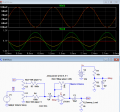
Here's the simulation with the pot change I mentioned.
It shows the output for a Master Volume of 0%, 50%, and 100%.
With the input pot at maximum, the maximum gain is 10 for a 1 megohm Master Pot.

upload_2017-6-30_11-47-42.png
 

Attachments

Thread Starter

Diogo Ferreira 2

Joined Mar 16, 2017
20
in the r_dummy_load i think i need to have a 4ohm resistor(output impedance) so i can connect my headphones which are 32ohm
will this change affect the proper functioning of this circuit?

can you send me the pot symbol for ltspice it seems i dont have it

oh and in the sine wave generator with 100mv amplitude i've read online that the normal output from a cellphone is aroun 800mv to 2.1 v are this normal values or wikipedia bullshit?
 
Last edited:

crutschow

Joined Mar 14, 2008
38,508
in the r_dummy_load i think i need to have a 4ohm resistor(output impedance) so i can connect my headphones which are 32ohm
will this change affect the proper functioning of this circuit?
As I noted in post #12, a standard op amp will not drive 32 ohms.
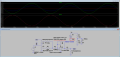
Below is the simulation with a power op amp that will drive the 32 ohm headphone up to about 2V peak voltage (≈60mW).

Note that you don't need (or want) an added 4 ohm load as the op amp already has a very low output impedance.
in the sine wave generator with 100mv amplitude i've read online that the normal output from a cellphone is aroun 800mv to 2.1 v are this normal values or wikipedia bullshit?
I used 200mV peak signal below because that gives the maximum non-distorted output for the maximum gain.
But those values are from wiki are probably in the typical range.

upload_2017-6-30_13-4-1.png
can you send me the pot symbol for ltspice it seems i dont have it
Attached are the pot files.
Put the .asy file in the C:\Program Files (x86)\LTC\LTspiceIV\lib\sym directory.
Put the .sub file in the C:\Program Files (x86)\LTC\LTspiceIV\lib\sub directory.
 

Attachments

crutschow

Joined Mar 14, 2008
38,508
Yes, if you build the circuit, it should work reasonably close to the simulation.
But I'll never say there can't be a problem. :rolleyes:

The LT1813 op amp I used in my last simulation should drive your headphones to over 50mW maximum if that's sufficient.
I don't think any of the standard op amps in your list will drive the low headphone resistance.
You'd have to check their maximum output current and/or minimum load resistance, neither of which are listed in the table.

Is this mono or are you going to build two for stereo?
If mono, then the headphone impedance will be 1/2 or double the stated impedance (depending upon whether you connect the two channels in serial or parallel) since the stated impedance is likely for one channel.
That could make the power out of the LT1813 too low for a good listening level.
In that case you would need to go to a higher power op amp or add an audio power amp.
 

Thread Starter

Diogo Ferreira 2

Joined Mar 16, 2017
20
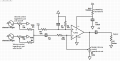
So i've made some changes to the schematic you've sent me and the result i got was this one.
it is what i want seen that the i dont need so much gain, if i need more gain because my input signal is a lower voltage it's just a matter of getting a new master volume potenciometer.
Capture.PNG

I will be making it stereo, one for both right channels and one for both left channels, so the headphone impedance should stay the same right?
i'm sry to bother you but you've been helping me so much

i will be making my own power suply with a 230V to 6v transformer(ready for pcb mounting) a full bridge rectifier up to 5A i think
it will give about 10v (6*sqrt(3)) DC after passing threw the possible 10 000uF cap with low ripple i hope XD (is this a solid configuration?)
 

crutschow

Joined Mar 14, 2008
38,508
I will be making it stereo, one for both right channels and one for both left channels, so the headphone impedance should stay the same right?
Yes, it should be whatever the headphone spec states.
i will be making my own power suply with a 230V to 6v transformer(ready for pcb mounting) a full bridge rectifier up to 5A i think
it will give about 10v (6*sqrt(3)) DC after passing threw the possible 10 000uF cap with low ripple i hope XD (is this a solid configuration?)
5A is overkill for that circuit, which will take a couple hundred milliamps at most.

6V rectified by a full-wave bridge will give about (6 * √2) - 1V(bridge Schottky rectifier drop) = 7.4V, so you need about 8Vrms from the transformer if you want 10Vdc out.
(The peak of a sinewave is the sqrt(2) times the RMS value, not the sqrt(3).)

That should probably work for your circuit, but the direct output of a rectifier-filter always has some ripple which can cause hum in audio circuits.
I would probably go for a DC rectifier voltage at least a couple volts above what you want and then use a regulator, such as the common LM7810 or LM317, to give a smooth, regulated, fixed voltage output.
 

Thread Starter

Diogo Ferreira 2

Joined Mar 16, 2017
20
and i have one more question, what will happen when i disconnect the headphones from the output it will be floating right? will it have any impact on the audio source might it damage something cellphone or computer etc?
 
Top