24V 2A DC Motor Driver Circuit

Thread Starter

Hall.Mark

Joined Jun 27, 2023
5
Hi,
I want to control 24V 2A DC motor. What should be the best way to drive it. I want to control them using STM32 MCU so I can have two GPIO Pins that can control Motor Forward or Reverse or Stop condition.

One idea came in mind was to use Relay Module but that can be problem as relay is not good for fast switching in case needed in future.
What are other available option for the same?
 

MaxHeadRoom

Joined Jul 18, 2013
30,654
Normally the best bet is by PWM, this way you have complete control of the RPM and speed of the motor in both directions.
A Mosfet H bridge would be used to control the motor.
What is the application?
 

LowQCab

Joined Nov 6, 2012
5,101
"" ............. there should be but (I) do not have any idea about (the) mechanical setup ""

If this is true, then You also have no idea whether the Motor can actually do the job.

When a Motor is over-loaded, or is "locked-up" and does not have enough power to move,
it will demand ~4 to ~10-times the amount of Current that it uses with "no-Load".
This may cause the Motor to over-heat and burn-up, or
it may cause the Electronic-Circuitry which is driving the Motor to burn-up.

You must first determine how fast the Door must move,
this will give You an idea of how much Torque will be required from the Motor/Gear-box.

How much Friction is created by the Rollers, or Guide-Rails, that the Door is supported by ?
How many Pounds of Force are required to move the Door very slowly ?

How is the Motor attached to the Door ?
Maybe a Cable and Pulleys ?, Maybe by Lever-Arms ?, Maybe by a Screw-Mechanism ?

What happens if something blocks the Door from moving ?


How will You control the acceleration, and deceleration, of the Door ?

All of the Mechanical details must be worked-out before a Motor/Gear-box is selected.

A ~24-Watt Motor is very weak for moving a "heavy" Door. ( how heavy is "heavy" ??? )

The Motor-Control-Method comes after all other calculations.
.
.
.
 
Last edited:

Thread Starter

Hall.Mark

Joined Jun 27, 2023
5
"" ............. there should be but (I) do not have any idea about (the) mechanical setup ""

If this is true, then You also have no idea whether the Motor can actually do the job.

When a Motor is over-loaded, or is "locked-up" and does not have enough power to move,
it will demand ~4 to ~10-times the amount of Current that it uses with "no-Load".
This may cause the Motor to over-heat and burn-up, or
it may cause the Electronic-Circuitry which is driving the Motor to burn-up.

You must first determine how fast the Door must move,
this will give You an idea of how much Torque will be required from the Motor/Gear-box.

How much Friction is created by the Rollers, or Guide-Rails, that the Door is supported by ?
How many Pounds of Force are required to move the Door very slowly ?

How is the Motor attached to the Door ?
Maybe a Cable and Pulleys ?, Maybe by Lever-Arms ?, Maybe by a Screw-Mechanism ?

What happens if something blocks the Door from moving ?


How will You control the acceleration, and deceleration, of the Door ?

All of the Mechanical details must be worked-out before a Motor/Gear-box is selected.

A ~24-Watt Motor is very weak for moving a "heavy" Door. ( how heavy is "heavy" ??? )

The Motor-Control-Method comes after all other calculations.
.
.
.
@ LowQCab
I got few answers after same questions raised. They have motor 24V and it will draw maximum of 2A. Door is moving with Gearbox which convers motor movement into linear movement. Maximum force they need is 200N. After looking at the design it looks like more of and DC actuator kind of mechanism. So I also suggested the same to use 200N rated DC Actuator. For this rating L298 driver looks suitable may be some other better solutions possible.
 

LowQCab

Joined Nov 6, 2012
5,101
The Peak-Output-Current of the L298 Chip is only rated at 3-Amps, this is completely inadequate.

You will need something in the range of ~10-Amps or so to prevent routine smoking of the Chip.

Or, if You want to cobble-up something on your own,
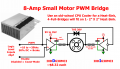
You could build something like the attached Schematics ..........

( I recommend using a Voltage/Current-Regulating Power-Supply for
mechanical and Electrical reliability )
.
.
.
Motor Reversing Push-Buttons FLAT .png
.
Low Power Motor Control External PWM 1 FLAT  .png
 

LowQCab

Joined Nov 6, 2012
5,101
The TVS-Diode is to protect the FET-Gate-Drivers, and is not required for the Relays,
but, Brushed-Motors may put-out huge amounts of RFI-Hash which can interfere
with other local Electronics, no matter how You control the Motor.

The Circuit using the FET-Gate-Drivers has the bonus of Speed-Control, and a "Freewheeling-Mode".
.
.
.
 

MisterBill2

Joined Jan 23, 2018
27,504
OK, I am joining in late, so others have asked good questions. A motor driving a door open and closed is a interesting application. If people or animals might use the doorway then suddenly safety becomes a concern.
The arrangement of the linkage between the motor and the door will determine if any speed controls are required, or if plain on/off control can be acceptable.
So there are a whole lot of considerations to decide.
 
Top