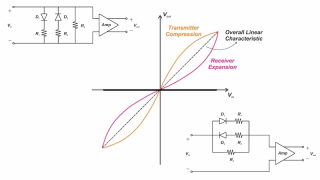
Can you make sure the led is ok, this is just a very simply circuit, you can check all the wiring and measure the voltage of battery and three resistors and led.
I'm using a multimeter to measure the voltage of the components, but I don't know if I'm doing it right. If I one arm (VΩmA) of the multimeter on the LED's anode and the other (COM) the LED's cathode, it tells me that there's 24 V "passing through the LED" even though I have my 1.2 kΩ resistance right before the LED.
I'm using a multimeter to measure the voltage of the components, but I don't know if I'm doing it right. If I one arm (VΩmA) of the multimeter on the LED's anode and the other (COM) the LED's cathode, it tells me that there's 24 V "passing through the LED" even though I have my 1.2 kΩ resistance right before the LED.
1. That may be the issue since the LED are from a old printed circuit. That said, is it possible I fried them by unsoldering them ? If not, how do I test a LED using my multimeter ? I got that little diode symbol on it, but the value stays at 1. 2. Resistors are all 400 Ω resistance, so : 3 * 400 Ω = 1.2 kΩ, right ? 3. I dont really understand what this means. 4. Tested the power supply with a multimeter and all seems fine. 5. Cables and connections seems fine.
I don't have enough knowledge in eletronics to calculate the resistance I need in my resistors to power a LED (3.3 VDC - 20 mA) on a 24 VDC - 1.6 A circuit.
I just need someone to explain to me how I calculate the resistance I need in my resistors.
20mA isn't a big deal for a dropper resistors, but you probably still need some sort of shunt regulator if you need any kind of voltage accuracy.
You might just as well use one of the many 3.3V 3-terminal regulators. At 20mA - your biggest concern is the dissipation caused by your supply voltage. A TO92 size regulator might be enough.
What is the make and model of your test meter?
Does it have a diode test function or resistance measurement function?
Use either function to test the LED. Try the test with the leads connect to the LED in both directions. The LED should light in one direction and not the other.
Ok everybody, seems like there was only ONE LED still alive. I tested like 5 or 6 of the 10 LEDs I have and assumed that they were all fried. but I was wrong. Everything is working fine now, thanks for the help !

 Facebook
 Google
 GitHub
 Linkedin