20 mini led circuit.

Thread Starter

Rebekah Anderson

Joined Dec 28, 2014
16
There are a plenty of diagrams showing LEDs in both series and parallel.
Plus I had made the circuit that worked for a short while on the PCB in the original post. It was just that the 1 Ohm resistor burnt out. (Miss identified the colours)
I wanted to confirm or suggestions best way to achieve my circuit. It was suggested to me to have a semi conductor in there the allow two different voltages. (6 and 12) but I am not 100% sure how to wire it all up.

I haven't seen many light systems with LEDs that carry a resistor for each one. Actually none.

So I don't agree I can't. So far I am not getting anywhere here either which is rather disappointing.
 

Thread Starter

Rebekah Anderson

Joined Dec 28, 2014
16
Hiya Alec.

Yes it is white, well that's what I asked for and that's what they delivered through the advert this came from.
Possible its options available in the physical format I requested.

But ultimately it's white and 3.5v forward. Voltage.
 

takao21203

Joined Apr 28, 2012
3,702
you can change voltage with a lm2576 it can work with smaller coils, 1n4148 too (2 or 3 in parallel).

Just for LEDs you only need small capacitors actually, like 47 or 100uF.
so it can be built small.

then you use one resistor but even that is not needed, the IC will keep the voltage very constant, and you have some 100s millivolts margin. if you drive them with too much current, they'll turn warm, even hot, and burn out.

I can sell you all these parts have a SMD kind too i think its LM2596, small coils, small SMD electrolytic capacitors.
And I have 15 Ohms and 68 Ohms resistors too.
 

Attachments

wayneh

Joined Sep 9, 2010
18,104
So far I am not getting anywhere here either which is rather disappointing.
Just because you have received a variety of opinions doesn't mean you haven't gotten good advice.

All of this has already been said:
• Use the highest voltage you can count on. This will allow you to put more LEDs in series and minimize power lost in current-limiting resistors or other controllers, and minimize the number of series strings that are placed in parallel. I'd much rather have 5 LEDs in one series string than 5 in parallel, because then I need to control one current, and it will be identical in each LED. The only negative is that each LED must be installed and conducting for the others to light.
• Control the current in every series string. I agree with the recommendation to use a current-limiting resistor on each parallel string, even if it's a string of only a single LED. Relying on the LED itself for control will usually lead to premature failure. They will all start at the same brightness, but eventually one will take a bit more current and then age and fade faster than the others. You'll be left with some bright and some dim.
• Target a current that is at least ~10% below the rated maximum for your LEDs. Running them full out ages them more quickly. They can appear plenty bright at even 5mA. You usually don't need 20mA.

Combining the last two points, I speculate that placing LEDs in parallel is more likely to work if the current is targeted far below the max. Ten LEDs in parallel at 5mA each, 50mA total, might have a far better lifespan than if they are set to 20mA each, 200mA total.
 

takao21203

Joined Apr 28, 2012
3,702
or a MC34063, which has a current sense, thats often prefered for LED circuits.

If you use a small coil it has a high DCR, current actually cant run away, and if you only drive at half current, there is little chance they heat up too much.

but voltage drive is more of a risk if the cooling fails, or if you drive them at 100% or more than that.

Like if you connect a lot of power LEDs to a large transformer, and its set right, voltage will just break down as much as current increases, so the LEDs never can burn out.

Same stepping up from a laptop brick, it will shutdown if current is exceeded.

However, often current controlled drive circuits are used.
 

Alec_t

Joined Sep 17, 2013
15,119
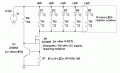
Here's a simple circuit which will drive them at a controlled current (set by R7 to be ~20mA in this example) from either 6V or 12V. The LEDs have individual series resistors to provide a degree of balancing for LEDs of slightly differing Vf.
Paralleled-LEDs.gif
 

Thread Starter

Rebekah Anderson

Joined Dec 28, 2014
16
When you say you should never connect in parallel or series, then that isn't helpful.

I'm only a beginner in this and needed help explaining how a 20LED circuit could work. A lot of products on the market with multiple LEDs don't have a resistor per LED. I can google a load of circuit diagrams showing this but I am limited in my ability reading them.

If the information I supplied wasn't enough then tell me what more you needed to know.
 
Please read the posts again, no one ever said you should not connect LEDs in series. It would not work in your case because two LEDs in series require 7V and your supply can be as low as 6V.

I gave you the answer way back in post #10, but to repeat;

If you want to keep it simple and you want your LEDs to operate on a voltage from 6 to 12V and you want them to illuminate evenly and not fail you at least need a 430 Ohm resistor per LED.

If you are not happy with the LED's current being dependent upon supply voltage and you are prepared to build a more complex circuit then refer to Alec t's circuit in #26
 
Last edited:

Thread Starter

Rebekah Anderson

Joined Dec 28, 2014
16
Space is at a premium on the board.
If you are saying that with a resistor per LED would not require any other component just a battery then I'll have to see if I have the space to do that.

At £0.36 it's £7.20 per board just for the resistors. Unless I can find them cheaper.

I didn't realise you were referring souly to my circuit regarding the series connection but post 12 seems a general statement.

As per my circuit board I the original post (with a bridge for the bottom middle 12 LEDs) I did get the desired illumination, evenly. Either by luck or something else. Thing is I want this circuit board to work, last and simple. I was given a semiconductor to fit in the circuit but the example I recieved from my friend didn't seem right. This is why I came here to get the advice. Proper dumbed down so I could understand. The lack of understanding comes from the fact I did get it to work for a limited time till the resistor burnt out as it was too low. (1 Ohm, online calculater has indicated 10 Ohm once I looked into it)
That's why I find it confusing that it's said it shouldn't work.
 
If you are paying £o.36 per resistor, you are paying too much. Try ebay.

Post #12 is a general statement, you should not connect LEDs in parallel, it says nothing about series connection, which bit are you reading?

Forget what anyone else has told you or that your circuit appeared to work before, follow the advice given here.
 
For your supply voltage range you need 1 x 430 Ohm resistor per LED. That is all there is to it, I cannot make it any simpler.

You cannot connect even 2 LEDs in series because they would require a forward voltage of 3.5V + 3.5V = 7V and your supply can be as low as 6V.
It was post 15
Post #15 is clearly a reference to your specific requirement
 

tracecom

Joined Apr 16, 2010
3,944
:confused: I'm confused.
According to post #4

So the LED is a flashing type, emitting R,G,B and Y light (sequentially?). But in post #9 you say it is a white LED.
I think the snip is actually a summary of the different colors of LEDs that are available. Notice that the Vf is listed as a range from 1.7 to 3.5V.
 

takao21203

Joined Apr 28, 2012
3,702
0.36 for one resistor? Gross. Almost $1?

The MC34063 IC is easy to work with, you could increase to 14V, make a few strings parallel.

If you are in the UK I can send fast, the IC, 2 or 3 small coils, adjustable resistor, shipping would be the most expensive part of it, I normally charge $4. (USD not GBP), but also accepting £ is no problem.

The MC34063 DIY kits I have (with a PCB) are for down-converting, not sure if it is easy to change them, its certainly possible. But they arent adjustable anyway.

Normally at higher voltage you can drive directly, since there will be almost one volt margin, and the small coil cant deliver so much current, normally not enough to burn out the whole array.

You could attach a small LED voltmeter to the circuit too, they dont cost much either.

But if you are just a beginner, it could be quite an effort to build this circuit.
 
howdy Rebekah !

Firstly, for someone who hasnt been into electronics for many years and has just etched her own PCB, HATS OFF TO YA !!!

Well done, your on the right tracks ! kinda reminds me when i dived in lol

okay i have an idea, coupled together from most of the posts and your original plans plus a bit of judging by eye of the PCB your trying to make, here's what ive got:

- Do use 1 resistor per LED, they are cheap as chips, 99p (UK Price on ebay) will get you 50-100 Resistors of the value you need ;-)
(i sold electronics kits on ebay and bought pretty much all my stock from ebay as well as other sources)

Doing this will keep the design simple and in accordance with your wish to have it last the ages ;-)

- an LDO may not be pointless, could be a good idea, choosing the right LDO is the hard part but with a bit of searching im sure the right one can be found & i have a suggestion or two lol

By my guess, your more than capable of etching a PCB, so i would say you can solder too, dont worry if your soldering skills arnt upto scratch, patience & time makes them better - i would suggest to buy a few simple soldering kits from ebay to practice on (try searching for a 555 timer Knight-Rider kit, very fun to solder and small enough to perhaps put into one of your RC Trucks !), or just practice on your project but do invest in a de-soldering pump too (in case you make a soldering mistake that needs to be removed), flux (a definite must for all soldering!) also on ebay lol and cheap as chips lol

Okay so here's what i came up with, i would highly recommend using the Computer Software called Eagle - you can design circuits on it with such ease and i could point you in the right direction for some real easy tutorials for it, here what i came up with:

Bearing in mind i dont know the dimensions of the PCB you made, just figured it for approximately 35mm x 200mm ( 3.5cm x 20cm ) 'ish lol

PCB:
RC Truck LED Strip - Circuit Board (PCB) by offtherails2010, on Flickr

Circuit Diagram (Schematic):
RC Truck LED Strip - Circuit Diagram (Schematic) by offtherails2010, on Flickr

So, using a 5v LDO with max input voltage of 15v, means we would be safe to use your voltage range input of 6v to 12v, and a max drop out voltage of 1v would still pump out 5v to all LED's.

So now all LED's are getting 5v input so the resistor for each LED should be 75 Ohms (correct me if im wrong here !)

Resistors: http://www.ebay.co.uk/itm/50PCS-Car...mponents_Supplies_ET&var=&hash=item43ca5ef8eb

The link above is just to show how cheap resistors are on ebay, and resistor selection packs are also available for a range of values in one pack ;-)

Back to the LDO, for this example i chose the AMS1117-5.0, it is an SMD LDO, but very easy to hand solder, in fact i rarely solder through-hole components these days as SMD is just so much easier for single sided home-made PCB's ;-)

you can get this LDO as a single component or pre-soldered to a tiny PCB:

http://www.ebay.co.uk/itm/DC-5V-to-..._Measurement_Equipment_ET&hash=item3f3ecc8837

But that one is only rated to 10v max input voltage, the capacitors they used on that board must not be higher than 12v i suspect as the actual LDO states in its data sheet it can take upto 15v input.

i added two 100uf capacitors near the LDO (the small rectangle shaped blocks), looking at the schematic, both for filter capacitors and 1 Polarised Capacitor (the bigger circular capacitor)

Anyhoo, you can download the PCB making software, Eagle, from HERE and ive attached the saved files that i created for the PCB and the Schematic for you to play around with, if you would like the free tutorials for how to quickly learn how to use it, they can be found by just googling or PM me ;-)

Im only still learning electronics from a big gap so not in any way a professional in the business nor do i have eons of experience as most of the seasoned electronics veterans have on this website, but i saw a way i could help put forward a few idea's for this project ;-)

but i do love working with SMD electronics, preferably, and making home-brew PCB's ;-)

by the way, google search Toner Transfer PCB Method, could help you greatly in making much better PCB's in the future ;-)

my 2 cents plus some lol

oh, um.. i couldnt upload the Eagle files, seems that those are not allowed to be uploaded on this website, if you need them, i'll see if i can put them on google drive or something, either way let us know ;-)

by the way, ive just knocked up this PCB in software as a basic example of how you can wire it all together, if you do start using Eagle, it will greatly help you in understanding how to put circuits together and as an added bonus, how to read circuit diagrams too (Schematics!)
 

Attachments

Last edited:
Top