2 questions regarding a simple circuit with an LED

Thread Starter

Robert Smith_1437948150

Joined Jul 26, 2015
38
Hi again AK, Sorry to bring this up again, just wondering if you can confirm something.

You said . "Reworking your statement, the battery sees the total impedance and "knows" how much current to push. More correctly, the battery presents an infinite source of electrons at a fixed pressure, and the impedances in the circuit determines the rate at which they flow."

In a circuit with a 12V battery, 2V LED and 500 Ohms resistor, the battery sees a total impedance of 500 Ohms. If the LED wasn't there the battery would be able to push with 12V against a resistance of 500 Ohms and the current would be 24mA.

...but when the LED is there, the battery still sees a resistance of 500 Ohms, but because the LED has a fixed voltage drop of 2V just to get it to conduct, the battery can only push the current around the circuit with remaining 10V and therefore the current is lowered to 20mA?

Something along them lines?

Regards,
Robert
 

MikeML

Joined Oct 2, 2009
5,444
...In a circuit with a 12V battery, 2V LED and 500 Ohms resistor, the battery sees a total impedance of 500 Ohms.
Not correct. The battery sees a complex impedance, part of which is a resistor, part of which is a LED which has a non-linear current vs voltage characteristic.

If the LED wasn't there the battery would be able to push with 12V against a resistance of 500 Ohms and the current would be 24mA.
Yes, but a better way of talking about the resistor+LED circuit is that the battery current will be less than 24mA. An even better estimate of the battery current comes from subtracting 2V from the battery 12V, and saying the current is approximately (12-2)/500 = 20mA. Finally, the actual current can only be known when you have the actual I vs V curve for the actual LED you are using, and if you know the temperature of the LED.
 

dl324

Joined Mar 30, 2015
18,326
...but when the LED is there, the battery still sees a resistance of 500 Ohms, but because the LED has a fixed voltage drop of 2V just to get it to conduct, the battery can only push the current around the circuit with remaining 10V and therefore the current is lowered to 20mA?
You're trying to over analyze this and, with your limited knowledge, you're just going to be more confused. You need a better grasp of the basics before you start trying to understand what the circuit is doing at "time zero".

LED forward voltage changes with temperature and current. When LED current and voltage change, it's impedance changes. For your purposes, you can ignore LED resistance because it's the forward voltage that's used to calculate current in the circuit.
 

Thread Starter

Robert Smith_1437948150

Joined Jul 26, 2015
38
Hi MikeML

"Yes, but a better way of talking about the resistor+LED circuit is that the battery current will be less than 24mA. An even better estimate of the battery current comes from subtracting 2V from the battery 12V, and saying the current is approximately (12-2)/500 = 20mA. Finally, the actual current can only be known when you have the actual I vs V curve for the actual LED you are using, and if you know the temperature of the LED."

Thanks, but I did put in my post that the current with the LED would be 20mA.

"Not correct. The battery sees a complex impedance, part of which is a resistor, part of which is a LED which has a non-linear current vs voltage characteristic."

Thanks. So the impedance the battery sees from the resistor and the LED means the current that it can push out equates to I = 12-2/500 (in my example). In simplistic terms, can it be thought of as if the battery has only 10V of 'unused' pressure to push the current around the circuit because the LED is 'using up' 2V to get it to conduct?

If that is correct that I am just going to leave it there...

Regards,
Robert
 
Last edited:

Thread Starter

Robert Smith_1437948150

Joined Jul 26, 2015
38
MikeML said:
Only if you recognize that the 2V is very approximate.
Just to be clear, do you mean the 2V drop from the LED is an approximate? i.e. different coloured LEDs have different drops? I just chose 2V as an arbitrary number in my example to make it easier.

Regards.
 
Last edited:

dl324

Joined Mar 30, 2015
18,326
Just to be clear, do you mean the 2V drop from the LED is an approximate? i.e. different coloured LEDs have different drops?
Different colors can have different parameters, including forward voltage. Even for LEDs of the same color from the same lot, there will be die to die variations that will give different forward voltage, color, and other parameters.
I just chose 2V as an arbitrary number in my example to make it easier.
That is understood; 500 ohms isn't a standard resistor value and 12V batteries rarely provide exactly 12V.
 

Thread Starter

Robert Smith_1437948150

Joined Jul 26, 2015
38
Thanks dl324.

Right got it now,

To summarise, with a 12V battery, 500 Ohm resistor and an LED with a forwarding voltage of 2V, the battery 'sees' the impedance of the battery and the LED and pushes a current of 20mA. If that LED breaks and I replaced it with another, even of the same colour, which happens to have a forwarding voltage of 2.1V, the battery 'sees' the extra impedance of the LED and lowers the current to 19.8mA.

That's correct isn't it? (in a simplistic overview sort of way...)

Regards,
Robert
 
Last edited:

MikeML

Joined Oct 2, 2009
5,444
...
That's correct isn't it? (in a simplistic overview sort of way...)
Yes, but here is why it is simplistic:

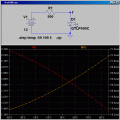
Look familiar? Let's ask LTSpice what is the current through the LED I(D1) and what is its forward voltage V(f) as the ambient temperature changes from -50 to +100deg C. The LED's I vs V behavior is a strong function of its junction temperature, as plotted...

106.gif

So, is it 2V and 20mA, or something else?
 

dl324

Joined Mar 30, 2015
18,326
That's correct isn't it? (in a simplistic overview sort of way...)
Yes.

As MikeML has pointed out, the forward voltage varies with temperature and that will change the current in the circuit.

For most LED current calculations, estimates are fine. I was taught to use around 1.4V for the forward voltage of an LED (long before blue or white LEDs were invented). To make the mental math easier, I would have rounded to 1.5V and would have estimated 21mA for the current.

The closest standard 5% resistor value to the 500 we've been using is 511; I would have rounded it to 500 to make the mental calculations easier...
 

MikeML

Joined Oct 2, 2009
5,444
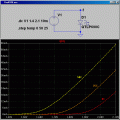
One more illustration: Same LED as in post #32, but driven with fixed voltage at three different temperatures.

If nothing else, this should point out the folly of driving LEDs with a fixed voltage.

For example, if we drove this LED from 2.00V source, look what happens to its current as its temperature changes. Can you say "thermal runaway"?

106.gif
 

MikeML

Joined Oct 2, 2009
5,444
Robert asked about post 32 and post 35:

...why when there is a resistor does a 50 degree increase in temperature increase the current only a few mA, but without one, a 50 degree increase creates a massive spike?

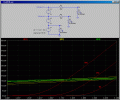
106c.gif

This might clarify it:

A comparison of driving three identical LEDs.

The voltage varies as indicated. The x-axis shows only V1, but add 2V to what is driving D2 and 4V to what is driving D3. Note Ra and Rb. They are sized so we can compare the LED currents.

The plot shows what happens at three different temperatures, namely at 0C, 25C and 50C, assuming all the LEDs see the same temperature. In each plot: I(D1), I(D2), and I(D3) progress from bottom to top at the three temperatures.

Note that increasing the supply voltage by 2V, and adding Ra just about flattens out (reduces the slope of) the Current curve, meaning that the current is much less dependent on the voltage fluctuation from 3.4V to 4.1V. Also, the spread between the current at 0C and 50C is greatly reduced. See Yellow Group.

Note that adding a second delta of 2V to the supply voltage (and increasing Rb) helps some more, further reducing the slope, and the temperature spread. See Green group.

Note that the higher the supply voltage (and the higher the series resistance), the closer the drive circuit comes to being a current source. In the limit, an ideal current source is an infinite voltage in series with an infinite resistance. So the closer the drive circuit approximates a current source (constant current drive), the happier the LED is...
 

Thread Starter

Robert Smith_1437948150

Joined Jul 26, 2015
38
Hi MikeML, sorry for the late reply.

Regarding your last post, I'll be honest with you, I didn't quite get it.... but it's good to know at least I asked a valid question haha

1. Bit of a side question first, even without a resistor, the same principle applies, as the temp rises and the current increases, the voltage drop of the LED decreases, similarly to what you showed in #32? (I am almost certain it is just want to be 100%).

Right, your final post, first of all thanks for doing that, it is greatly appreciated. I am quite out of my depth with it but your saying it is better to have a higher voltage and higher resistance... I'm not quite sure how this actually helps prevent the huge increase in current as the temp rises i.e. what's physically happening in the circuit, but it's good to know.

2. Pretty obvious this one, but without a resistor in the circuit it is better to have the source voltage closer to the forward voltage of the LED?

3. ...but if you have a resistor, theoretically the higher the voltage and higher resistor to set an appropriate current, the better it is at preventing the current spiking as the temperature increases?

4. An example using the image you provided in #36, looking at LED 3, if you increased the resistor from 200 Ohms to 400 Ohms, the LED would dimmer, but the current increase with a rising temperature would be less than when it was at 200 Ohm?

Any help with the above 4 questions would be appreciated, and they only have to be simple answers, as I said I already feel out of my depth.

Regards,
Robert
 

dl324

Joined Mar 30, 2015
18,326
MikeML's point is that LEDs should be driven from a current source because they'll try to maintain a fixed current regardless of junction temperature. This is more important when you're trying to match luminous intensity.

It is often acceptable to operate LEDs as in your circuit. The human eye has a logarithmic response to light and can't perceive small changes in intensity.

I have an optoelectronics book written by some engineers at Hewlett Packard's optoelectronics division and most of the applications use resisters; not true current sources.

There are situations where current sources would be more appropriate; yours isn't one of them.
 

MikeML

Joined Oct 2, 2009
5,444
Hi MikeML, sorry for the late reply.

Regarding your last post, I'll be honest with you, I didn't quite get it.... but it's good to know at least I asked a valid question haha

1. Bit of a side question first, even without a resistor, the same principle applies, as the temp rises and the current increases, the voltage drop of the LED decreases, similarly to what you showed in #32? (I am almost certain it is just want to be 100%).
Yes. This behavior is an undesirable fact of life for LEDs; that is just how they behave. If driven from a constant-voltage, they can self-destruct due to thermal runaway, especially the higher power ones.

Right, your final post, first of all thanks for doing that, it is greatly appreciated. I am quite out of my depth with it but your saying it is better to have a higher voltage and higher resistance... I'm not quite sure how this actually helps prevent the huge increase in current as the temp rises i.e. what's physically happening in the circuit, but it's good to know.

2. Pretty obvious this one, but without a resistor in the circuit it is better to have the source voltage closer to the forward voltage of the LED?
Yes
3. ...but if you have a resistor, theoretically the higher the voltage and higher resistor to set an appropriate current, the better it is at preventing the current spiking as the temperature increases?
Yes
In a series circuit, by KVL, the sum of the voltage across the resistor (Vr) plus the forward voltage of the LED (Vf) equal the supply voltage (Vs). As Vr gets larger relative to Vf, then the thermally-induced-change in Vf (ΔVf) becomes small compared to Vr. In a series circuit, the change in loop current is also reduced because Vr+Vf=Vs, but now ΔVf is a small fraction of Vr.

4. An example using the image you provided in #36, looking at LED 3, if you increased the resistor from 200 Ohms to 400 Ohms, the LED would dimmer, but the current increase with a rising temperature would be less than when it was at 200 Ohm?...
But you forgot that the when I increased Rb to 200Ω, I simultaneously added 2V to its supply, so that I(D3) is approximately the same as I(D2), so the LED brightness would be the same.

Look at the green and yellow traces. Note that the three green lines (bottom to top, 0C to 50C) are flatter than the three yellow lines, meaning that with the higher supply voltage (and higher value of R to keep the current the ≈same), temperature variation has a smaller effect on the green set compared to the yellow set. Both are hugely better than the bare-nekkid LED in the red set.

Most newbies think that LEDs are lamps, and should be driven with a constant voltage. I hope you now understand why not...
 
Top