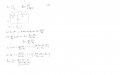
ok i did that and i believe that i have the correct answer. thnx
here's another problem which i solved and checked my solution and it is indeed the correct one. when i checked the full solution, the teacher immediately assumed i=0 when he calculated h12 and h22 (i1=0).
now i dont know if he is really smart and somehow understood it from the circuit itself or he did made mathematical calculations and was lazy to put them in his solution.
can it be assumed just from looking at the circuit that i=0? if so then how? because all i see (when i1=0) is 2 resistors in parallel and both of them in series with dependent current source. i "imagine" that the current i2 enters the parallel resistors and splits into current -i (in R1) and i2+i (in R2).
is it possible to intuitively understand that i=0?
the teacher's full solution is just saying immediately that i=0 and therefore the dependent current source is disconnected so no current flows in the circuit. no math involved there. i truly believe that he posts his full solutions in a way that we wont be able to copy from.. he is a bit crazy lol
my solution i already handed to the teacher.. sorry
Pick some specific values for everything. Say R1=R2=1kΩ, β=-2, V2=1V. Then pick i=-1mA. You then have 1mA of current flowing from the outside to the inside of both resistors (making i1=0 and i2=2mA), dropping 1V along the way making the voltage at the top of the dependent source 0V. The current in the current source, by KCL, has to be 2mA. But 2mA/(-1mA)=-2=β, thus everything is satisfied even though i is NOT equal to zero.
See how long it takes him to figure out what is going on.
ok.. i attached the professor's solution for h11 and h21 parameters.
as i said, h12 and h22 are straightforward as he assumes i=0 immediately and therefore the whole circuit is open and no current flows at all.
now finally today he explained to us why he did it!
he has a method which he says that only he uses it and that he will publish a paper about it, that he generally refers to as "engineerical approach" as opposed to "mathematical approach" ('engineerical' - is that how you say it?).
what this engineerical approach says is first, when you analyze a circuit of some sort, first silence all dependent sources (current sources are open circuited and voltage sources are shorted). then examine if the parameters that the dependent sources are dependent on exist in the circuit. if yes, then reconnect the sources, and if not then leave them silenced.
so, in the case of the above problem, he open circuited βi and examined if the current 'i' exists. obviously it doesnt since when we zero βi the whole circuit is open and no current flows. therefore we should leave βi silenced (open circuited) and the solution to the parameters h12 and h22 is trivial.
another point he made us clear is this (as said by his own words) - "dont be smart asses! β, and any other similar coefficient of a dependent source always agrees with the portrayed direction of the source so in this case β>0! and if i would write in your exam that the source is named -βi then β is negative!"
i swear this were his exact words lol.. as i told you - he is a bit crazy but also probably the best professor in the institute

 Facebook
 Google
 GitHub
 Linkedin