1mA through 1MOhm Resistor

dannyf

Joined Sep 13, 2015
2,197
What other components do I need in order to force 1 mA through this resistor?
One of two things:

1. A 1000v power supply. You can forgo the two batteries or connect them back to back in the circuit.
2. A 982v power supply, in serial with the two batteries.

You may be able to think of other combinations.
 

WBahn

Joined Mar 31, 2012
32,852
I read what the original poster (OP) asked for, and it sounded more like they didn't understand what they were doing. My example gives them something to think about that does provide a solution that may actually be what they needed. If nothing else it gives them more understanding or to think about.

Given the scenario stated by the OP, what I provided is as close as he is going to get by simply adding another component.
The key question as stated by the TS was, "What other components do I need in order to force 1 mA through this resistor?"

I asked the TS to clarify what they meant by, "all this without increasing the voltage," but either what they are trying to do is impossible or the "components" they need must constitute a voltage converter that takes in 18 V DC and outputs something that has an effective voltage of 1000 V.
 

WBahn

Joined Mar 31, 2012
32,852
I could be wrong but I read that as a need to keep theb1 M ohm load on the18 V. If the objective is to get1 mA regardless of voltage step down the voltage.
In the final word I think his answer is simply just "no".
How does stepping down the voltage from 18 V allow him to get 1 mA through 1 MΩ?
 

WBahn

Joined Mar 31, 2012
32,852
Current is a result of voltage across a resistance. You do not "generate a current". You generatev a voltage. How much current will flow is a matter of resistance.

If your objective is to het 1 mA out of 18 V with a 1 M ohm load on the18 V you need to chop up the 18 V DC then run it through a step down transformer to about 300 mV.
Huh????

Could you elaborate on this?
 

EM Fields

Joined Jun 8, 2016
583
So I have two batteries of 9V (so 18V) and a 1MegaOhm resistor.

What I want is a 1 mA current through the resistor. How do I accomplish this? What other components do I need in order to force 1 mA through this resistor?

If I just connect the 18V to the resistor, by Ohm's law, I would not accomplish anything.

Obs: Of course, all this without increasing the voltage so I get 1mA.

Is it possible?
Nope.
 

mcgyvr

Joined Oct 15, 2009
5,394
In light of other respondents on this thread, could you please elaborate as to why you want precisely 1mA throught that specific resistor at 18V or is this simply for argument's sake, as it is physically impossible, not ever going to happen.
There you go..
Its clear the answer is no.. But if the OP were to come back and explain the why/whats then we can attempt to provide the proper way to achieve their needs..
 

ian field

Joined Oct 27, 2012
6,536
So THAT'S how you strobe pocket xenons! :D
Nowadays its much easier to use white LEDs.

24 LED magnetic work lights are easy to come by, they're invariably wired in parallel.

A simple blocking oscillator can generate enough voltage to trip a DB3 diac at about 32V - about 47uF is a good starting point, but it depends how fast you want it to flash and how much power you want to put in.
 

WBahn

Joined Mar 31, 2012
32,852
Amazing.
Over 30 posts to discuss on to put 1mA through a 1 megohm resistor. :rolleyes:
Yeah. Hopefully the TS will come back and actually answer the questions asked in Post #5. But, let's keep in mind that the OP was made barely over 24 hours ago and the TS has a life, too.

To help him along...

@RdAdr :

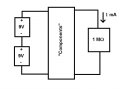
Is this what you have in mind?

1Mohm1mA.png
If not, please provide some kind of a sketch of what you DO have in mind?
 

panic mode

Joined Oct 10, 2011
4,990
don't buy batteries, they are so called 'constant voltage' source... next time you walk into a store or gas station just them you need 'current source'.
 

EM Fields

Joined Jun 8, 2016
583
So I have two batteries of 9V (so 18V) and a 1MegaOhm resistor.

What I want is a 1 mA current through the resistor. How do I accomplish this? What other components do I need in order to force 1 mA through this resistor?

If I just connect the 18V to the resistor, by Ohm's law, I would not accomplish anything.

Obs: Of course, all this without increasing the voltage so I get 1mA.

Is it possible?
Ohm's law states that E = I R, so the voltage required to force 1 milliampere through 1 megohm would be 1 milliampere times 1 megohm, which is 1000 volts.

With two 9 volt batteries in series, in series with one megohm, the best you could hope for for would be
I = E/R = 18V/1MΩ = 18 microamperes, so the answer to your question is "no"
 

Tonyr1084

Joined Sep 24, 2015
9,744
I suppose if you can cool the resistor to near absolute zero then possibly you'll get 1 mA through it. But I'm guessing. Turn the resistor into a superconductor with a resistance of 18,000 Ω. And that's even IF you can turn it into a superconductor.

1,000 v ÷ 1,000,000Ω = 1 mA (0.001 A)
100 v ÷ 100,000Ω = 1 mA
10 v ÷ 10,000Ω = 1 mA
1 v ÷ 1,000Ω = 1 mA
0.1 v ÷ 100Ω = 1 mA
0.01 v ÷ 10 Ω = 1 mA
0.001 v ÷ 1Ω = 1 mA
18 v ÷ 18,000Ω = 1 mA

At 18 volts and 1 MegΩ, you're getting 18 µA (0.018 mA or 0.000018 A) It's called "Ohms LAW" because it's an immutable LAW. 18 volts through a 1 MegΩ resistor is going to draw 18 µA (Micro-Amps, not Milli-Amps). Adding ANY additional resistance in series is only going to increase the resistance and draw even less amps. Adding something in parallel - that will draw more current through the circuit but NOT through the 1 MegΩ resistor. No matter what you do to the circuit, you're not going to force more amperage through it. Parallel resistance means providing an alternative path around the main resistor. More current follows a different path (path of least resistance) but never will any more than 18 µA flow through that resistor with only 18 volts supplied. Just won't happen!
 
Last edited:

WBahn

Joined Mar 31, 2012
32,852
I suppose if you can cool the resistor to near absolute zero then possibly you'll get 1 mA through it. But I'm guessing. Turn the resistor into a superconductor with a resistance of 18,000 Ω. And that's even IF you can turn it into a superconductor.

1,000 v ÷ 1,000,000Ω = 1 mA (0.001 A)
100 v ÷ 100,000Ω = 1 mA
10 v ÷ 10,000Ω = 1 mA
1 v ÷ 1,000Ω = 1 mA
0.1 v ÷ 100Ω = 1 mA
0.01 v ÷ 10 Ω = 1 mA
0.001 v ÷ 1Ω = 1 mA
18 v ÷ 18,000Ω = 1 mA

At 18 volts and 1 MegΩ, you're getting 18 µA (0.018 mA or 0.000018 A)
The very notion "a superconductor with a resistance of 18,000 Ω" is nonsensical. A superconductor, by definition, has zero resistance (among other things, such as expelling all magnetic flux).
 

GopherT

Joined Nov 23, 2012
8,009
The very notion "a superconductor with a resistance of 18,000 Ω" is nonsensical. A superconductor, by definition, has zero resistance (among other things, such as expelling all magnetic flux).
Semantics. Using context words, I see he meant "less good resistor" when he said "super conductor".
 
Top