1Hz Signal, Counting Bits, Frequency Divider (Guidance Requested)

Thread Starter

Guest3123

Joined Oct 28, 2014
404
Sorry for excluding the "CD"4060... That one has a higher operating voltages. The one you found is however very useful if you are operating on lower voltages

http://eu.mouser.com/ProductDetail/Texas-Instruments/CD4060BE/?qs=sGAEpiMZZMtdY2G%2bSI3N4QbAITGbt2JcChfYw2OoQl4=
Excellent. So I did good at finding the 4060. Lower voltages.. The n-Channel MOSFET (942-IRLB8721PBF) I have works with voltages as low as 1.8V, and the power supply I have is 5.045v So lower voltages is fine. So the one I found says operating voltages of 2 V to 6 V. That's perfect then.

Why an n-Channel MOSFET? Because these ICs from what I understand are LOW POWER devices. The n-Channel mosfet, I've gotten the gate down to as low as 165uA for the gate. So if I need to power something, even a little LED, I'll just pop in an n-Channel mosfet to see the LED blink at 2Hz or 1Hz.

I'll be lucky if I can just get 2Hz. Seeing how I actually know almost nothing how these work. I did a little research for a few days to learn about sequential logic, but I gave up.. Figured I'd learn from the ground up, but no. I just want to learn how to hook this 4060 up, and then learn how to wire up the 4013. I think I found the 4013, is this the 4013 IC? 595-CD4013BE or CD4013BEE4.

I think I'm actually starting to see a little light at the end of this, what seems like a long tunnel.

Yes, I meant the CD4060 and CD4013.
They can be found here.

The CD74HC4060E is a higher speed version of the CD4060 but it operates at no more that 6V versus 15V for the CD4060.
That's great !! I like the fact that is a higher speed version. It's only $0.56 or whatever. As for the voltages, I'm working with the n-Channel mosfet, and voltages I've mentioned in the above reply. So 6V is fine. If I wanted to make this smaller, I would want to use like a button cell battery or something, so 2-6V is fine. As for hooking it up, I'm still very confused and have absolutely no clue how it's hooked up. Looking at the datasheets is Greek to me, so I have no clue.

As for dividing the 2Hz down to 1Hz, I'd need a 4013 IC, which I believe is one of these (CD4013BE or CD4013BEE4).. Not sure until someone says, yes, or gives positive feedback.

So after I get those two parts, then it's just a matter of finding the Capacitors, resistors, etc. The crystal I believe is this one (815-AB38T-32.768KHZ).

Yes, it's very difficult for me. I just want to learn about some electronics, and all I need is a little guidance, which I'm getting, thanks to the helpful people here on AAC. :)

If it were a Mosfet, Resistor, or a Linear voltage regulator, I can do it. I also just made a NAND gate using two n-Channel MOSFETs, that were listed in the above text. The video, if anyone has seen it yet, can be found here.

I like electronics, but sometimes, when I want to try to climb the ladder a little, and learn a little more stuff, it's difficult for me. Regardless if it's very difficult to understand or very frustrating, and I don't want to ask for help, I try to push forward, and try and try but yet again.

I love to help others, I usually do very good videos, and try to make the videos very clear and easy to understand. So when you help me, your helping millions of others. :)

Not to forget, when people search for this kind of thing, people will also see this thread, and be very thankful.
 

Thread Starter

Guest3123

Joined Oct 28, 2014
404
The CD4013 will divide the rate by two. Check out my reply to your other thread.
Let me try to describe the basic operation of dividing a signal down to a lower rate.

You have a signal at some rate. Like 32,768 Hz for example, but in this initial description it doesn't matter.

Next, consider a toggle flip flop. They can be made from various flip flops, but the most important characteristic is that every time the clock input changes, the output "toggles" its state. Assume the output is a zero. The clock changes state and the output becomes a one. The second time the clock changes states, the output returns to a zero.

Look at this description carefully. For every two input changes, the output changes once. You have divided the input rate in half.

Now feed the output of the first flip flop into a second flip flop. Now you have divided the input by four (divide by two divided by two)

You keep in adding flip flops until you get the input signal divided down. In the case of a 32,768 Hz signal, you need to divide it by two, 14 times. So 14 flip flops.

Now, this is a lot of flip flops, so a better solution is to use counters. Interestingly, counters are made of cascaded flip flops in a single package. But, I think you need to understand the long way first before you can understand using counters.

So that is what I have to add. Hope it helps.

Would you like to lead in the conversation on exactly how to hook up the 4060, and the 4013? Because I have no clue. Even with reading the datasheets I'm clueless. I'm asking for assistance & guidance. That involves people actually drawing out or pointing out how it's wired. As easy as it is to most people, it's not easy for me. Call it a walkthrough. It wouldn't just be helpful to me, but for others that read this thread in the future, are are seeking help with the 1Hz generator. Then later down the road, I'll hook it up to a 7 segment. But for now, it'll be hooked up to an LED or LEDs.
 

shortbus

Joined Sep 30, 2009
10,049
The n-Channel MOSFET (942-IRLB8721PBF) I have works with voltages as low as 1.8V,
In your other thread I tried to correct you about this. You need to stop considering the Gth value in your system. That value is mostly used when designing an audio amplifier. It is the lowest value that will allow the mosfet to conduct ant a very low amperage value and very high resistance. It's not the gate voltage that means the mosfet is turned "on" to allow the listed values through it. In other words for what your doing, totally ignore the Gth voltage.
 

crutschow

Joined Mar 14, 2008
38,543
...............
Would you like to lead in the conversation on exactly how to hook up the 4060, and the 4013?
..................
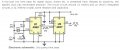
The reference I listed in post #8 shows how to connect the chips. Do you not understand that?

I would use the standard CD4060 and not the CD74HC4060E, as the higher speed device has different characteristics, such as input capacitance, that may adversely affect the operation of the crystal oscillator section.
 

shteii01

Joined Feb 19, 2010
4,644
Yup. Just for learning purposes. I want to make a simple 1Hz signal. After I learn how to do that, I'll maybe learn how to increment a 7 segment. but the 7 segment as well as whatever makes it possible for the 7 segment to change from a 0,1, 2, 3, 4 etc. will sit on a shelf whever it's at right now. I just want to learn how to make the 1hz signal, Just gonna sit here in 1st gear, until I learn the how to make a VERY STABLE 1Hz signal. So that circuit will do that then huh.. Ok.. I need assistance understanding how it's wired up. Preferably with images, ... I'm more of a visual learner.

Can you point me to where the parts are for that circuit?
Ok. You are looking at the wrong places. Clock crystals are nice, but they are not the basic building block, they are more advanced way to get an oscillating signal.

To create a simple low frequency (like 1 Hz) signal you need an oscillator circuit. Phase-Shift Oscillator using op amp and Colpitts Oscillator are some of the simplest oscillator circuits that use resistors, capacitors, a transistor and/or op amp. These are the very basic building blocks. Anything else will be much more complex.
 

ian field

Joined Oct 27, 2012
6,536
The CD4013 will divide the rate by two. Check out my reply to your other thread.
Which one is the D flip-flop? - With the D; you simply tie the not-Q output back to the D input and it toggles each time the trigger event is provided. Several types of flip-flop can be used - with the JK; you just pull both J & K high and the clock toggles it.
 

Thread Starter

Guest3123

Joined Oct 28, 2014
404
The reference I listed in post #8 shows how to connect the chips. Do you not understand that?

I would use the standard CD4060 and not the CD74HC4060E, as the higher speed device has different characteristics, such as input capacitance, that may adversely affect the operation of the crystal oscillator section.
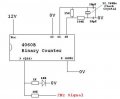
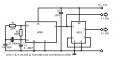
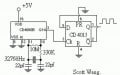
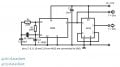
Can you help me find the CD4060 and CD4013 people are talking about please? I can't seem to find it on Mouser. If it's not on Mouser, then I guess I'll need to buy it somewhere else. Yes, it looks like I can hook it up. I have a problem with one of the connections though. Looks like a variable capacitor. But yet on other circuit drawings, it doesn't have that.

A VERY ACCURATE 1Hz.jpg 1-hz-generator.png Hunted001257.jpg Hunted001259.jpg Hunted001260.jpg

There's several of these Circuits online. Some don't even have the variable capacitor component.
 

crutschow

Joined Mar 14, 2008
38,543
..........
I have a problem with one of the connections though. Looks like a variable capacitor. But yet on other circuit drawings, it doesn't have that.
...................
The variable capacitor is to account for variations in stray capacitance, which depends upon the layout.
You probably can get by with a fixed cap, but you may need to try different values to get proper oscillation.
 

AlbertHall

Joined Jun 4, 2014
12,629
The variable capacitor will pull the crystal frequency very slightly so you can get your clock to keep very precise time. Most clocks and watches don't bother though and you definitely don't need to.
 

Thread Starter

Guest3123

Joined Oct 28, 2014
404
Which one is the D flip-flop? - With the D; you simply tie the not-Q output back to the D input and it toggles each time the trigger event is provided. Several types of flip-flop can be used - with the JK; you just pull both J & K high and the clock toggles it.
lol, I've been watching videos NON STOP about the SR Latch, SR Flip Flop, and the JK Flip flop..

I did this video of the circuit in Circuit Simulator in response to my understanding of the JK Flip flop. I think I understand it now, but it's kinda crazy that the NAND has three inputs.

The video : NAND JK FLIP FLOP TOGGLE ANIMATION

Basically, JK are high, so technically, it's like they're tied together.
 

Thread Starter

Guest3123

Joined Oct 28, 2014
404
The variable capacitor will pull the crystal frequency very slightly so you can get your clock to keep very precise time. Most clocks and watches don't bother though and you definitely don't need to.
While keeping it still extremely accurate, what value should I use? If I didn't want to use a variable capacitor?
 

djsfantasi

Joined Apr 11, 2010
9,237
lol, I've been watching videos NON STOP about the SR Latch, SR Flip Flop, and the JK Flip flop..

I did this video of the circuit in Circuit Simulator in response to my understanding of the JK Flip flop. I think I understand it now, but it's kinda crazy that the NAND has three inputs.

The video : NAND JK FLIP FLOP TOGGLE ANIMATION

Basically, JK are high, so technically, it's like they're tied together.
Don't quite understand what you are saying!
 

AlbertHall

Joined Jun 4, 2014
12,629
Any of 15pF, 22pF, 33pF will do nicely. As you can see here the change in frequency is very slight, in the fifth digit of the frequency.
Incidentally, is he actually saying "a capacitor in serious with the crystal" or is that just his accent?
 

Thread Starter

Guest3123

Joined Oct 28, 2014
404
Any of 15pF, 22pF, 33pF will do nicely. As you can see here the change in frequency is very slight, in the fifth digit of the frequency.
Incidentally, is he actually saying "a capacitor in serious with the crystal" or is that just his accent?
Several words aren't that clear. I see this a lot from people doing videos on Electronics, as well as other types of videos.
 
Top