15kva isolation transformer help

Reloadron

Joined Jan 15, 2015
7,890
One sweet boat or more appropriate yacht. When I had mine it was in NC so the boat remained in the water all year. Took it out about every 3 years for bottom work. Up here where I now am while Lake Erie is nice every year the boat needs storage and while this year has been kind it will freeze over eventually, makes for nice ice fishing. :)

Any problems just come back and if you think about it let us know how things go.

Ron
 

Thread Starter

duncan mccallie

Joined Apr 2, 2015
34
On a boat, or any place else, for that matter, as soon as one side of the line is tied to "ground", every point on the other side becomes a shock hazard relative to everything that might be connected to ground. ^This includes feet on a wet floor and any faucet, and most metal appliances. In our homes we have no choice because the distribution system has one side grounded for a number of reasons. But once we have an actual ISOLATION transformer we no longer have that hazard, the shock can only be between the two sides, and all of the grounded items are open circuit to the shock source. The hazardous voltage between the two sides of the line is still there, but it is less likely to get between those two than between one of them and ground.
Thus it is time to stop and think carefully before connecting all of the conductive structure of a boat to one side.

AND NOW, I am wondering why the previous transformer had to be replaced. A 15 KVA transformer of any quality is a fairly expensive item, and so there must be a real reason for replacing it. Hopefully whatever brought about the need for the replacement has been adequately addressed.
Thanks MisterBill2,
I’d operated successfully with the Charles Industies 12KVA unit for several years, including several marinas with the new GFI shorepower pedastals. Then about a month ago, It apparently shorted internally and tripping the 50 amp breaker on the dock.
 

MisterBill2

Joined Jan 23, 2018
27,522
OK, then. My experience is that it is important to know the cause of component failures, to avoid repeats. Transformers do sometimes develop problems, especially in a maritime environment. And higher humidity is never a transformers friend.
 

Thread Starter

duncan mccallie

Joined Apr 2, 2015
34
OK, then. My experience is that it is important to know the cause of component failures, to avoid repeats. Transformers do sometimes develop problems, especially in a maritime environment. And higher humidity is never a transformers friend.
There is one other peculiar symptom/development that appeared at the same time.
When I bypassed the shorted transformer, the automatic transfer switch on the Outback inverter refused to operate. It still works fine with the onboard generator power but not shorepower. This has me baffled and I’ve been hoping another functioning transformer will somehow “clean up” the shorepower?
I had a chat with the support folks at Outback but they insist their unit can tell the difference between the two power sources. apparently it can?
 

MisterBill2

Joined Jan 23, 2018
27,522
There is one other peculiar symptom/development that appeared at the same time.
When I bypassed the shorted transformer, the automatic transfer switch on the Outback inverter refused to operate. It still works fine with the onboard generator power but not shorepower. This has me baffled and I’ve been hoping another functioning transformer will somehow “clean up” the shorepower?
I had a chat with the support folks at Outback but they insist their unit can tell the difference between the two power sources. apparently it can?
do a resistance check on the failed transformer, both from all terminals, primary to secondary, and also to the frame ground and any other connections.
What were the power input connections from the other transformer to the inverter/transfer switch arrangement? We are missing a bit of information here, and evidently it matters.
 

Thread Starter

duncan mccallie

Joined Apr 2, 2015
34
do a resistance check on the failed transformer, both from all terminals, primary to secondary, and also to the frame ground and any other connections.
What were the power input connections from the other transformer to the inverter/transfer switch arrangement? We are missing a bit of information here, and evidently it matters.
The power from both the transformer and generator lead to a selector switch at the panel and then thru a 120v circuit breaker to the transfer switch in the inverter.
When I initially found the short in the input side of the transformer, it didn’t occur to me to test resistance to the secondary leads. I can try that today. Thanks again
 

Thread Starter

duncan mccallie

Joined Apr 2, 2015
34
The power from both the transformer and generator lead to a selector switch at the panel and then thru a 120v circuit breaker to the transfer switch in the inverter.
When I initially found the short in the input side of the transformer, it didn’t occur to me to test resistance to the secondary leads. I can try that today. Thanks again
One other question: The marina here is “rustic” and although the voltage is a solid 240, the wiring is sketchy. Is there a simple way to test that it is otherwise “clean” ?
 

MisterBill2

Joined Jan 23, 2018
27,522
One other question: The marina here is “rustic” and although the voltage is a solid 240, the wiring is sketchy. Is there a simple way to test that it is otherwise “clean” ?
Check to see if the onboard generator has any other connectivity to the inverter, such as a common or some other connection. And I an guessing that the onboard generator is produccing 240 volts AC but it may be DC. please let us know. This is getting "very interesting."
 

Thread Starter

duncan mccallie

Joined Apr 2, 2015
34
Check to see if the onboard generator has any other connectivity to the inverter, such as a common or some other connection. And I an guessing that the onboard generator is produccing 240 volts AC but it may be DC. please let us know. This is getting "very interesting."
Yes, the generator puts out 240vac. Its only output is to the panel with the selector switch which it shares with shorepower.
Everything behaved as it should for several years, until the transformer suddenly failed.
(I moved the boat to this dock and shorepower arraignment about three months before the transformer failed.)
 

MisterBill2

Joined Jan 23, 2018
27,522
Yes, the generator puts out 240vac. Its only output is to the panel with the selector switch which it shares with shorepower.
Everything behaved as it should for several years, until the transformer suddenly failed.
(I moved the boat to this dock and shorepower arraignment about three months before the transformer failed.)
Is this a problem with the new transformer? Or was that a problem after the other one failed?
 

Thread Starter

duncan mccallie

Joined Apr 2, 2015
34
Is this a problem with the new transformer? Or was that a problem after the other one failed?
It began malfunctioning immediately after the old transformer failed and I bypassed it. I haven’t wired in the new transformer yet. Close but “snowed in” 12” last night that’s rare for Puget Sound.
 

MisterBill2

Joined Jan 23, 2018
27,522
It began malfunctioning immediately after the old transformer failed and I bypassed it. I haven’t wired in the new transformer yet. Close but “snowed in” 12” last night that’s rare for Puget Sound.
OK, that is good news in that it is not an error in the way that the new transformer was installed. So it is some other cause. Hopefully it is not damage done by the trans failure.
 

Thread Starter

duncan mccallie

Joined Apr 2, 2015
34
OK, that is good news in that it is not an error in the way that the new transformer was installed. So it is some other cause. Hopefully it is not damage done by the trans failure.
Strange that it still works perfectly on the generator.
Could there be some sort of issue with the quality of the neutral coming in from marina that I could test? ( grasping here)
Thx
Duncan
 

Reloadron

Joined Jan 15, 2015
7,890
Two methods are used for Isolation Transformer so lets look at them both.
Wired as an Isolation Transformer.

1. Isolation Transformer System with Single-Phase 240-Volt Input, 120/240-Volt Single-Phase Output with Boat Grounded Secondary. Shield Grounded on Shore and Metal Case Grounded on Boat. The ungrounded shore current-carrying conductors are connected from the power inlet to the primary winding of the isolation transformer through an overcurrent protection device which simultaneously opens both current carrying conductors. Do not connect the shore neutral. Fuses shall not be used in lieu of simultaneous trip devices. 240-Volt branch circuit breakers and switches simultaneously open all current-carrying conductors. 120-Volt branch circuit breakers are permitted to use single-pole breakers in the ungrounded current-carrying conductors. Polarization of conductors must be observed in all circuits. The green grounding wire from the shore is connected to the shore power inlet shell which is insulated from metal-hulled boats. Do not connect the shore green wire to the boat ground. The grounded neutral from the secondary of the isolation transformer and the case of the transformer are connected to the system ground, neutral conductor and engine negative terminal or its bus.


2. Isolation Transformer System with Single-Phase 240-Volt Input, 120/240-Volt Single-Phase Output, Ground Fault Protection and a Grounded Secondary. Shield and Metal Case Grounded on Boat. The ungrounded shore current-carrying conductors are connected from the power inlet to the primary winding of the isolation transformer through a ground fault protection device which simultaneously opens both current-carrying shore conductors. Fuses shall not be used in lieu of simultaneous trip devices. 240-Volt branch circuit breakers and switches simultaneously open all current-carrying conductors. 120-Volt branch circuit breakers are permitted to use single-pole breakers in the ungrounded current-carrying conductors. Polarization of conductors must be observed in all circuits. The green grounding wire from the shore power inlet is not connected to the to the isolation transformer shield or case nor to the boat ground.

Now one big difference is your original transformer was designed with a 240 volt primary. Your new transformer is designed around a 240 / 480 volt primary which is just a matter of how the primary side is connected. The primary side is designated H1 through H4. To remain with a 240 volt primary side H1 and H3 are joined together and H2 and H4 are joined together. So you now have H1, H3 and H4, H4 which is two hot lines to your shore power. These two shore power lines are normally Red and Black sometimes designated L1 and L2 and the voltage between them, line to line is 240 volts.

Your original transformer had a terminal for Transformer Shield which the new transformer does not have and the Shield line was typically connected to shore power Grounding connector normally a Green wire. The grounded Neutral conductor was typically White from shore power. It was not used and will not be used since this is about Isolation and additionally there is no real need for the green ground (shore power). All you really care about is L1 and L2 or the Black and Red (240 Volt) shore power lines. These get connected to your transformer primary at H1, H3 and H2, H4. There is no need for shore power ground or neutral.

Your new transformer secondary consist of X1 through X4. This is where we tie X2 and X3 and that X2,X3 junction becomes your ship board power Neutral and Ground at your circuit breaker panel. The panel sees 120 volts - 0 - 120 volts or 240 volts line to line be it generator or shore power following your new transformer. Any switching between power source will only be switching between two lines. The Neutral from your transformer (X2 and X3 junction) and your generator Neutral are all tied as a single Neutral which at no point is switched.

Ron
 

crutschow

Joined Mar 14, 2008
38,508
If the secondary neutral is not grounded to the boat frame on the secondary side, then I would think there should be a resistor connected from neutral (X2-X3) to the metal frame to bleed off any static charge.
A 10k ohm resistor can do that while keeping any shock current to ground below lethal levels (≥100mA).
 

Reloadron

Joined Jan 15, 2015
7,890
If the secondary neutral is not grounded to the boat frame on the secondary side, then I would think there should be a resistor connected from neutral (X2-X3) to the metal frame to bleed off any static charge.
A 10k ohm resistor can do that while keeping any shock current to ground below lethal levels (≥100mA).
I have based my responses on this pdf which I posted way back in the beginning and was the document for the original transformer which is being replaced with the GE Transformer. They did point out two examples of isolation using the original transformer.

Ron
 

MisterBill2

Joined Jan 23, 2018
27,522
An interesting possibility is that as the previous transformer was failing, before the overload tripped the over-current protection device, that some of the primary turns were bypassed. This would change the ratio and cause the output voltage to rise, possibly a lot. So it may be that some over-voltage protection device at the inverter input was triggered or damaged. That is an area to look at. It may also be that it was some transient on the incoming power that triggered the transformer into failing then instead of later.
Of course, this is a guess, but it is based on a string of reasonable possibilities.
 

Thread Starter

duncan mccallie

Joined Apr 2, 2015
34
Two methods are used for Isolation Transformer so lets look at them both.
Wired as an Isolation Transformer.

1. Isolation Transformer System with Single-Phase 240-Volt Input, 120/240-Volt Single-Phase Output with Boat Grounded Secondary. Shield Grounded on Shore and Metal Case Grounded on Boat. The ungrounded shore current-carrying conductors are connected from the power inlet to the primary winding of the isolation transformer through an overcurrent protection device which simultaneously opens both current carrying conductors. Do not connect the shore neutral. Fuses shall not be used in lieu of simultaneous trip devices. 240-Volt branch circuit breakers and switches simultaneously open all current-carrying conductors. 120-Volt branch circuit breakers are permitted to use single-pole breakers in the ungrounded current-carrying conductors. Polarization of conductors must be observed in all circuits. The green grounding wire from the shore is connected to the shore power inlet shell which is insulated from metal-hulled boats. Do not connect the shore green wire to the boat ground. The grounded neutral from the secondary of the isolation transformer and the case of the transformer are connected to the system ground, neutral conductor and engine negative terminal or its bus.


2. Isolation Transformer System with Single-Phase 240-Volt Input, 120/240-Volt Single-Phase Output, Ground Fault Protection and a Grounded Secondary. Shield and Metal Case Grounded on Boat. The ungrounded shore current-carrying conductors are connected from the power inlet to the primary winding of the isolation transformer through a ground fault protection device which simultaneously opens both current-carrying shore conductors. Fuses shall not be used in lieu of simultaneous trip devices. 240-Volt branch circuit breakers and switches simultaneously open all current-carrying conductors. 120-Volt branch circuit breakers are permitted to use single-pole breakers in the ungrounded current-carrying conductors. Polarization of conductors must be observed in all circuits. The green grounding wire from the shore power inlet is not connected to the to the isolation transformer shield or case nor to the boat ground.

Now one big difference is your original transformer was designed with a 240 volt primary. Your new transformer is designed around a 240 / 480 volt primary which is just a matter of how the primary side is connected. The primary side is designated H1 through H4. To remain with a 240 volt primary side H1 and H3 are joined together and H2 and H4 are joined together. So you now have H1, H3 and H4, H4 which is two hot lines to your shore power. These two shore power lines are normally Red and Black sometimes designated L1 and L2 and the voltage between them, line to line is 240 volts.

Your original transformer had a terminal for Transformer Shield which the new transformer does not have and the Shield line was typically connected to shore power Grounding connector normally a Green wire. The grounded Neutral conductor was typically White from shore power. It was not used and will not be used since this is about Isolation and additionally there is no real need for the green ground (shore power). All you really care about is L1 and L2 or the Black and Red (240 Volt) shore power lines. These get connected to your transformer primary at H1, H3 and H2, H4. There is no need for shore power ground or neutral.

Your new transformer secondary consist of X1 through X4. This is where we tie X2 and X3 and that X2,X3 junction becomes your ship board power Neutral and Ground at your circuit breaker panel. The panel sees 120 volts - 0 - 120 volts or 240 volts line to line be it generator or shore power following your new transformer. Any switching between power source will only be switching between two lines. The Neutral from your transformer (X2 and X3 junction) and your generator Neutral are all tied as a single Neutral which at no point is switched.

Ron
Thanks Ron,
My neutrals from Transformer and Generator are switched with the hot leads on a big (expensive as I recall) rotary selector switch before leading to a neutral bus bar. Not good?
 

Reloadron

Joined Jan 15, 2015
7,890
Thanks Ron,
My neutrals from Transformer and Generator are switched with the hot leads on a big (expensive as I recall) rotary selector switch before leading to a neutral bus bar. Not good?
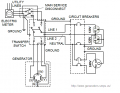
I won't say not good but a little peculiar. While not a boat I have a similar setup, I have a generator (16.0 KW) with a fully automatic transfer switch. When I lose AC mains power (utility company) the generator auto starts and does an auto transfer and the actual transfer switch only switches what I mentioned earlier L1 and L2, here is what a manual versipon looks like.

Generator Transfer Switch Manual.png

Now in your case the Utility Lines above would be Shore Power following your isolation transformer. Note how only X and Y or what I call L1 and L2 are actually switched. The Neutral is not switched and unless there is a shipboard reason to switch it I can't see why it would be. The circuit breaker panel only shows a few circuits 120 volt and 240 volt but in real life there could be 20 to 40 breakers in there. The actual switch type can be rotary drum (popular) or lever design but normally you are only switching two lines (240 volts) and not the neutral. Square D and Siemens are popular but there are dozens of manufacturers and yes, they are expensive, especially for good quality. Again, normally two pole but you could get a three pole if neutrals are also to be switched. Also, keep in mind the above is merely an example.

Ron
 
Top