12V DC Motor Overload Protection Help/Advice

Thread Starter

tonycrouch1183

Joined Jun 1, 2024
10
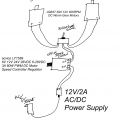
Hello all, I hope it's ok to post this in this chat as I could not find anything specific to what I am needing help with. I have a little project that I am building that has (2) 12V dc motors, a switch to choose which one gets power, a speed controller, and the power supply. Fairly basic in design.

My concern is that if one of the motors gets in a bind while having power applied and just stops turning (sorry don't know the technical term for that) then how to I protect the item so that the motor doesn't overheat and catch fire?

The motor is a JGB37-520 12V/600RPM motor that says it has a no load current of 0.05–0.15 A and a max load current of 350ma. Is there a simply way to provide protection in the event the motor gets in a bind and can't turn yet still has power applied to it?

I greatly appreciate any help and input! Thank you!
 

Attachments

LowQCab

Joined Nov 6, 2012
5,101
He is assuming a "SMPS", which is about 99% of the common "Wall-Wart" Power-Supplies that You will run into.

Generally, they are self-protecting above their rated-maximum-Current.
.
.
.
 

Thread Starter

tonycrouch1183

Joined Jun 1, 2024
10

Reloadron

Joined Jan 15, 2015
7,857
My first thought is figure out why one of two motors is exhibiting problems? Next I would just use a fuse as suggested. If not a resettable fuse a common 0.5 amp slow blow fuse. Anyway, the issue is why one motor is stalling?

Ron
 

Thread Starter

tonycrouch1183

Joined Jun 1, 2024
10
My first thought is figure out why one of two motors is exhibiting problems? Next I would just use a fuse as suggested. If not a resettable fuse a common 0.5 amp slow blow fuse. Anyway, the issue is why one motor is stalling?

Ron
Sorry I may have not explained it correctly. I do not have any issues with the motors but they are being used to wind something that "should" be manually stopped when it gets to the end. I want to insure that if it was forgotten and the item spooled to the end that the motor would not be able to spin but would still have power applied to it. My worry is that it could overheat and catch fire so I just want a way to insure "IF" that happens that there is a way for power to be cut off, thus my thoughts on a fuse.
 

Reloadron

Joined Jan 15, 2015
7,857
Sorry I may have not explained it correctly. I do not have any issues with the motors but they are being used to wind something that "should" be manually stopped when it gets to the end. I want to insure that if it was forgotten and the item spooled to the end that the motor would not be able to spin but would still have power applied to it. My worry is that it could overheat and catch fire so I just want a way to insure "IF" that happens that there is a way for power to be cut off, thus my thoughts on a fuse.
In that case I am taking the fuse route. :)

Ron
 

Thread Starter

tonycrouch1183

Joined Jun 1, 2024
10
In that case I am taking the fuse route. :)

Ron
Ok thanks Ron! I just orderd some inline .5a slow blow fuses with holders. Just curious, if you look at my diagram, do I need one for each motor after the directional switch or can I put just one inline between the dc power supply connector and the speed controller?
 

dendad

Joined Feb 20, 2016
4,635
The Polyswitch (brand name ) I mentioned in post #5 are what I have used in my industrial control devices and have proved to be very good. I cannot remember the last device I designed that used an actual fuse. If you need a "fail" indicator, add an LED with a suitable series resistor across the Polyswitch (or fuse) and it will light in a fail condition when powered. If the Polyswitch operates, remove the power and let it cool down and it will reset.
 

MisterBill2

Joined Jan 23, 2018
27,186
What is the output current rating of your 12 volt power supply?I think that I read 2 amps. The speed controller ratings are a bi confusing, but I thing it was mentioned to be able to handle up to 3.5 amps. Does the speed controller have an adjustable current limit? That would be the easy solution. Or maybe the power supply has an adjustable current limit. That can be home-made fairly easily, with a reed switch and a few turns of wire around it for the operating coil. When a motor stalled, the current rise would close the relay, which would operate a latching relay to switch off the 12 volt power.
I suggest one fuse in the supply line, because only one motor at a time will be running, two set to run would be a fault condition.
One way to avoid a motor stall condition problem would be to use momentary switches to power the motors.
Another solution will be an over-current protection relay.
 

Thread Starter

tonycrouch1183

Joined Jun 1, 2024
10
What is the output current rating of your 12 volt power supply?I think that I read 2 amps. The speed controller ratings are a bi confusing, but I thing it was mentioned to be able to handle up to 3.5 amps. Does the speed controller have an adjustable current limit? That would be the easy solution. Or maybe the power supply has an adjustable current limit. That can be home-made fairly easily, with a reed switch and a few turns of wire around it for the operating coil. When a motor stalled, the current rise would close the relay, which would operate a latching relay to switch off the 12 volt power.
I suggest one fuse in the supply line, because only one motor at a time will be running, two set to run would be a fault condition.
One way to avoid a motor stall condition problem would be to use momentary switches to power the motors.
Another solution will be an over-current protection relay.
That’s what I was thinking and hoping that one in the supply line would work. I tried momentary switches (by accident) when I first set it up but realized I preferred to have my hands free for other purposes while it was running as it can run for a few minutes. Would there by any advantage of an over current protection relay vs an inline fuse?
 

MisterBill2

Joined Jan 23, 2018
27,186
The big advantage of using an over-current trip relay is that it only needs to be reset, while a fuse needs to be replaced. Also, an over-current trip system can have an easily adjusted trip point that responds much faster than a fuse.
 

Reloadron

Joined Jan 15, 2015
7,857
Also, an over-current trip system can have an easily adjusted trip point that responds much faster than a fuse.
While I agree as to speed do you really want speed? I recommended slow blow for a reason, you don't want motor start current tripping anything. I guess it's a matter of what works best for a given situation.

Ron
 

Thread Starter

tonycrouch1183

Joined Jun 1, 2024
10
The big advantage of using an over-current trip relay is that it only needs to be reset, while a fuse needs to be replaced. Also, an over-current trip system can have an easily adjusted trip point that responds much faster than a fuse.
True, but I sort of want it to be a hassle so it doesn't become a habit to leave it in a state that makes it happen. :)
 

dendad

Joined Feb 20, 2016
4,635
If you want it to be annoying, use a Polyswitch and add a Piezo buzzer as well as the LED across it so there is a loud penetrating noise on overload.
 

Thread Starter

tonycrouch1183

Joined Jun 1, 2024
10
While I agree as to speed do you really want speed? I recommended slow blow for a reason, you don't want motor start current tripping anything. I guess it's a matter of what works best for a given situation.

Ron
I've got slow blows coming in this week so hopefully I'll have a chance to test it and report back. Appreciate everyones help so far!
 
Top