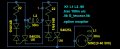
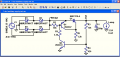
12V AC motorcycle regulator

Status
Not open for further replies.

Norfindel

Joined Mar 6, 2008
326
Is the part something like this?:


It looks really small. I doubt it has more than two zeners back-to-back inside. It's also all-metal, which probably is to keep heat flowing to the outside.

The TRIAC circuit will probably short the voltage from the alternator to it's sustaining voltage for the remaining of the semi-cycle once it's value reaches the triggering value, so the RMS value could get quite low.

It seems to me than there's no easier, cheaper, and effective way than using the two zeners.

The LM317 can be used to regulate AC, but it can go only to 40v maximum.

Or you could bridge-rectify it, and make a discrete voltage regulator with a resistor, zener, and emitter-follower transistor. If the alternator cannot supply much more current than the lamp needs to use, that means it's voltage will go down quickly when shunted, and maybe the linear rectifier won't need to dissipate tons of power. You will still need to put all this in a box used as heatsink and seal it, however.
 

Thread Starter

Suzukiman

Joined May 1, 2010
94
Is the part something like this?:


It looks really small. I doubt it has more than two zeners back-to-back inside. It's also all-metal, which probably is to keep heat flowing to the outside.

The TRIAC circuit will probably short the voltage from the alternator to it's sustaining voltage for the remaining of the semi-cycle once it's value reaches the triggering value, so the RMS value could get quite low.

It seems to me than there's no easier, cheaper, and effective way than using the two zeners.

The LM317 can be used to regulate AC, but it can go only to 40v maximum.

Or you could bridge-rectify it, and make a discrete voltage regulator with a resistor, zener, and emitter-follower transistor. If the alternator cannot supply much more current than the lamp needs to use, that means it's voltage will go down quickly when shunted, and maybe the linear rectifier won't need to dissipate tons of power. You will still need to put all this in a box used as heatsink and seal it, however.
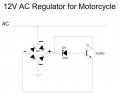
No that is probably a single phase rectifier/regulator. I posted two pictures of the unit I am refering to in post #19 here: http://forum.allaboutcircuits.com/showpost.php?p=254296&postcount=19

You will see it has only two wires, one which is ground.

Your unit above rectifies the voltage and then regulates the DC voltage by having an SCR connected to ground. Its commonly used in just about all motorcycles with a fixed magnet alternator. Later units use FETs in the same way. Linear regulation is usually not used by motorcycle manufacturers.
Thanks anyway.
 

Solcar

Joined Jun 8, 2007
21
Sorry it took me so long to get back to you, Suzukiman. Since the triac was unable to stop conducting enough to turn off anytime during a full cycle (Norfindel, you got that!), my next idea was to try two separate SCRs instead. Each would be independent from the other and might have a half cycle, more or less for the current it's conducting to drop below the holding level. I was going to simulate it but since the hard drive crash, my simulator has lost its thyristor models and symbols. If I can successfully restore them, I might be able to try out the SCR idea.
 

enduro250z

Joined Jul 6, 2010
77
Hi suzukiman, i am a bike person and fully understand you here!. I found this forum as i my self woudl like to know haw to build my own AC regulators.

My old bike (Suzuki PE250) had a custom built 12 volt AC regulator which was made by a guy who used to make these for enduro riders here in Australia in the 1980's as aftermarket AC regulators were not readily availble then.

These regulators were built for bikes running 100 -250 Watts raw AC power. The custom built regulator on my bike seemed to pack up and didnt work so i was curious as to what was inside. It consisted of a large heatsink 87 x 70 x 31mm with a set of 4 fins on each side and a gap in the middle. In the middle were components all covered by silicone. I had to dig it all out. I found a TO-3 transisor which has the following markings. I think it has the Motorolla 'M' and then MJ802 & 8226. It also has what i believe is just a standard 35amp bridge rectifier pack about 30 x 30 x 9mm and 4 spades and then it had what i believe is a zener diode and from memory i think it was a 13.7 volt???? Im really not sure. It was hard to read it. I will have to try and find it again. I tried to deconstruct it as best as i could but im not 100% on the circuit layout and what is insulated from what but i did do a rough drawing. I would like build a new one and understand how it works. There was only a red and black wire comming out the unit. Although it has a bridge rectifier in it the unit was not rectifying the AC power from the alternator in the bike. I believe the bridge rectifier was just using the diodes to take the load or switch the power???. The T0-3 pack was mounted to the heat sink.

I will try and get some photos and a drawing on here in the next few days.
 
Last edited:

enduro250z

Joined Jul 6, 2010
77
Ok now here is a drawing i made of the regulator i pulled apart but im really not sure i have got it drawn correct as it took some work to dismantle it all and dig out the components.

As i understand it there is a
transistor in a TO-3 case- Ok i looked this up in a old 80's electronics sellers catalogue and found some data. I couldnt find this component in any new books so maybe NLA?? is there an equivalent??
This is what it said

Bipolar transistor
type - MJ802
Case - TO-3
POL MAT - NS
Vce - 90
Vcb - 100
IC mA - 30A
Vces @ IC- 0.8 7.5a
Hfe @ IC mA - 25-100 7.5a
MHz Ft @ IC mA - 2 1A
Ptot mW - 200W
Use - High power O/P

Now i dont really understand any of that though!

bridge rectifier pack with a stud mount hole in the middle. There is some marking on it but are a bit hard to read but im pretty sure with is just a high power bridge rectifier.
And then there is what i believe is just a tiny zener diode. I havent found it yet. I took it out and i had it somewhere but i think ive lost it but i might still be able to find it. From memory it was a tiny thing in a clear sort of case. it wasnt black. I can remember seeing some orange brown colour on it but i think that may have been the internals. I remember seeing a band at one end and i looked it up in a electronics book and im pretty sure it was a 13 volt diode as i reckon i found some numbers on it. This was several years ago so thats why i cant remember it well.

Anyway i would like to make a new one of these but have it so it shunts the power at about 15 volts AC. 12 volt globes can handle 15 volts Ok and they wont blow. It makes them burn nice and bright for night riding. Perhaps this regulator can be made smaller aswell as its pretty bulk on this heat sink. The regulator was up under my fuel tank and the heat sink wasnt bolted to the bike frame. It was just glued to frame with silicone. If it was placed in a cool air flow and bolted to the frame it migth not need a big heat sink.

I dont know how many watts this unit could dump, but i would say at least 100 watts. I would have to see if i can find out more about the transistor as i think that is the determining factor.

Look forward to hearing what you gurus says about this.

Late edit - amazingly i found the diode stuck to a tiny bit of tape on a cupboard. Extremely hard to read the numbers on it. Ive got to see if i can magnify it but from memory i reckon it was a 1N4743 1watt 13 volt. Its has a clear case, black bank and the internals are a orange rust colour. Yeah i can see a 47 on it and a 3. Im not 100% sure there is a 4 infront of the 3 but i reckon my memory is good enough to go with 1N4743.

 
Last edited:

Solcar

Joined Jun 8, 2007
21
I'm picking up the impression that the cathode of the zener diode is electrically connected to the collector of the MJ802 by means of that mounting screw. The circuit then acts as an amplified zener diode, keeping the voltage at the collector of the transistor equal to the zener voltage (plus the base-emitter voltage of the transistor). It seems you have determined the circuit composition well.
 

Thread Starter

Suzukiman

Joined May 1, 2010
94
Now this thread is on the right track!! Enduro250Z we need to get your diagram drawn up as a schematic and do some testing!

Solcar thanks for coming back as I am not an electronics fundi and will need some wise advice here!

I will try and draw it in schematic form for any further advice. Enduro250Z thanks!!
 

Solcar

Joined Jun 8, 2007
21
Suzukiman, you're welcome. I have just finished simulating the way with the two SCRs. After you'd play around with the values of the zener diodes and the resistors in the real life circuit, I think it could work. Values of the zeners would be identical and the resistors would also be the same.

Now I see you have two ways to try to solve your problem. I think the amplified zener is easiest of the two possibilities if a heatsink would not be a problem. I think the idea you had of using thyristors is cool, so I continued on with it because i was curious, if for no other reason. I imagine that I could need it myself sometime.

The connections to the bridge rectifier are switched in that amplified zener diagram that you posted. Not far off though!

Edited
 

Attachments

Solcar

Joined Jun 8, 2007
21
One thing that makes the SCR circuit more iffy is the problem of how to simply represent a magneto in the simulator. I've done more simulations with alterations to the circuit and have some doubt how well it really works in real life. :(
 

Solcar

Joined Jun 8, 2007
21
Aha, I added a lamp across the coil and now it's feasibility looks much better. The circuit needed a lot of the coil energy to be absorbed.
 

Thread Starter

Suzukiman

Joined May 1, 2010
94
The connections to the bridge rectifier are switched in that amplified zener diagram that you posted. Not far off though!

Edited
Solcar, thanks a million for your contributions. I am positive that some of these AC regulators use SCR's or TRIACS.

Please just point out what I missed on enduro's diagram. I am just too dense to see it! Could you suggest a replacement for the MJ802 with a different case that will make heatsinking easier? Could you run this on your simulator?

Thanks again for your help and interest it is much appreciated!
 

Solcar

Joined Jun 8, 2007
21
I don't have that triac circuit anymore, but I wonder if it might work since I didn't have the light bulb included in it when I simulated it. I'm much less confident about it, however.
 

Solcar

Joined Jun 8, 2007
21
I've gotten the triac models reinstalled into my LTspice simulator. I see hope for the triac circuit after all, too. Adding the light bulb across the coil makes a big difference. Another change is to add a resistor in series with the back to back zener diodes.

The most certain circuit I see right now is the amplified zener. Now, if you can't resist the curiosity and spirit of experimentation... !
 

SgtWookie

Joined Jul 17, 2007
22,230
Solcar,

I fiddled around with a circuit briefly, but frankly I'm not very familiar with TRIACs.

Anyway, have a look at the attached; I probably not only have bad models for the TRIACs, but have installed them upside-down and backwards.

D1-D4 are a full-wave bridge. R1 tries to keep the TRIAC turned on (I probably have the wrong polarity here; perhaps a boost cap would do the trick).

R2 keeps Q1 turned off when Q2 is not conducting.
Q2, R3 and R4 are a "rubber Zener" set to regulate the output at ~14v.
When Q2 conducts, Q1's base sinks current, which should turn off the TRIAC. C1 reduces the ripple on the output.

Anyway, that's how I thought it would work. Of course, it doesn't work due to my incomplete understanding of TRIACS and their applications.
 

Attachments

Solcar

Joined Jun 8, 2007
21
Hello SgtWookie

Looks like you were having fun! I love playing with the LTspice simulator. The triac and SCR work by being triggered by a minimum required gate current and stay on until the current through the main pathway of the component drops below the hold current. That means the regulation approach works from the opposite perspective. When the voltage being regulated drops below a certain level, the thyristor gets enough current applied to its gate to turn it on. Then when the AC or pulsing DC supplying it drops below the level of the regulated voltage, the thyristor can turn off.

I placed a PMOS in your circuit instead of a triac, and it worked! That type of circuit is one of my favorites.
 

SgtWookie

Joined Jul 17, 2007
22,230
Yeah, the trouble with a PMOS is the body diode.

It'll conduct in reverse and result in high power dissipation.
[eta]
Actually, there are several problems with using a P-ch MOSFET besides the body diode.

If Vgs drops lower than -20v, the MOSFET will be destroyed. Gate would have to be clamped to the source using a Zener or the like.

The MOSFET will have slow turn-on and turn-off times, leading to high power dissipation.

That's why I was fiddling around with the TRIAC. Actually, since the input is rectified in the toy I came up with, an SCR would be more appropriate. Just as long as the current through the gate could be boosted to say, 20mA or so, it would kick in until the current fell through 0. That's basically what I was trying to do; disable the SCR gate when the output was high enough.
 
Last edited:

enduro250z

Joined Jul 6, 2010
77
Solcar - the connection of the cathode on the diode and the + of the rectifier are in that loop terminal. The loop is insulated from the heat sink via a fibre washer. Since the heatsink is annodized i dont think it is going to conduct anyway. Then there is a plastic bush inside the hole through the heat sink so the screw doesnt touch the heat sink. The screw then screws into the MJ802 tansistor case. I can not remember if there was a fiber washer under the head of the screw sandwiching the loop terminal between 2 fiber washers, but even if there was i think the inside edge of the loop would still have a tiny bit touching the screw and still making contact with transistor case.

I dont know heaps about electronics and mainly just know the basics. So would you say that i have got it drawn out right and that it should work and the cathode and + from the rectifier are ment to be electrically connected to the transistor case via the mounting screw? Would it work if the that connection ws isolated from the transistor case? what would have been the reason to isolate the loop terminal from the heatsink with a fiber washer?

Suzukiman - your proper drawing seems to match up with what ive drawn, but do you disagree with it Solcar? I will have to check it again with my drawing and the remains of the unit itself later on. There is some info on the MJ802 transistor on th net which i saw last night. I also have a chart that listed a few alternatives.

In the specs of the MJ802 there is '200 watts'. So Would this be the amount of power the regulator can dump? That would be good as that would mean if you got high powered lights, you dont have to constanly run them during the day and the regulator can dump everything from the alternator.

The guy that built this was an electronic guy and i imagine he built maybe up to 100 of these through the 70's to early 90's. I know lots of guys used his regulators and they were proven in competition. I tryed to contact him several years ago but he said he no longer does bike stuff like custom regulators and stator rewinds and he no longer had the info.

So what would you guys say, apart from the size of the components and bulkiness of the unit is the circuit definitely something that would work well? Im going to go with saying that the zener was a 13 volt one. Would it have regulated to exactly 13 volts or a bit less? I read some where that if you want a particular working voltage you gotta use a zener a few volts higher than what you want. I was thinking of using a 15 volt one.

I reckon my design could be made smaller with a smaller rectifier and transistor aswell.

I have also found an old custom made regulator in my stuff made by someone else which was off an old Yamaha race bike with a rewound 250 Watt alternator running 2 x 100/90 H4 halogen lights. So thats 180 watts low beam and 200 watts high beam plus a few watts for brake/tail light. Now this regulator is much much smaller and has one wire coming out it. From what i can see so far, i can only see one component which is a TO-220 case transistor i think?. This AC regulator has to be electrically mounted to the bike frame and I was always told that if you got over about 200 watts you gotta have your lights on all the time because the regulator cant dump all that power. These regulators are also competition proven and i know many have been sold and they seem to produce bright crisp lights so that leads me to believe they are working at 14-15 volts I reckon.

I would just like to make my own, even if its kinda copying another design and i bet i can make it for less $ that what it costs to buy one already made from a shop.

Back to my circuit above, can one of you guys run it through a simulator and test it?
 
Last edited:

enduro250z

Joined Jul 6, 2010
77
Well i studied suzukimans diagram of my hand drawn version and i cant find whats wrong. It looks the same basically. You have the connections to the rectifier the same as i have, unless im totally blind and missing something????.

Anyway here are photos of the unit i deconstructed. As you can see its pretty beeffy and agricultral looking. If i make a new one i could do a better job. The old owner must have ground some bits off the heat sink to get it to fit under the tank.


I imagine it could handle a lot of power as the MJ802 is rated at 200 watts. With this unit, would it matter if it was bolted to the bike chassis electrically? I know it has the black earth wire comming off the rectifier, but if i made it again i would like to bolt it to the frame again in a different location and the bike frame would also help with additional heat sinking and i may not need such a big heat sink. Im just wondering if the collector of the transistor is connected to the heat sink electrically or not and if i have bolts through the heat sink to the frame and a connection is made from the heat sink to the bolts if it will muck anything up?. Under the transistor there is the black annodized heat sink so im sure it couldnt be making contact and the transistor mounting holes through the heat sink have plastic bushes to cover the raw alloy thats exposed from the drilling, but im not 100% sure. One other thing i found was that under the MJ802 there was a thin metal shim between the heat sink and the transistor. On each side was white compound for heat transfer. What i want to know is what was the metal shim for??
 
Status
Not open for further replies.
Top