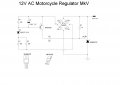
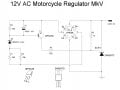
12V AC motorcycle regulator

Status
Not open for further replies.
No problem, waiting for you as you are the main source of info now to confirm that the schematic is drawn exactly right!
Hope you can build a pilot one for testing, I will have to order the parts, but do not have a bike at hand for testing.
Can you give a picture of the component board please.
Thanks

Ive just about done all i can do with the circuit ive revealed. I will be ordering a new 225watt Tympanium reg in the next day or so which will take 7 days or so to arrive from USA. I will open it up and see how it compares. Tympanium regs are the bench mark when it comes to AC regs. Many Baja 1000 winners have used them. I wouldnt be surprised if the custom made one i pulled apart is a direct copy of the Tympanium. There are many knock offs of these regulators. I think Moose and MSR and Electrosport all have had chinese Tympanium copies made.

I probably cant build a sample one just yet, but i see no reason why it shouldnt work. Ive got one of these on a bike now and it should be the same circuit inside. i havent exactly got easy access to running bike to test one on at the moment though. Im hopping the gurus on here can run it through a simulator though to see what it does.

I will take a photo of circuit board. Not much to see though, and its looking a little ragged now. A few components have fallen off. Ive got it drawn out though so you can see the best way to construct it. Its just on a tiny bit of universal circuit board from Jaycar i reckon. No etching required. I think theres about 60-70 small solder pads.

I would still like to here if my first simple circuit with the zener, brigde and TO-3 transistor is a workable design aswell.
 

Thread Starter

Suzukiman

Joined May 1, 2010
94
Hi,
The position of R4 and C4 does not matter on the schematic as they are still connected in the same way.
You can properly check the resistors by just unsoldering 1 leg and bending it way from the PCB

R1 resisor if 120 ohm will be black, red, brown, if it is 1.2k then it will be black, red, red. Maybe the last red has turned black due to heat and age. If you can just confirm this ones measurements when unsoldered on one side.

R6 I will change to 47 ohm as your measurement and colours show that.

The variations you measure are normal and the 5% tolerance allowed is most likely what you were seeing.

The capacitor if 63 V means it can work with voltages up to 63V, but still 100uF, just more tolerant to a higher voltage. A 100V would also be good, but becomes slightly larger in size.

I do not think you have to worry too much about the BC547 if there are variants such as BS547 B, C etc and you can choose take the higher current and voltage rating one for peace of mind, but otherwise use any one you can get.

Good job so far!!
 
Last edited:

Thread Starter

Suzukiman

Joined May 1, 2010
94
I would still like to here if my first simple circuit with the zener, brigde and TO-3 transistor is a workable design aswell.
Its quite amazing that no-one has responded on that diagram, hopefully someone will soon. Otherwise it means build and test one.

I will order the parts for both when I order some components next and then build and try on the first bike that I can find. The casing/heatsink can come later once we know the diagrams are correct
 
R1 is still fully attached on board but most others had one broken leg
I will cut it off and measure in the morning
It definitely has brown tolerance band then then brown, then black then the next colour I was sure was initially red, but now looks a little brownish but different to the other colours but im 90% sure it is red and the last colour sure looks the same as the other browns.
Im measuring 1.2 K so if your right that would mean the last 2 colours are red but I can no way see that the very last colour was red.

Out of interest what is a brown- brown, black, red, brown?

You had a mistake on the 47 ohm one so you might be wrong on R1 too?

I think in the end we need to go with the measurement of 1.2K as all my other measurements seem to match what the colours say ?
 

Thread Starter

Suzukiman

Joined May 1, 2010
94
Have a look here: http://www.hobby-hour.com/electronics/resistorcalculator.php
It is imporatnt that the colour bands are read in the correct sequence. The first band is always the one closest to the edge.
I have fixed the values for R1 and R6 and updated the schematic.

You can now go ahead and build one, just bolt the triac to a bit of flat alluminium for testing and feel it for heat. the rest of the components draw very little current. You could use a 1 Amp bridge instead of 4 x 1N4007's if you want to.
Just remember that the triac case may be common to the MT2 terminal unless you use an isolated type.
Good luck.
 
OK! This is finally worked out and my suspicions were right all along.

I un clipped leg of the resistor and still got 1.2 Kohm

Then went to that online calulator and but in
brown (tolerance), brown, black, red, brown and it said 1.2k so looks like the second from last colour was red as i suspected and it just had gone a little darker. I noticed the calculator was around the other way around so i had to do it this way though.

brown, red, black, brown, brown and then i got 1.2kohm!

So that has the resistor part sorted which i thought was going to be hard. Seems that all that heat i put into it didnt damage the resistors.

I would still like to know if those other higher rated triacs will work, but im still tempted to go with the 3 component reg ( trans, zenner and bridge)
 
Well I received a brand new Tympanium 12V AC regulator today and ripped right into it. Because the potting mix was much more rubbery it was a lot easier to get into and not damage the components.. What I have found is very interesting. The circuits and components look similar to the circuit we have been working with so far. I will be able to 100% positively ID all the components but have only done a few so far.

As I have read the codes off the components

1 x Transistor – TO-92 case – MPS A56 747
1 x TO-220 case Transistor or Triac? – 2N6507G 0941 (plus theres a few other tiny numbers if you need to know)
1 x Electrolytic capacitor – 100uf 10v - 85°C – (note how its 10 VOLT!!! This is exactly what I found in the other circuit but a few guys on here reckon it should be 63v)
4 x black diodes – Look to me like normal rectifier diodes, I should be able to get the numbers off them later. They look physically the same as what I found in the other regulator.
5 x resistors – 1 metal film, 4 carbon – will list colours later on.
1 x Zener diode – 1N5237C or possibly 1N5207C – would like to know what volts this one is.LATE EDIT- i looked up 1N5237C on the internet and it seems to be telling me its 8.2 volts??? if correct this means i have been sold 6 volt regulators and not 12. If thats the case im going to have to contact the place that sold me them.

And that’s all that’s to it. Will get my hand drawn circuit diagram with all the components up here before end of the week.

I would like to know what the TO-220 case component is.

Now all the sales info that goes with this claim it can handle 225 watts. Its gonna be interesting to see if that’s true!

Suzukiman, i will photograph both of these circuit boards for you still. Ive just been busy.
 
Last edited:

SgtWookie

Joined Jul 17, 2007
22,230
Well I received a brand new Tympanium 12V AC regulator today and ripped right into it. Because the potting mix was much more rubbery it was a lot easier to get into and not damage the components.. What I have found is very interesting. The circuits and components look similar to the circuit we have been working with so far. I will be able to 100% positively ID all the components but have only done a few so far.

As I have read the codes off the components

1 x Transistor – TO-92 case – MPS A56 747
MPSA56; PNP transistor. Datasheet: http://www.fairchildsemi.com/ds/MP/MPSA56.pdf
1 x TO-220 case Transistor or Triac? – 2N6507G 0941 (plus theres a few other tiny numbers if you need to know)
It's an SCR; 400v 25A. Datasheet: http://www.onsemi.com/pub_link/Collateral/2N6504-D.PDF
1 x Electrolytic capacitor – 100uf 10v - 85°C – (note how its 10 VOLT!!! This is exactly what I found in the other circuit but a few guys on here reckon it should be 63v)
That's certainly an odd voltage rating for a motorcycle voltage regulator.
4 x black diodes – Look to me like normal rectifier diodes, I should be able to get the numbers off them later. They look physically the same as what I found in the other regulator.
5 x resistors – 1 metal film, 4 carbon – will list colours later on.
1 x Zener diode – 1N5237C or possibly 1N5207C – would like to know what volts this one is.LATE EDIT- i looked up 1N5237C on the internet and it seems to be telling me its 8.2 volts??? if correct this means i have been sold 6 volt regulators and not 12. If thats the case im going to have to contact the place that sold me them.
It would help a great deal if you could post a complete schematic.
Yes, the 1N5237 is rated for 8.2v breakdown with a 20mA current flow through it.
Until the complete schematic is posted, we really can't tell what the output voltage will be.
 

Thread Starter

Suzukiman

Joined May 1, 2010
94
Some 12V shunt regulators could use lower voltage zeners in a specific configuration to regulate 12 - 15V so the 8.2V zener could be correct. That may also be why the capacitor is 10V rated as that part of the circuit may have low voltage. Just guessing until we see the schematic.

There are ways to test the zener for its breakdown voltage by using a battery and a resistance and then measuring the voltage with your multimeter

I recall reading somewhere that the rule of thumb is that all 12V automotive type circuits should use components rated higher than 40-45 V to eliminate failures in case of any transients. Someone else may be able to confirm this. That may not have been applied to older or aftermarket parts parts.
So using a 63V or 100V capacitor just makes it more robust and should not affect the circuit working at all. A 10V will definitely fail if it installed in a part of the circuit where higher voltage is present, such as 12-15V
 
Thanks guys. Ive contacted the seller and Tympanium direct to try and work out if i have got 6 or 12 V regulators.

Interesting to see the transistor is a PNP and the other circuit had NPN. I will get the circuit drawing up in a few days or so. im just real busy right now. It would seem odd that the zener is 8.2V and not 13-15V though if it is a 12 v reg. We shall see.
 
Here we go, i rushed right onto this. A bit agricultral looking but this is the best i could do in time available.


Resistors

R1 - Gold, Red, Red, Red – carbon film 5% - 2.2KOhms- measured 2.183 KOhms
R2 – Brown, Red, Black, Orange, Orange – metal film 1% - 33KOhms - measured 33.12 KOhms
R3 – Gold, Brown, Orange, Orange – carbon film 5% - 330Ohms - measured 326.2 Ohms
R4 – Gold, Brown, Orange, Orange – carbon film 5% - 330Ohms - measured 325.6 Ohms
R5 - Gold, Red, Black, Brown - carbon filme 5% - 1KOhm - measured 0.992 KOhms

Zener Diode – 1N5237C
Electrolytic capacitor – 100uf 10v 85°C

TO-220 case component – 2N6507G (plus a few other numbers)
T = Transistor - TO-92 case MPS A56 747

D = Diodes – These seem to be just plain black power/rectifier diodes. I could see the bands this time. Numbers are hard to read but so far I can read 1N400 so they might be 1N4004 or 1N4007. I will try have another look at them to work It out.- EDIT- worked out they are 1N4004

Notes – the mounting hole of the TO-220 case is grounded inside the aluminium regulator case which is there for common to the brown chassis wire and the motorcycle chassis itself.

Hopefully ive got it all layed out correct. Suzukiman, if you can draw this up properly I will check it again. I will also work out the resistor Ohms if I get some time soon.

*Update, just worked out resistors but i will check all with multimeter as soon as i can, epecially R2 as the colours are a little tricky to work out whats brown and whats oranage and i cant conclusively work out which end the tolerance band is as they are all evenly spaced apart!.

This should now be enough to get us started to work out this regulator though.
 
Last edited:

Thread Starter

Suzukiman

Joined May 1, 2010
94
enduro250z,

I have updated the schematic. R1 in parallel with R2 may not be correct or the values of R1 & R2 may be wrong, not sure.
Could you confirm if R5 actually connects to the AC line.

Here is the schematic I have updated as per your feedback. Please cross check with your information.


Attachments

Last edited:
The positve lead of the capacitor joins up to the silver band (cathode?) end of 2 diodes, but it looks like ive only drawn it connecting to one. It also joins to to the silver band end of the diode that connects to the lead of the TO-220 case that has the yellow wire comming from it i reckon. This is a little confusing for me. I will mark it on my drawing and tell me if you agree with that. Give me 5 mins.
 
I think ive left out a resistor too! this is gonna take a little while to sort out.

Ok look back up top, ive fixed the diagrame. Hopefully its right now.

On the diodes i can see 'MCC'. Still trying to read what comes after 1N400........ Yes i can read it now had to look at it with a bright LED and look at the diode really closely. I microscope would have been real handy. They are 1N4004. I would assume thats what they are in my first diagrame from the other week too.
 
Last edited:

Thread Starter

Suzukiman

Joined May 1, 2010
94
Could you just double check the R5 1K resistor you have added. The side going to the Yellow wire to AC power does not seem right. I have replaced the schematic with the updates.

Could you also check if the R1 and R2 are definitely in parallel as shown. It seems odd that they would be connected like that, maybe one of their values are not correct.
Thanks.
 
Last edited:
Yes the 2 resistors are in parallel. The 1% one is on the 'track' side of the board and the 5% one is on the normal component side.

With R5, one end goes to the junction of the TO-220 and R3 as i have drawn it and the other end joins in with the diode, yellow AC wire and the left leg of the TO-220 just as i have drawn it. There is one big solder pad with all those connections common. There is no other pads/tracks near by. Even if i ran an imaginary line though the pad, assuming they accidentally bridged 2 pads, that would mean one end of the diode, resistor and the left leg of the T0-220 would be going no where and there would be no solder track taking them anywhere. Also this reg would have been tested by the maker before sent off to wholesalers so i doubt they are gonna send out a dud one with a bridged set of pads, so it has to be like that and the connections all common to the one pad has to be right. i will keep checking but im 99.9999% sure i have got it right.

Also you have the diodes as 1N4007. I can clearly see now that they are 1N4004.

Edit -
I have now checked all resistors with multimeter and I was correct with the colour codes. I have written what the multi meter said next to the resistors above and all is correct.

We need to work out what this is regulating too. Its ment to be a 12 volt one and regulating around 14-15 volts. The 8.2 volt zener is really suspicious and has me worried how this can work. To me it would seem like an ideal zener for a 6 volt regulator. The person who sold this to me says they are ment to be 12volt but im not convinced at the moment.

This regulator is ment to handle shunting 225watts. I looked at the specs for the SCR 2N6507G but i couldnt work out which amp rating is the one that refers to the 225 watts?? I want to see if its true that they can handle 225watts.

Also i checked with multimeter and the 2 resistors R1 and R2 are in parallel, their legs are common to the same solder pads.

1000's of these regulators have been sold in the past 30 years, so i cant see how the 10volt capacitor can not be any good. If it wasnt they would have uprated in R&D by now, so i only assume that there is no way near 10 volts going through it. Same goes for my other circuit the other week that i was sure had a 10v capacitor.
 
Last edited:

Thread Starter

Suzukiman

Joined May 1, 2010
94
This is how I see it working without going into details and calculations. Hopefully someone who understands this better will help here:

1) SCR1 is connected between the AC line and ground and is then switched via its gate to shunt the AC voltage when it exceeds a certain level and unswitched again when below that level. This happens very fast.

2) D1-D4 form a diode bridge to rectify the AC to DC to be used as a supply voltage for the SCR driver part of the schematic.

3) R4, ZD5, R1&R2 form a voltage devider. R1 and R2 in parallel are used to fine tune the voltage that goes to T1. The resistors also keep the current via ZD5 within its rating.

4) When the voltage between the negative line of the diode bridge and the positive line goes above 12V, then ZD5 will cause 8.2 V to appear on the base of T1 which will switch on and output a positive via R3 to the gate of SCR1 and it in turn switches on, conducts and shunts the AC voltage to ground.

5) SCR's tend to keep conducting after being triggered while current flow is taking place and acually latch, so T1 will not be able to switch it off.

6) When the AC voltage drops below 12V the voltage on the base of T1 drops below 8.2V, T1 switches off and SCR1 remains on.

7) R5 now allows AC voltage to the SCR gate and this switches SCR1 off. In actual fact this AC voltage is are always present and will keep SCR1 from switching on. Only when a full positive DC signal is received on the gate via T1 will SCR1 trigger as it overrides the AC via R5. (this part may be completely wrong)

Just a comment, in this schematic it would not make any difference whether you use 1N4004 or 1N4007 diodes, or even a bridge, as long as they are about 200V working. The capacitor only being 10V is due to the fact that it is working in a very low voltage part of the circuit, again a 100uF 63V or 100V should work just as well, but normally becomes a bit larger in size. SCR1 is an anode to case TO220 type and makes it easy to connect directly to heatsink which can be grounded.

That is my take very roughly on how it may work. Hopefully someone with more knowledge will come along and correct my errors and add what is missing.
 
Last edited:
Ok, i can sort of follow that, your explanation is pretty good for me to follow. Its good to know that the capacitor is in a low voltage part of the circuit and wont get damaged but i didnt read what you said the capacitor does and how do you come up with the magical output figure of 12 volts???? I can tell for sure that no AC regulator would shunt at 12 volts, especially this particular brand. Most will be set to at least 13.8 volts and some of the higher performance racing ones could be as high as 14.7 or 15 volts for nice bright lights as we found in the last circuit that had a 15 volt zener. My research from what ive heard people say is that this particular one is regulating somewhere around 14-14.7 volts. How do we find out exactly what is working at? What is the component that is making the descision on the shunting voltage? on the last ones we looked at they were easy as they had 13 and 15 volt zeners, but on this circuit we have a 8.2V zener and its not doing the same job as the zeners in the last circuits.

Can we safely say this is not a AC regulator ment for 6 volt systems yet?

I agree, we need the experts to drop in again
 
Last edited:
Status
Not open for further replies.
Top