12v 4 channel relay module

MaxHeadRoom

Joined Jul 18, 2013
30,662
On the surface it appears rather simple, Terminal strip, +DC and Common, the jumpers set for sink or source input and then take the appropriate jumper to either + or COM and an input, dependent on the jumper setting.
Max.
 

AnalogKid

Joined Aug 1, 2013
12,135
Photo of the underside of the board might help us reverse-engineer the jumper field wiring. Max's drawing in #16 is not right for this board (3 jumper pins per relay), but it suggests that one jumper position might be control through the opto while the other is direct control to the drive transistor. or something like that.

ak
 

Thread Starter

Hussain Shabbir

Joined Mar 5, 2018
18
Photo of the underside of the board might help us reverse-engineer the jumper field wiring. Max's drawing in #16 is not right for this board (3 jumper pins per relay), but it suggests that one jumper position might be control through the opto while the other is direct control to the drive transistor. or something like that.

ak
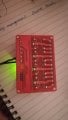
If this helps
The two wires are dc +ve and - ve
IMG_20180410_080212.jpg
 

AnalogKid

Joined Aug 1, 2013
12,135
OK, I've worked out an UPDATED schematic of the input stage. The optoisolator input is built for AC, two LEDs back-to-back. Can't draw it till later.

input > resistor > opto input diodes > GND

Opto transistor emitter > GND

Opto Collector > resistor > Vcc
Opto Collector > resistor > PNP transistor base

PNP transistor emittter > Vcc

PNP transistor collector > relay coil > GND
> EMF diode > GND
> resistor > LED > GND

Each input has a 3-pin jumper field. With the jumper in the HI position, pulling an input high (connecting it to Vcc) will turn on the relay. With the jumper in the LOW position, pulling the input low (connecting it to GND) will turn on the relay.

ak
 
Last edited:

Thread Starter

Hussain Shabbir

Joined Mar 5, 2018
18
OK, I've worked out a schematic of the input stage. Can't draw it till later.

HI input > resistor > opto input diode > GND

Opto transistor emitter > GND

LOW input > opto transistor collector

Opto Collector > resistor > Vcc
Opto Collector > resistor > PNP transistor base

PNP transistor emittter > Vcc

PNP transistor collector > relay coil > GND
> EMF diode > GND
> resistor > LED > GND

Vcc to HI input turns on optocoupler transistor, collector goes low turning on relay driver transistor.
Vcc to LOW input pulls the opto transistor collector low directly, turning on relay driver transistor.

ak
Could you tell me how to make it work? I have tried every combination and it doesnt work. Would be a great help
 

AnalogKid

Joined Aug 1, 2013
12,135
I thought I had it worked out, but the bottom side photo changes things. I'm right about the PNP relay driver, base resistors, relay coil, suppression diode, and output LED. Still working on the opto.

It all makes sense if the opto has an AC input - two LEDs back-to-back or one LED and a bridge. Any writing on the optocoupler?

Poked around DK, I'm convinced it is an AC opto with back-to-back LEDs. Edited post #26.

ak
 

MaxHeadRoom

Joined Jul 18, 2013
30,662
The info with from one seller is:

Module description:

1. Maximum load on normally open pin: AC 250V/10A, DC 30V/10A.
2. Trigger current 5mA;
3. Module can be set high level or low level trigger by jumper wire;
4. Power indicator light (green), relay status indicator light (red);
5. Module size: Approx. 73mm * 50mm* 18.5mm.

Module interface specifications:

1. DC+ : DC power supply positive pole
2. DC- : DC power supply negative pole
3. IN1~IN4 : relay signal triggering pin

Relay output:

1. Normally closed pin (NC1~NC4) : relay normally closed pin
2. Common pin (COM1~COM4) : relay common pin
3. Normally opened pin (NO1~NO4) : relay normally opened pin

High or low level trigger option:

1. S1~S4:They are option switch for relay 1~4;
3. It is low level triger if COM pin connect to LOW pin; It is high level triger if COM connect to High.

Max.
 

AnalogKid

Joined Aug 1, 2013
12,135
And note - the input LED current limiting resistor already is on the board. Once power and ground are connected to the board and the onboard jumpers are in place, relays can be controlled with jumper wires / switches between the input terminal and the correct power terminal.

ak
 

Thread Starter

Hussain Shabbir

Joined Mar 5, 2018
18
And note - the input LED current limiting resistor already is on the board. Once power and ground are connected to the board and the onboard jumpers are in place, relays can be controlled with jumper wires / switches between the input terminal and the correct power terminal.

ak
That means my connections were not at fault, there must be a problem with the module, right?
 
Agree, seems simple enough, You;ll need at least 40 mA per relay power wise.

So, connect 12 V which you did and got a power light without any jumpers - GOOD!

You place a jumper to get active low or active high.

Then either jumper the input to gnd or +12 and either the LEDS should DIM (power and relay) or come on. If they dim, then not enough power,

They could have made the active high or low 5V.

Reverse engineer one channel.

They did say opto, but why? What numbers can you make out on the big 4 lead part?
 

AnalogKid

Joined Aug 1, 2013
12,135
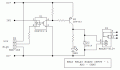
Relay board single channel schematic.

Note - *none* of the part numbers are correct; they are close-enough items in my library.

ak
Relay-Board-1.gif
 
Top