120v Fan Relay

MisterBill2

Joined Jan 23, 2018
27,615
See posts #4, #8, #18.
Te circuit in post #8 is correct but the connections are not identified adequately. The description in post #4 is correct BUT it lacks any details. The result is that a bunch of folks did not understand what was suggested.
Post #18 is correct, but then includes a whole lot of extra commentary.
 

Tonyr1084

Joined Sep 24, 2015
9,744
Last edited:

MisterBill2

Joined Jan 23, 2018
27,615
The fact that suggested solutions including diodes kept appearing indicated that not all understood.what sort of hardware system was being discussed.
 

MisterBill2

Joined Jan 23, 2018
27,615
The system was a standard heating/cooling thermostat and the TS was seeking the best way to switch a fan on when either heating or cooling was called for. That was the requirement. MOST of those systems are powered with 24 volts AC, and in addition, we were not told if this system was also controlling a heating/cooling system or just a fan. So it would not be good to add diodes into an unknown situation that might also be controlling a furnace. THAT is why suggesting a diode OR logic addition might have caused a problem.

SO the answer id YES, I was quite familiar with both the standard scheme of connections and also the TS interesting requirements.
And I did not name any names in my comment.
 

crutschow

Joined Mar 14, 2008
38,536
we were not told if this system was also controlling a heating/cooling system or just a fan. So it would not be good to add diodes into an unknown situation that might also be controlling a furnace. THAT is why suggesting a diode OR logic addition might have caused a problem.
Don't see how adding diodes would affect the AC to the rest of the system.
And THAT is why I don't see that you fully understand the system or what was suggested.
 

Ian0

Joined Aug 7, 2020
13,157
The description in post #4 is correct BUT it lacks any details.
The excuse for my brevity is that I was typing on an iPad.
However, as there were two 24V AC signals, I thought it would be obvious where to connect two 24V AC relays (there is nothing else 24V AC) and as Relay contacts are generally deployed to switch loads it would also be obvious how to connect the load.

At risk of digressing, the problem becomes more interesting if the fan is also 24V AC and has to be supplied from one of the 24V AC signals. It becomes quite tricky if a third 24V AC signal is added, especially if the three 24V AC signals do not share a common neutral.
 

MisterBill2

Joined Jan 23, 2018
27,615
The excuse for my brevity is that I was typing on an iPad.
However, as there were two 24V AC signals, I thought it would be obvious where to connect two 24V AC relays (there is nothing else 24V AC) and as Relay contacts are generally deployed to switch loads it would also be obvious how to connect the load.

At risk of digressing, the problem becomes more interesting if the fan is also 24V AC and has to be supplied from one of the 24V AC signals. It becomes quite tricky if a third 24V AC signal is added, especially if the three 24V AC signals do not share a common neutral.
Certainly the answer you gave was totally correct. However, my thinking is that the less background a TS has behind their question, the more details the answer should have, to avoid leaving them wondering what that answer means.
And a common mechanical heating/cooling thermostat usually has a series resistive heating element (the anticipater) in series with the heating section contacts. So the current available for the switched load is limited a bit. I am not sure how the electronic thermostats achieve the same results.
 

vu2nan

Joined Sep 11, 2014
357
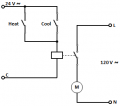
Should potential-free contacts be available for the 'Heat' and 'Cool' signals, a single 24 V AC relay would do.

1.png

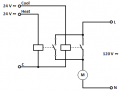
If not, two 24 V AC relays would be required.

1.png

Nandu.
 
Last edited:

ThePanMan

Joined Mar 13, 2020
923
Basics of home HVAC: 120VAC, gas (natural or propane) {OR ELECTRIC HEAT; no gas}; a thermostat, a control board, the heating system (electric element or gas furnace), the compressor and the circulating fan. To be quite honest I just don't see a need for having a separate control system for the fan. Now we all know how dangerous it is to "Assume". Nevertheless, assuming it's a normal HVAC system from as far back as the early 70's, the control board should handle ALL those functions without a need for any additional circuitry or wiring.

Excessive verbiage? Maybe. But it's better to offer a clear understanding than to - um - assume the TS fully understands how the system works. If that's the case, however, then the TS should not need to ask. That's my opinion and I'm sticking to it.

Unwatched.
 

ThePanMan

Joined Mar 13, 2020
923
My impression is that the fan he wants to control is other than the furnace fan.
That's a distinct possibility. But then all he needs is a feed from the furnace fan to switch a relay which then feeds 120VAC to the new blower. No concern for 24VAC or separate inputs (A & B so to say). I'm wondering if his goal is something other than what he's sharing. Perhaps he's come up with some great new secret system that will revolutionize the HVAC world and he doesn't want anyone to beat him to the punch. If that's the case - don't worry, I'm not punching anything.
 

ThePanMan

Joined Mar 13, 2020
923
Post #18 is correct, but then includes a whole lot of extra commentary.
my thinking is that the less background a TS has behind their question, the more details the answer should have, to avoid leaving them wondering what that answer means. (bold italic underline is my (Pan) edit)
So - "extra commentary" is too much but "more details" are needed?
I'm going to hate myself in the morning.
Fortunately it's not morning and I'm already over it.
 
Top