120v Fan Relay

Thread Starter

Ajwarner1

Joined Sep 8, 2023
3
Hi all. I'm trying to control a 120v fan with two separate 24volt signals ( 2-24v inputs that control one 120v switch) In other words, when my thermostat calls for heat, I want the fan to kick on, and when the thermostat calls for cooling, I want the fan to kick on. Can someone pease help me with what kind of relay I need? Thanks!
 

MaxHeadRoom

Joined Jul 18, 2013
30,595
Hi all. I'm trying to control a 120v fan with two separate 24volt signals ( 2-24v inputs that control one 120v switch) In other words, when my thermostat calls for heat, I want the fan to kick on, and when the thermostat calls for cooling, I want the fan to kick on. Can someone pease help me with what kind of relay I need? Thanks!
Isn't there an aux contact on each relay?
Is this two separate thermostats?
 

ThePanMan

Joined Mar 13, 2020
864
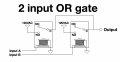
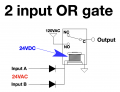
Connect AC "Line" to the NO contacts on the relays. [edit] do not connect NEUTRAL to the relay, you could accidentally create a dead short. [end edit] When Input A (24VDC) turns on (the relays need to be a 24V DC design, not AC design) it will supply 120VAC to the output. OR (which is where this gets its "OR" name) if input B turns on it will supply 120VAC to the output. One caveat here - if both inputs A & B are active at the same time the output will be high. An OR gate turns on when any or all of its inputs are high (active). It's not likely your heater/Air Conditioner will be trying to both heat and cool at the same time so this shouldn't be a problem.
1694195938430.png
There are other solutions as well. This just addresses your request as directly as possible. Another solution would be to use an IC that can take either input (yes - an "OR" gate) and put out an output. However, you'll still need a relay to switch the fan on. That being the case you'd also need a transistor or FET of some kind to control the relay depending on its coil amperage needed.

There are still other solutions as well.
 

crutschow

Joined Mar 14, 2008
38,412
It would seem that Ian0's suggestion to use two relays with their outputs in parallel is the simplest way to go.

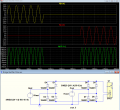
Alternately, you could use diode bridges to rectify the control signals to DC and connect the DC outputs in parallel to a single 24Vdc coil relay (below).
The simulation shows current into the relay coil (green trace) for a signal from either the heat or cool signal.

If the relay chatters with the unfiltered DC, you can add some capacitance across the bridge outputs, but only just enough to reduce the chatter.
Otherwise the RMS voltage will get too high and cause the relay to overheat.

1694199582919.png
 
Last edited:

MisterBill2

Joined Jan 23, 2018
27,316
In a normal, common heating-cooling thermostat, the heat switch function only switches on the heating portion, and the fan starts when there is heat to circulate. In the cool mode the cool contact operates both the refrigeration compressor and the circulation fan..
So to use the thermostat for just fan control, connect the "fan" contact to operate the fan relay, and then also have the heat contact of the thermostat, in addition to operating the heat portion, also operate a second relay that has contacts in parallel with the thermostat "fan" connection.
 

ThePanMan

Joined Mar 13, 2020
864
That would give only a half-wave rectification, which would almost guarantee the relay will seriously chatter.
That's why my circuit used full-wave bridge rectifiers.
So add a capacitor.

@ @crutschow Just out of curiosity I'm going to take a 12V transformer, 12V relay and a single 1N4001 diode and see how much chatter I get. IF I get chatter I'll add capacitance until it's gone.

We don't know how much current there is associated with the 24VAC supplied so we can only guess.

In a normal, common heating-cooling thermostat, the heat switch function only switches on the heating portion, and the fan starts when there is heat to circulate. In the cool mode the cool contact operates both the refrigeration compressor and the circulation fan..
So to use the thermostat for just fan control, connect the "fan" contact to operate the fan relay, and then also have the heat contact of the thermostat, in addition to operating the heat portion, also operate a second relay that has contacts in parallel with the thermostat "fan" connection.
Good points.
 

ThePanMan

Joined Mar 13, 2020
864
My old furnace had only two switches inside the fire box. The fan control switch was set to come on when temperatures inside the chamber reached somewhere around 120˚F. The other switch was a NC switch that opened when temperatures got up to around 180˚F. That was a safety feature. The high temp switch would shut the gas off in case of a lack of air flow whether the fan failed or the ductwork became clogged. That OLD furnace was somewhere around 70% efficient, meaning 30% of the heat produced went up the stack. The new furnace is completely different in the way it controls everything. The fan receives signal from a control board controlling the fan speed and when it turns on and off. Whether heating or air conditioning - the fan is automatically controlled by the control board. So I'm wondering why the TS wants to control the fan on their own.

OH OH Oh, just remembered, my OLD furnace had a switch that bypassed the fan control and just turned it ON all the time. So if I wanted to circulate air all I had to do was open the panel and flip the switch. OR for greater convenience I could have run another control wire (24VAC) to a switch upstairs (main living space) to control a relay that would bypass the fan control and run the fan when I wanted it running.

I'm left wondering why the TS wants to control a system that should already be fully controlled. If the TS is making their own HVAC system - they'd be well advised to make sure the engineering is correct and that every possible failure mode has been considered or something is going to burn out. Or worse, the house may burn out (to the ground).
 

crutschow

Joined Mar 14, 2008
38,412
So add a capacitor.
You would need to select a capacitor value that doesn't generate an RMS DC voltage much above the relay coil rating.

Another disadvantage for a half-wave rectifier is that is pulls DC from the transformer.
A cheap transformer (which I expect is used in this system) may saturate with that.
And given the low-cost of bridge rectifiers, I don't see that much of a cost advantage to use a single diode.
 

ThePanMan

Joined Mar 13, 2020
864
You would need to select a capacitor value that doesn't generate an RMS DC voltage much above the relay coil rating.

Another disadvantage for a half-wave rectifier is that is pulls DC from the transformer.
A cheap transformer (which I expect is used in this system) may saturate with that.
And given the low-cost of bridge rectifiers, I don't see that much of a cost advantage to use a single diode.
That's why You're an expert. The approach I mentioned is something I would have probably tried. Back when I was young I tried to power a 12 volt car radio from a 12 volt transformer with a selenium bridge rectifier. When I got horrible hum I experimented with a 16 volt electrolytic cap. Put it on the transformer output. No effect. Put it after the rectifier. No effect. Put it across the mains input to the transformer. I learned something at that moment. A 16 volt electrolytic cap doesn't much like 120 VAC. All I was left with was some smoke and a few leads. Never found the can or the fiber guts. I've never really pursued it beyond the basics. It's a numbers thing. Things you understand so well are like a foreign language spoken with a heavy accent to me. I doubt I'll ever go much beyond where I am already. But I respect those who have greater knowledge. I respect you.
 

Tonyr1084

Joined Sep 24, 2015
9,744
Connect AC "Line" to the NO contacts on the relays. [edit] do not connect NEUTRAL to the relay, you could accidentally create a dead short. [end edit] When Input A (24VDC) turns on (the relays need to be a 24V DC design, not AC design) it will supply 120VAC to the output. OR (which is where this gets its "OR" name) if input B turns on it will supply 120VAC to the output. One caveat here - if both inputs A & B are active at the same time the output will be high. An OR gate turns on when any or all of its inputs are high (active). It's not likely your heater/Air Conditioner will be trying to both heat and cool at the same time so this shouldn't be a problem.
View attachment 302363
There are other solutions as well. This just addresses your request as directly as possible. Another solution would be to use an IC that can take either input (yes - an "OR" gate) and put out an output. However, you'll still need a relay to switch the fan on. That being the case you'd also need a transistor or FET of some kind to control the relay depending on its coil amperage needed.
Two AC coil relays - no diodes. Nothing more simple than that. Someone already said two relays before Pan said it.
Two really ordinary relays with 24V AC coils, with the contacts in parallel.
 

MisterBill2

Joined Jan 23, 2018
27,316
Two ordinary 24 volt AC relays, Normally OPEN CONTACTS IN PARALLEL, coils operated separately as I described in post #13. one controlled by the fan terminal, the other controlled by the heat terminal. Nothing terribly complex. No diodes, no capacitors, no DC connections.
 
Top