120 kV current sense for 8 mA spread

Thread Starter

Ally Cat

Joined Mar 28, 2016
80
I need to design a current sense circuit to into an ADC off of a Cockcroft Walton amplifier with generates voltages in excess of 120 kV. The current is not very high only about 5 mA at most. However the voltage difference is not the problem it is the extreme high voltage that will fry any ADC it comes in contact with.
 

danadak

Joined Mar 10, 2018
4,057
Needless to say isolation key here, no pun intended.

Something like on amplifier side like an LED driven by a current source in turn
controlled by a voltage drop across an Rsense. This type of circuit would not have
to be ground referenced. Its has some non linearity, but output should be a fairly
linear f() of Iled. One would use a UP and a cal routine during manufacturing test to
cal it and the photo sensor detecting LED light output.

Maybe a solid state laser diode might be better, eg. to get distance between readout
and CW generator.


Not an expert here,

Is current related to CW voltage ? If so tapping the field of the CW amp
might be another possibility. Could use torque from field interacting on
a plate, or a sampled V effect ?

Regards, Dana.
 

Danko

Joined Nov 22, 2017
2,170
Use on HV side current to frequency converter instead ADC.
On output of converter connect LED.
Use optical fiber for delivering pulses to simple frequency meter.
 

Thread Starter

Ally Cat

Joined Mar 28, 2016
80
Hi Dana

This is a good idea. I just have to find some high voltage resistors that can take the voltage to be a current sense. I think the Engineer who had the tasking before me tried to tap into the field by using a magnetic sensor. The current is so low it did not show up verses background effects.

Regards
 

ebp

Joined Feb 8, 2018
2,332
Before you can do anything requiring active circuitry on the high side, you must come up with a way to power that circuitry. This of course means that whatever is used must be able to withstand 120 kV between the input and the output, unless you use a true floating power supply such as a battery. This very severely limits what can be used. Certainly no standard transformer or DC-DC converter will be usable.

There are a couple of people at AAC who have extensive experience with high voltage circuitry, but I don't recall who.
 

Janis59

Joined Aug 21, 2017
1,894
Up to 380 000 Volts I had worked many times, the electron microscopes, the ion accelerators, power supplies and multiplier ladders, etc.

Classics is to set the small resistor in the GROUND side of circuit. Cheap, simple, effective, accurate.
However in Cockroft-Walton probably it may contain unwelcome currents of previous cascades. One way, it may be deducted mathematically.

Or on high side light-guide optic cable may be used for ultimate decoupling. For example, by means of HBRF pairs 1528-1533 or newer 2528-2523. Or Hall magnetic sensor like HMC1501 with reading by AD7907.

Or, taking in account that You are charging caps with rather high frequency source, may be its enough to apply the ferrite core current transformer on output capacitor. It will not show the straight output current, but in most cases it corresponds to it, except the fronts.

Just one thing to observe is the safety gaps standing 120kV / 3 kV/mm = 4 cm for component safety and 10-15 cm for human safety, IF (!!!!) the sharp corners are eliminated. If there is not possible to eliminate the sharpness, let minimum fourfold that safety distances.

Any need for high voltage side Vcc obtaining must be solved on basis of hanged battery or batteries.
 

Danko

Joined Nov 22, 2017
2,170
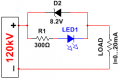
LED may be connected direct in series with HV line.
Zener diode and resistor prevent LED from damage or parameters changing because of possible current spikes.
120kV.png
 
Last edited:

RichardO

Joined May 4, 2013
2,270
If you don't need a real accurate measurement you could measure the current going into the voltage multiplier. This would be a lot easier and safer if it works.

Doing the measurement at the input will be made less accurate if the output voltage is variable.
 

Thread Starter

Ally Cat

Joined Mar 28, 2016
80
Thanks for your input. This is a high side solution. Measuring current from cathode is not possible for this solution. I have done some simulations and yes there is allot of ripple and current is pretty jumpy as a result. Magnetic sensors have been tried before as my previous post suggested. Not enough magnetic field due to low current usage. Thanks for the pointers on dealing with HV. I don't even plan to be in the same room with this stuff when powered on. I will try to give Dana's idea a shot if possible. It should not cost much to try. I will need an accurate reading for this solution to work. So we can consider this post still open till I finish the test. I am still open to other idea's.
 

ebp

Joined Feb 8, 2018
2,332
Just tossing this out without having thought about it much, other than that the bandwidth would be low:

- capacitor in parallel with neon lamp placed in series in the high side - a relaxation oscillator delivering one flash per x millicoulombs. fibre optics or just line-of-sight to detector; major problem is achieving stable peak point and valley point voltages
 

Janis59

Joined Aug 21, 2017
1,894
The old school way is to use matched pairs HV voltage dividers on a high side
Dont forget that average large sized resistor can take, maximum permittable, 350 Volts but smallish 150 V. So, immagine the 1205 sized SMD resistor matrix, consisting 120 000/120=1000 pieces in the raw. If every takes 5 mm a place, the whole divider length will be 5 meters!!!
 

nsaspook

Joined Aug 27, 2009
16,330
Dont forget that average large sized resistor can take, maximum permittable, 350 Volts but smallish 150 V. So, immagine the 1205 sized SMD resistor matrix, consisting 120 000/120=1000 pieces in the raw. If every takes 5 mm a place, the whole divider length will be 5 meters!!!
That's why you use Maxi-Mox resistors with up to a 50.0KV rating each.
 
Top