Simple design puzzle

Thread Starter

adam555

Joined Aug 17, 2013
858
Hi, I'm new to circuit design and need some help solving what seems a simple puzzle: I need 2 potentiometers to act as one.

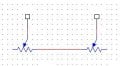
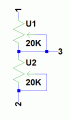
The closest I got was this:


But this will not do the work because it would only have to pins (acting like a variable resistor rather than a potentiometer). What I need is the 2 potentiometers combined together and connected to 3 wires, which will give me the total resistance when adding the result from the 2 first wires + the last 2 wires (like a single potentiometer).

Can anyone please help?
 

Attachments

Thread Starter

adam555

Joined Aug 17, 2013
858
I not sure what you are asking for, so I guess this is not what you want.
Hi, thanks for the help, but that would also work as my example -as a variable resistor rather than a potentiometer-. What I need is a result that would combine the 2 potentiometers but result in 3 wires (as a single potentiometer would have).

Imagine that each potentiometer is 20K, then I need to combine both potentiometers to give me through wire #1 and wire #2 between 0K and 40K, and between wire #2 and wire #3 the exact opposite result 40K to 0K (like one potentiometer acting alone).

I'm not even sure if this could be done, but it doesn't matter if you need to add extra components; only the two 20K potentiometers need to be there... and the 3 connecting wires.
 

Thread Starter

adam555

Joined Aug 17, 2013
858
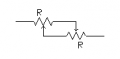
Also tried this:


But it also doesn't work because the resistance between the middle and left wires is not balanced with the middle and right wires -as a single potentiometer would-.
 

Attachments

WBahn

Joined Mar 31, 2012
32,823
Why are you trying to do this? This sounds like a homework problem of some kind.

If I were to put the circuit you show in Post #4, or strantor's in Post #5, into a black box with just the three leads brought out, how would you tell that it wasn't just a potentiometer in there? I'm not saying that you can or can't, but that's what YOU need to establish in order to accept or reject a possible solution.

It strikes me that there is something missing from your statement of the objectives in Post #1. You say that the goal is to have it so that the resistance from one end to the other is the sum of the resistances from one end to the middle and from the middle to the other end. But it would seem that, to look like a pot, you need a couple of other things. First, to be able to adjust it so that all of the resistance is on one side of the tap, all of the resistance is on the other side of the tap, or anything in between. Second, you need it so that the resistance between the end taps is constant. Then it will look like a pot, although perhaps one with two knobs and some wacky relationship between the ratio of the resistances of the two sides.
 

crutschow

Joined Mar 14, 2008
38,503
This makes no real sense to me. :confused: If you can explain what you are trying to accomplish with this odd circuit, then perhaps we could come up with some better solutions.
 

ErnieM

Joined Apr 24, 2011
8,415
Imagine that each potentiometer is 20K, then I need to combine both potentiometers to give me through wire #1 and wire #2 between 0K and 40K, and between wire #2 and wire #3 the exact opposite result 40K to 0K (like one potentiometer acting alone).
1) Remove the first 20K pot.

2) Remove any remaining 20K pots.

3) Add 40K pot.

Done.
 
Last edited:

Thread Starter

adam555

Joined Aug 17, 2013
858
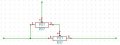
like this?
Thanks for your help. I tried that configuration but it doesn't work because the left and right outputs are not balanced. What I mean is: if you add the resistance between left-middle + right-middle, wherever the pots are set to, it wouldn't give you the same results (as a single potentiometer would do).

Why are you trying to do this? This sounds like a homework problem of some kind.
This makes no real sense to me. :confused: If you can explain what you are trying to accomplish with this odd circuit, then perhaps we could come up with some better solutions.
Basically, what I want to do is to modify a joystick; to be precise, turn some racing pedals into rudder pedals. So, the pedals have two potentiometers, one for the accelerator axis and another for the break axis; and what I need is to combine both axis into a single rudder axis.

The problem is that this axis needs to act exactly as one potentiometer alone, and I'm unable to combine both potentiometers to act in this way. I can get them to act as a variable resistor, using just 2 connections; but not like a potentiometer with 3 balanced connections.
 
Last edited:

Thread Starter

adam555

Joined Aug 17, 2013
858
It strikes me that there is something missing from your statement of the objectives in Post #1. You say that the goal is to have it so that the resistance from one end to the other is the sum of the resistances from one end to the middle and from the middle to the other end. But it would seem that, to look like a pot, you need a couple of other things. First, to be able to adjust it so that all of the resistance is on one side of the tap, all of the resistance is on the other side of the tap, or anything in between. Second, you need it so that the resistance between the end taps is constant. Then it will look like a pot, although perhaps one with two knobs and some wacky relationship between the ratio of the resistances of the two sides.
Yes, that's what I need; the 2 acting exactly as one...

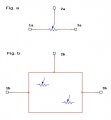
For example:


In figure a, with just one potentiometer, the resistance between point 1a and 2a (R1) is equal to the total resistance (Rt) minus the resistance between point 3a and 2a (R2). So, we could say that:
Rt = R1 + R2

Now, what I need is those 2 potentiometers inside the box in figure b to be combined in such a way that the formula above is also true.

Can this be done; adding as many components as needed, but without taking out any of the 2 potentiometers or the 3 connections?
 

Attachments

Last edited:

hexreader

Joined Apr 16, 2011
619
.... so what about a single pole 2-way micro-switch that switches between pot outputs when the accelerator is at the top of it's travel.

.... since you will not want to accelerate and brake at the same time.
 

crutschow

Joined Mar 14, 2008
38,503
........................

Basically, what I want to do is to modify a joystick; to be precise, turn some racing pedals into rudder pedals. So, the pedals have two potentiometers, one for the accelerator axis and another for the break axis; and what I need is to combine both axis into a single rudder axis.

..................
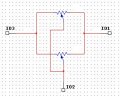
I think the closest you can get is to put the two potentiometers in series and take the output from the junction of the two as shown (pin 3). The connection of each pot wiper can be either at the bottom or top of its respective pot, depending upon the output polarity you need relative to the pedal movement.

The problem is that with both pedals at the extremes you will have a short between pins 1 and 2. You thus may need some added resistance in series with those pins if a short is a no-no.

A real rudder, of course, has the two pedals mechanically tied together and you don't have that, so the rudder pedal action will be different from a real rudder.

Dual Pots.gif
 

Thread Starter

adam555

Joined Aug 17, 2013
858
.... so what about a single pole 2-way micro-switch that switches between pot outputs when the accelerator is at the top of it's travel.

.... since you will not want to accelerate and brake at the same time.
I'm not sure what you mean. Would that involve removing the 2 potentiometers?

If it involves removing the potentiometers it would work for me, because I want to leave the pedals intact to use back as racing pedals. I was actually planning on doing two different wiring sets which could be selected with an external switch; allowing the pedals to be used in both modes.

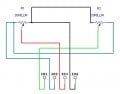
If it helps, this is the original wiring for the 2 axis:


Attachments

Last edited:

Thread Starter

adam555

Joined Aug 17, 2013
858
I think the closest you can get is to put the two potentiometers in series and take the output from the junction of the two as shown (pin 3). The connection of each pot wiper can be either at the bottom or top of its respective pot, depending upon the output polarity you need relative to the pedal movement.

The problem is that with both pedals at the extremes you will have a short between pins 1 and 2. You thus may need some added resistance in series with those pins if a short is a no-no.

A real rudder, of course, has the two pedals mechanically tied together and you don't have that, so the rudder pedal action will be different from a real rudder.

View attachment 58562
Just tried that configuration... it nearly works, but not when connected because the 2 outputs are not balanced (as in a single pot). What need is that the sum of the resistance between the middle and either side will always be the total resistance. In your example, if I turn both potentiometers to 100%, then the resistance in both sides goes to 0, as you said, but it should be 0 in one side and 100% in the other; and viceversa, when both potentiometers are turn to 0%, then one side should give 100% and the other 0%.
 

Thread Starter

adam555

Joined Aug 17, 2013
858
No, both pots would remain - wired as you show in post #1 but with a micro-switch mechanically added to either the accelerator pedal or the brake pedal.
I was just looking for micro-switches on the internet, and all of them are mechanically activated; what will turn it on and off?
 

LDC3

Joined Apr 27, 2013
924
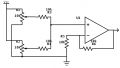
This will take your accelerator (from 0 V to 5 V) and add it to your brake (from 5 V to 0 V) and produce Maximum Acceleration of 10 V and Maximum Brake of 0 V, with 5 V representing no acceleration or braking (coasting). I think you may need to invert one of the pots and possibly decrease the input to the op-amp so the output stays within the 0 V to 5V range.
 

Attachments

Last edited:

Thread Starter

adam555

Joined Aug 17, 2013
858
This will take your accelerator (from 0 V to 5 V) and add it to your brake (from 5 V to 0 V) and produce Maximum Acceleration of 10 V and Maximum Brake of 0 V, with 5 V representing no acceleration or braking (coasting). I think you may need to invert one of the pots and possibly decrease the input to the op-amp so the output stays within the 0 V to 5V range.
Thanks a lot; I'm going to test it right now. :)

One question, you mention Volts instance of Ohms... that's sort of confusing me. :confused:
 

LDC3

Joined Apr 27, 2013
924
Thanks a lot; I'm going to test it right now. :)

One question, you mention Volts instance of Ohms... that's sort of confusing me. :confused:
Since I put 5 V across the pots, the pots act as a voltage divider. I could refer to having 0 Ω or 5 V when the pot is at the top end, and the resistance of the pot or 0 V when at the other end.
Circuits don't see resistance, they see voltage or current, so it is better to express the items as either a voltage output or a current output.
 
Top