Facebook
 Google
 GitHub
 Linkedin
For three phase systems, the electrical networks get complicated and it becomes difficult to analyse the system using only the voltage rule V=I*Z (a single phase approach).
Balanced systems have all sources equal equal and all loads (impedance) equal. Such balanced networks have simple formulas available to analyse them.
In practice however, not everything is ideal in a circuit and significant events or flaws can result in imbalance hence it is always best to be able to analyse the network should it be in an unbalanced state. Examples of unbalanced networks are;
An effective approach is to reduce the complexity of the connections to a single phase source and single impedance( sum of internal impedance of the source and load connected across said source; Thevenin's theorem).
The overall network behavior is then easily established by summing up the effects caused by individual/separate sources; Superposition theorem).
Three phase networks are of 2 varieties namely;
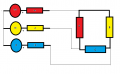
All the 3 major single phase sources or loads form a radial pattern sharing a common point.
Delta
All the 3 main single phase sources or loads form a loop.
Symbols;
The key for symbols used is as follows;
g//h ; g is in parallel to h
g&b; g is in series with b
g.h.j.k#x ; Impedance g, h, j, k in a loop with a clockwise orientation.
Incoming terminal between g and k,
Outgoing terminal between h and j,
Bridging impedance x connected between g,h and j,k shared terminals
i.e.

1.Star-Star perspective

Source M should see the following impedance;
m & A & ( (B&n)//(C&q) )
2.Star-Delta perspective

The source M should see the following network;
m&( B.q.n.A#C ) .
3.Delta-Delta perspective

Source M should power the following network;
m& ( ( (A//p)&(n//c) )//B).
4.Delta-Star perspective

Source M internal impedance m, perceives the network;
m & ( A.C.q.n#B ).
Challenge;
The main challenge is to resolve a bridge network into a single impedance. Which shall be covered in the next blog.
Balanced systems have all sources equal equal and all loads (impedance) equal. Such balanced networks have simple formulas available to analyse them.
In practice however, not everything is ideal in a circuit and significant events or flaws can result in imbalance hence it is always best to be able to analyse the network should it be in an unbalanced state. Examples of unbalanced networks are;
- A phase is overloaded/poorly-loaded compared to other phases in a transformer
- Faults affecting a single phase or two phases(not all 3 at once)
- Introducing power supply from the load side(Feeding power to a grid)
The overall network behavior is then easily established by summing up the effects caused by individual/separate sources; Superposition theorem).
Three phase networks are of 2 varieties namely;
- Star configuration
- Delta configuration
All the 3 major single phase sources or loads form a radial pattern sharing a common point.
Delta
All the 3 main single phase sources or loads form a loop.
Symbols;
The key for symbols used is as follows;
g//h ; g is in parallel to h
g&b; g is in series with b
g.h.j.k#x ; Impedance g, h, j, k in a loop with a clockwise orientation.
Incoming terminal between g and k,
Outgoing terminal between h and j,
Bridging impedance x connected between g,h and j,k shared terminals
i.e.
1.Star-Star perspective
Source M should see the following impedance;
m & A & ( (B&n)//(C&q) )
2.Star-Delta perspective
The source M should see the following network;
m&( B.q.n.A#C ) .
3.Delta-Delta perspective
Source M should power the following network;
m& ( ( (A//p)&(n//c) )//B).
4.Delta-Star perspective
Source M internal impedance m, perceives the network;
m & ( A.C.q.n#B ).
Challenge;
The main challenge is to resolve a bridge network into a single impedance. Which shall be covered in the next blog.