Zener diodes

Thread Starter

Futurist

Joined Apr 8, 2025
721
I've not done much with these for years, but have a question.

Could one cascade these, like devise a circuit where the degree of regulation gets better and better as the "output" of one is used as the "input" of another?
 

dl324

Joined Mar 30, 2015
18,219
Could one cascade these, like devise a circuit where the degree of regulation gets better and better as the "output" of one is used as the "input" of another?
No.

But you can use multiple zeners to obtain different low reference voltages.
 

Thread Starter

Futurist

Joined Apr 8, 2025
721
No.

But you can use multiple zeners to obtain different low reference voltages.
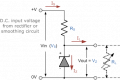
Well look at this:

1748020576996.png

If the input voltage fluctuated (and the load was relatively fixed, varied slightly) then the zener would be "regulating" the input.

So if the output in that circuit were fed to a second similar stage, would that second output not be more stable than the first stage's output?
 

dl324

Joined Mar 30, 2015
18,219
So if the output in that circuit were fed to a second similar stage, would that second output not be more stable than the first stage's output?
No really. Operating the zener well past the knee current would essentially accomplish the same thing. If you want stable and accurate voltages, don't use zeners.
 

crutschow

Joined Mar 14, 2008
38,316
Well look at this:

View attachment 349794

If the input voltage fluctuated (and the load was relatively fixed, varied slightly) then the zener would be "regulating" the input.

So if the output in that circuit were fed to a second similar stage, would that second output not be more stable than the first stage's output?
Yes, for input voltage variations, but not for output load variations, initial voltage tolerance, or temperature effects.

For better stability, use a Zener-emulator IC shunt voltage reference such as the programmable TL431, with a cost little different from a Zener.
They are significantly more stable, both for current changes and temperature.

Zeners are not usually used for voltage regulation anymore due to their deficiencies.
They are still useful for voltage clamping or for a fixed voltage drop where an accurate/stable voltage is not necessarily required.
 
Last edited:

sagor

Joined Mar 10, 2019
1,046
Zeners have a "drift" or tolerance, based on current and temperature. If you increase the input voltage, the current through the zener will change also, and will cause the zener voltage to change slightly. Also, as the zener heats up, it will drift a bit with the reference voltage as well. Changes are not really that big, but it does change.
Read the zener datasheet. Some will show the typical V vs I curve, and the slopes are never perfectly straight.
An example for a 5W 100V zener (1N5378B) shows a voltage change of "up to" 2.5V (Delta Vz) when current changes from 10% of Izm (max current) to 50% Izm. That would equate to a 2.5% regulation.
 
Last edited:

crutschow

Joined Mar 14, 2008
38,316
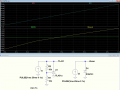
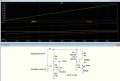
For your amusement, below is the LTspice sim of a TL431a shunt regulator set for 5V (green trace) versus a 5.1V Zener (yellow trace) over a current change of 1mA to 20mA to show the difference in regulation accuracy:
This doesn't include the initial 1% voltage accuracy for the TL431a or the 5% accuracy for the Zener.

1748061154846.png
 
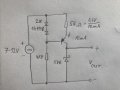
Yes, the second stage will be more precise, but it’s not much power effective since the first stage will have to be “current overdriven” to cover power consumption of second stage also.

To get more precise voltage a much more effective is to use a one stage and supply the zener with constant current:

IMG_2102.jpeg
 

Wendy

Joined Mar 24, 2008
23,797
Shoot, a conventional diode is relatively stable if you feed it a stable current, except for being a slightly temperature variant device. I've done this a few times for noncritical simple regulators.
 

Ian0

Joined Aug 7, 2020
13,097
Most Zener diodes are avalanche diodes (those above 6V) and have a negative temperature coefficient.
Those below 6V are real zener diodes and have a positive temperature coefficient. Around 6V the two effects cancel out and the voltage hardly changes with temperature.
Either side of that voltage you can find zeners with the same temperature coefficient as transistor Vbe junctions and the same magnitude but opposite sign, so you can build stable transistor references.
 
Top