Zener diode maximum reverse current

Ian0

Joined Aug 7, 2020
13,132
I suppose that in a bi-directional transorb, or any other AC clamp consisting of two zeners in series, back to back, then one of them is being used forward biassed.
 

DickCappels

Joined Aug 21, 2008
10,661
Tell your instructor that an LM741 opamp design is 54 years old but the LM358 is newer, better and costs less than half.
An LM358 dual opamp has outputs that go very close to ground and do not need output pullup resistors.

The inputs of some LM741 opamps will not work when the supply is 15V and an input is 12V or higher.
The inputs of some LM358 opamps will not work when the supply is 15V and an input is 13.5V or higher.
The inputs of some LM393 comparators will not work when the supply is 15V and an input is 13.5V or higher.
Then reduce the voltage of PR2 and PR3.
It is amazing how much progress was made in the few short years between the introduction of the venerable LM741 and the LM324, followed rapidly by the TL07x, TL08x and TL06x which are still used today.

The LM741 was (I think) the first internally compensated ops amps and did not need a lot of care to keep it from oscillating wildly, so it found its way into a lot of textbooks. Lucky for me I got out of school before op-amps became a thing.
 

crutschow

Joined Mar 14, 2008
38,522
The LM741 was (I think) the first internally compensated ops amps and did not need a lot of care to keep it from oscillating wildly, so it found its way into a lot of textbooks.
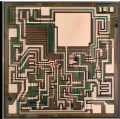
Yes it was the first, by fabricating a 30pF compensation capacitor directly on the chip (which can be seen as the large structure (below):
It also was more tolerant of input over-voltage and output short-circuits than previous IC op amps, such as the 709.
I remember when it first came out, thinking is was the cat's meow of IC op amps.

It does have the advantage, as a learning tool, of having a lot of non-ideal parameters (input voltage/current offset, I/O voltage range, limited frequency response, slew-rate, etc.) that the user must learn to must compensate for, as compared to the ideal amps in the text books.

1683050854544.png
 
Top