yet another question about transistor driver for IRFZ44N

Thread Starter

rewIndustry

Joined Feb 4, 2023
30
The IRL44Z will probably not withstand very much abuse,
I would recommend a much tougher FET like a IRFP4368PBF,
with a FET Gate-Driver number IXDN630MCI.
It comes in a big fat TO-247 Package and is Current-Limited only by the Package-Limitations,
just about guaranteeing that it will start a fire before it fails.
The Supply must be Fused for the Wire-Gauge used of course.
The FET-Driver will require a 1uF Ceramic-Capacitor attached close to the Power-Input-Pins
to insure operational-stability, and fast switching-speeds.
This FET can easily drive 2-Pumps simultaneously.

This is all over-kill because if it fails your Boat may sink or be damaged.

The FET Gate-Driver only draws 10-micro-Amps in stand-by mode,
an insignificant load for a Lead-Acid-Starter-Battery.
The Battery should be connected to a "Battery-Maintainer" at all times when not in use in any case.

Then use a Standard-Float-Switch to activate the Input of the FET-Driver,
this will remove all Motor-Loads from the Float-Switch,
leaving only a ~1K Load-Resistor to switch.
The FET-Driver has a CMOS-Input which is very High-Impedance, this means it
could easily pickup odd Electrical-Noises without some moderate Resistive-Load attached to it.
A ~10K Input-Resistor will protect the Input from any possible over-Voltage anomalies.

The FET will need to be protected from Brushed-Motor-RFI-Hash by
a Common-Mode-Choke, DigiKey number 399-SCF47C-400-1R8C040JH-ND,
and a Freewheeling-Diode, DigiKey number 497-19457-ND.

All of these Components need to be screwed-down
inside a Cast-Aluminum-Box which will also act as a Heat-Sink,
and then Potted to seal-out the Salt-Air-Environment.

The Control-Box requires a permanent ~5-Amp-rated Battery-Connection
which is separate from the Power-Supply(s) to the Pump(s).

If You still want to pursue this very-simple, but moderately-expensive project,
I'll provide You with a Schematic.

I would not ever recommend the use of any type of bare-wire probe in a Salt-Environment.
.
.
.
 

Thread Starter

rewIndustry

Joined Feb 4, 2023
30
thank you, however i am stuck with the components i have available, at least at this time - takes quite a while for things to get here, where i live.

will study all of your advice, thank you, and review it carefully - in my perspective, if mosfets are that fragile, maybe i should stick with relays?

will also study choke, versus the capacitor that i have been advised, earlier in this thread, to leave out - if this is something i can make here, i will include a choke, thank you.

i have only a basic set of diodes, the common 1N types, mostly, was planning to use the fastest and heaviest of these, or perhaps two.

am trying to get away from mechanical float switches, do not trust them, my system uses a kind of TDS sensor to monitor the water level.

boat safety is covered by the fact that all of this is controlled by a raspberry picoW - wifi connected SBC that reports to my cloud every minute, and provides quite a lot of system telemetry, with more in the works - plenty to alarm me, if things aren't working.

at the moment i'm just trying to replace the relay i burned out, in my first attempt, so i can get back to testing my system.
 

Thread Starter

rewIndustry

Joined Feb 4, 2023
30
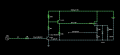
am now trying to make the attached circuit work.

i think i may be using the FET in the wrong way, i want it to switch the 12v supply to the motor, rather then grounding the motor, simply because i would also like to insert a voltage divider, as shown, so that i can monitor the voltage drop across the motor when it is running.

this trick works fine with a mechanical relay circuit, but i think i should not be doing this, with an N type mosfet.Screenshot 2024-03-28 at 13.47.26.png
 

AnalogKid

Joined Aug 1, 2013
12,158
this trick works fine with a mechanical relay circuit, but i think i should not be doing this, with an N type mosfet.
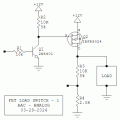
For best efficiency and least heat, correct. If you want to switch the 12 V rail into a grounded load, use a circuit called a high-side switch. Basically, you change the n-channel FET to a p-channel FET. It is connected similarly to you 2N3906 (reference designators - !). Source to +12 V, gate to the driving circuit, drain to the load, load to GND.

With this change you do not need the 2N3906 transistor. Delete it, and connect the FET gate where the base was, between the 100K and 1M resistors. Because a power MOSFET gate can withstand 20 V, you can delete the 1 M resistor also. Now the gate is connected to the 2N3904 collector directly.

Also, I would decrease the 2N3904 base resistor to 10K. Unnecessarily high impedances invite noise to cause unintended actions.

UPDATE: Schematic. I am not recommending you change any part numbers. These are transistors in my design library that are good enough to illustrate the concept.

ak
!!FET-Load-Switch-1-c.gif
 
Last edited:
Top