Facebook
 Google
 GitHub
 Linkedin
Linked is another thread asking a question about negative ion generators. I don't want to hijack that thread so I'm starting my own.
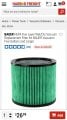
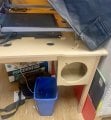
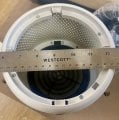
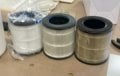
I run a wood burning laser engraver, low power (7.5 watt LED laser). It produces smoke. The work station consists of a table top with holes. Covering the table top is a lift off cover. When I lift it off it's full of smoke. Hence, the purpose of the holes. I've set up a filter to draw down and capture the smoke but it depends on filters which are not washable or reusable. So it will be going through a lot of filters.
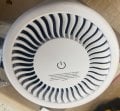
In the linked thread the question is raised about negative ion generators. So I've been looking for something superior to the setup I now have going. Money is not a major concern but I don't want to spend thousands of dollars. So what little I know about ionizers is that they can remove smoke from the air. Yes, they do make the smoke stick to the plates but the plates can be cleaned. That is to say it's not a one time use and throwaway item.
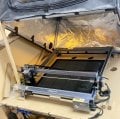
So there's this set of stainless steel plates approximately 2 1/2 inches wide (63.5mm), 18 gauge by 24 inches (609.6mm) long; 18 plates. I've found a few ion generator modules on line but they have five spikes (pointed tips are important for ion emission into the air stream). I'm thinking about building my own generator. With such a large surface for smoke capture, I'm dubious about the idea that a small ion generator would have enough power to make such a large set of plates effective in absorbing the smoke prior to exiting the chamber.
Among the considerations is use of a MOT (Microwave Oven Transformer) with the HV coil intact (1KVAC). Then use the HV diode to rectify the charge. But the 18 plates are spaced approximately (from memory) 4mm apart. Unless all plates are wired in common I could be building a potentially deadly high voltage capacitor. So don't think I'm being reckless in this endeavor. I haven't put anything together yet other than the plates which were once used to investigate HHO generators. No, we're not going into HHO generators, this is a leftover from that endeavor. But I think it might be possible to use the plates as smoke arrestors in a two foot ABS tube.
So does anyone know anything about a good ion generator module? Or perhaps on the construction of my own ion generator - without killing myself!
I run a wood burning laser engraver, low power (7.5 watt LED laser). It produces smoke. The work station consists of a table top with holes. Covering the table top is a lift off cover. When I lift it off it's full of smoke. Hence, the purpose of the holes. I've set up a filter to draw down and capture the smoke but it depends on filters which are not washable or reusable. So it will be going through a lot of filters.
In the linked thread the question is raised about negative ion generators. So I've been looking for something superior to the setup I now have going. Money is not a major concern but I don't want to spend thousands of dollars. So what little I know about ionizers is that they can remove smoke from the air. Yes, they do make the smoke stick to the plates but the plates can be cleaned. That is to say it's not a one time use and throwaway item.
So there's this set of stainless steel plates approximately 2 1/2 inches wide (63.5mm), 18 gauge by 24 inches (609.6mm) long; 18 plates. I've found a few ion generator modules on line but they have five spikes (pointed tips are important for ion emission into the air stream). I'm thinking about building my own generator. With such a large surface for smoke capture, I'm dubious about the idea that a small ion generator would have enough power to make such a large set of plates effective in absorbing the smoke prior to exiting the chamber.
Among the considerations is use of a MOT (Microwave Oven Transformer) with the HV coil intact (1KVAC). Then use the HV diode to rectify the charge. But the 18 plates are spaced approximately (from memory) 4mm apart. Unless all plates are wired in common I could be building a potentially deadly high voltage capacitor. So don't think I'm being reckless in this endeavor. I haven't put anything together yet other than the plates which were once used to investigate HHO generators. No, we're not going into HHO generators, this is a leftover from that endeavor. But I think it might be possible to use the plates as smoke arrestors in a two foot ABS tube.
So does anyone know anything about a good ion generator module? Or perhaps on the construction of my own ion generator - without killing myself!