I only report spam.Let’s don’t feed the troll. Report them instead.
I'd rather call out stupidity than pretend it doesn't exist.
I only report spam.Let’s don’t feed the troll. Report them instead.
One thing that caught my attention was how they were originally bound for Clark in the Philippines, but she was so sea sick on the voyage that his commanding officer suggested that she disembark at Pearl and then had his orders changed so that he could remain with her. This was an example of something that I saw several times while I was on active duty. The military has a reputation for creating family hardships because the mission comes first. This is pretty much the nature of the beast. But, what few people ever realize, is that it is not uncommon for commanders to go out of their way to minimize those hardships when they can when they are harder than the norm. One of my coworkers (in the Air Force) was married to a gal in the Navy. Both services made efforts to post them to places where they could both be stationed together. It wasn't always possible, but he figured that they probably spent more time together that many service members did as a result of unaccompanied tours of duty. Other instances included members that had family members, usually parents, that were struggling (health, aging, etc) and the member requested a transfer to the nearest base to assist. Every such request that I was aware of was granted, even in the case of one person that had just reported to their current base about a month earlier.
There's some misleading stuff in that article.From a LinkedIn post:
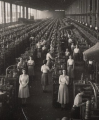
In 1944, a factory outside Detroit was doing something that seemed physically impossible—rolling a completed four-engine bomber off the assembly line every 63 minutes, 24 hours a day.
The Willow Run plant stretched over 3.5 million square feet—so vast that supervisors used bicycles to get from one end to the other. When Ford Motor Company agreed to build B-24 Liberators here, skeptics said it couldn't be done. These weren't cars. Each bomber required 1.2 million parts, 360,000 rivets, and precision that could mean life or death for the ten-man crews who would fly them into combat over Europe and the Pacific.
Henry Ford's engineers looked at the challenge and saw something others missed: if you could mass-produce a car, why not an airplane? They designed the world's longest assembly line and reimagined aircraft manufacturing from the ground up. Parts moved on conveyor belts. Subassemblies came together with automotive efficiency. What had taken scattered aviation companies weeks to build, Willow Run aimed to complete in hours.
The numbers tell an almost unbelievable story. By the time production hit its stride in 1944, Willow Run was producing one complete B-24 Liberator every 63 minutes. Workers attached 58,000 pounds of metal, wiring, engines, and armaments into a flying machine faster than most people today could assemble furniture. Over three years, nearly 8,700 bombers rolled out of that single factory—accounting for half of all B-24s built during the entire war.
But here's what the statistics can't fully capture: who built them.
At its peak, Willow Run employed over 40,000 workers. A third of them were women. Many had never touched a rivet gun before Pearl Harbor. They came from farms and kitchens, from small towns across Michigan and beyond, drawn by patriotic duty and paychecks that offered independence they'd never known. With bandanas holding back their hair and coveralls replacing dresses, they climbed into bomber fuselages, operated massive machinery, and proved that "women's work" was whatever work needed doing.
These were the real Rosies. Not a poster or a symbol, but actual women named Violet, Rose, and Eleanor who welded, drilled, and assembled with the same skill as any man. They worked swing shifts and graveyard shifts. They learned trades in weeks that typically took years. And they did it knowing that every rivet they placed, every wire they connected, might save the life of someone's son flying missions over Germany.
The factory operated around the clock. Three shifts kept the assembly line moving through day and night. When workers clocked out, others clocked in, and the work never stopped. The sound of riveting echoed constantly—a mechanical heartbeat that never paused, never rested, never quit until victory was won.
Thanks for the clarification. It makes me wonder how tight a relationship production and maintenance have. Although in practice they're two entirely different things.In essence, they trained alongside the exact planes they were going to leave with and head for deployment.
Very different things. The training wasn't done on the production line -- I didn't mean to imply that. There were separate training facilities on site. I don't know that maintenance folks actually mated up with the birds they would be maintaining -- they probably just shipped out to their units. But most of the aircrews (or at least the key positions, I don't know about gunners and such) were mated up with a plane coming off the assembly line and flew it to its first assignment -- this solve the problem of how do we get planes delivered by ferry pilots who we then have to get back to the plant. Then final aircrew acted as the ferry crew and simply stayed with the plane. Now, whether they then got shifted to the oldest hunk in the squadron while "their" plane was given to the ranking pilots is a different story altogether.Thanks for the clarification. It makes me wonder how tight a relationship production and maintenance have. Although in practice they're two entirely different things.
| Thread starter | Similar threads | Forum | Replies | Date |
|---|---|---|---|---|
|
|
Tales from the grill... | Off-Topic | 1298 | |
|
|
Tall Tales | Off-Topic | 4 |
| Similar threads |
|---|
| Tales from the grill... |
| Tall Tales |