Would this LED series design work?

Thread Starter

pr4veen

Joined Oct 21, 2024
12
Hellow,

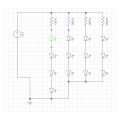
I sell small wooden decors and one customer has requested that I fit one of my products with LED's to make it into a lamp. I like the idea and want to give it a try. However, I have no idea how any of these work. I have figured I would need 13nos 5mm DIP yellow LEDs. This has to be connected to a 220V AC power supply. So from my research I've come up with the below design for connecting my LED's.

Once I've completed connecting my LED's as shown in the diagram. I would connect it to a female DC jack mounted on my wooden product. Then I'll be using a 12V 2A DC power supply adaptor to connect my product to the 220V AC power supply.

An alternate idea that I have is to connect the final LED circuit to a 12V 2A LED strip power supply and connect that directly to the 22V AC power supply.

Since I'm selling this to a customer, I would like to use the most efficient method to power these LED's so that they last longer.

Please let me know, if any of my ideas would work and which is a better option or whether there are better options than what I have mentioned here.

The yellow LED's have a

Vf = 2.1V
If = 30mA

Thank you so much


circuit (1).png
 

Jerry-Hat-Trick

Joined Aug 31, 2022
822
Firstly, I'd strongly recommend using the 12V DC power supply. Far too dangerous to connect directly to the 220V AC supply.

The proposed 200R resistor in series with 3 LEDs and the 120R resistor in series with the 4 LEDs will be pushing the LEDs close to 30mA - you may want to drop the current a bit (with bigger value resistors) to give the LEDs a longer life. 1/4 watt resistors should be fine.
 

MrChips

Joined Oct 2, 2009
34,809
You are on the right track.
Get an inexpensive 12-15 VDC wall adapter.
Your circuit looks fine. Adjust the values of the resistors for adequate LED brightness.
 

Tonyr1084

Joined Sep 24, 2015
9,744
Schematic is sound. But like Jerry-Hat-Trick said, 30mA is pushing it. And if they're superbright LED's they'll be blindingly bright. With SB LED's 10mA is plenty bright. Even 5mA is going to be satisfactory in many cases.
 

Thread Starter

pr4veen

Joined Oct 21, 2024
12
Firstly, I'd strongly recommend using the 12V DC power supply. Far too dangerous to connect directly to the 220V AC supply.

The proposed 200R resistor in series with 3 LEDs and the 120R resistor in series with the 4 LEDs will be pushing the LEDs close to 30mA - you may want to drop the current a bit (with bigger value resistors) to give the LEDs a longer life. 1/4 watt resistors should be fine.
Thank you. I was planning on using either the 12V DC power supply or the 12V LED strip driver.

If I use a 130R resistor along with the 4LEDs the current comes down to 27mA. Would that be ok or should I go lower then that? I'll replace the 200R resistors accordingly.

Thank you for confirming the use of the 1/4 watt resistor :)
 
Last edited:

Thread Starter

pr4veen

Joined Oct 21, 2024
12
Schematic is sound. But like Jerry-Hat-Trick said, 30mA is pushing it. And if they're superbright LED's they'll be blindingly bright. With SB LED's 10mA is plenty bright. Even 5mA is going to be satisfactory in many cases.
Thank you. According to the LED specifications the forward current is 30mA. So reducing the current to 5mA, only affects the LEDs brightness and it would not negatively affect the LED in any other way?


I'm guessing the right way to go about it would be to buy a few resistors that would bring the current lower and test the LEDs for the right brightness.
 

WBahn

Joined Mar 31, 2012
32,824
I'm assuming that the choice of thirteen LEDs is driven by the physical design of the lamp?

A few things to consider -- and which may or may not be relevant in your case.

Your overhead voltage of about 4 V to 6 V should give you pretty good current regulation. You could reduce the power consumption a bit by going to two strings of four and one string of five. The current regulation on the string of five would suffer, though. But I suspect that power efficiency isn't much of a concern here.

Going off the last point, you could consider using a 5 V supply (lots of those around and they are dirt cheap given the ubiquity of USB) and have thirteen individual LEDs, each with its own resistor. Even at 30 mA, that less than 400 mA and only 2 W of power. You will likely find that 15 mA to 20 mA is more than sufficient (and will lead to much longer LED life). An added benefit is that if one LED fails as an open (which is how they usually fail), then only that LED goes dark, as opposed to the entire string of three or four.

With one string having four LEDs and the other strings having three LEDs, there will be a difference in output between the LEDs as the input voltage changes. Humans are pretty insensitive to changes in isolated LED output, meaning that if you show me an LED with 10 mA flowing in it and than I leave and come back and it has 15 mA flowing in it, I might be hard pressed to tell you which was which. But if two LEDs are next to each other, the difference between them catches our attention at a much smaller difference.

Even with the same current flowing in all of them, variations from LED to LED could result in differences that are noticeable when they are all together, especially if the person is able to look at them directly. The goal, of course, is to have them close enough that one being brighter or dimmer than the rest doesn't draw attention to it. If you use separate resistors for each LED, this gives you the option (which you may not end up needing) of tweaking the resistor values so that the brightness appears nice and uniform to the human eye. Depending on the object, this might actually require less light from some and more light from others to account for the angles they are mounted at and the nature of the object in the vicinity of each LED.
 

be80be

Joined Jul 5, 2008
2,395
200 ohm on the 4 leds 300 ohm on 3 leds

from LED Series Resistor Calculator on DigiKey site lots of good stuff there
 

djsfantasi

Joined Apr 11, 2010
9,237
According to the LED specifications the forward current is 30mA
That specification refers to the maximum current the LEDs can operate at. If you calculate for that current, variations in resistor values could end up pushing more current through than it’s rated maximum reducing LED life. As others have suggested, design for 5, 15, or 20mA.
 

MisterBill2

Joined Jan 23, 2018
27,510
Driving the LED at that published maximum current is a lot like driving your car with the tach at red-line: OK if you are drag racing to win, otherwise a less optimum choice.
For a lamp that is intended to last quite a while, a tradeoff in efficiency is probably OK, which would be to have a separate resistor for each LED and running them all in parallel off of a 5 volt supply. The benefits are first, that you can trust that supply to be either 5.0 volts or 5.3 volts, adequately regulated, and second that an open-failure of a single LED will only be that one LED out. It will also allow easier different LED color selections, if that is desired.
 

Tonyr1084

Joined Sep 24, 2015
9,744
According to the LED specifications the forward current is 30mA. So reducing the current to 5mA, only affects the LEDs brightness and it would not negatively affect the LED in any other way?
That specification refers to the maximum current the LEDs can operate at.
Was going to say the same thing; 30mA is the MAX it's designed for. Like @MisterBill2 said, it's like driving your car constantly at full throttle. You don't want to do that.

One thing that may or may not be important is temperature. LED's are current operated devices. More current means more brightness. It also means more heat. And heat can lower the forward voltage. As that is reduced they may see more current. Hence, what might start out as 30mA can quickly become 32mA, 35mA, 40mA and then darkness ensues. And as someone said, if one in a string goes out - the entire string, that string only, goes out. Running at lower current ratings promotes less heat and longer life. That someone else mentioned as well. As to exactly what current you want to run at depends on how and where you're going to use this setup. If you're using it in a brightly lit area then you'll want to favor the higher end of the current. But in a darkened room lower current is the ticket.
 

atferrari

Joined Jan 6, 2004
5,011
A practical suggestion: do not exaggerate with brightness. In few days your customer could find it annoying.
Check where it would be located and how dark the location is in night time.
 
Top