Wireless Remote of an AC Motor

Thread Starter

VetteGS1

Joined Oct 16, 2018
18
I was wondering if I could get some help for a home project. I’m building a dumb waiter, for lack of a better term, that will be used to haul items from my garage floor up to the attic space above my garage.

I plan on modifying a winch motor running on 110V that will be used to do the heavy lifting. I wanted to set it up with a wireless remote switch to raise and lower the steel cable. I know basic home electrical wiring, but I’m a complete novice when it comes to setting up wireless control of an AC device.

I was looking for any help or direction on something like this.

I'll be happy to elaborate further if more information is needed about the winch or the project.
 

Reloadron

Joined Jan 15, 2015
7,893
I plan on modifying a winch motor running on 110V that will be used to do the heavy lifting.
A simple winch motor will normally have an attached pendant with a few normally open push button switches which are interlocked so you can't push for example an Up and Down button at the same time. I would just get a few DPDT relays and wire them through each other so only one can operate at a time. That's one set of contacts. The remaining normally open contacts are in parallel with the Up and Down buttons on the pendant. As a remote I would just find an inexpensive remote relay board, something like this, and use that to drive your control relays.

Well defined only comes when the actual winch name plate data and circuit is known so my suggestion is overall generic. The initial relays I mentioned may not even be necessary.

Ron
 
Last edited:

Thread Starter

VetteGS1

Joined Oct 16, 2018
18
I was thinking of a garage remote too. But the problem I’m facing, along with a wireless remote solution, is how to stop the winch when it reaches the top and bottom of it’s travel. The winch I’m going to use has one spool with steel cable and a hook at the end for lifting objects. I’m fabricating a flat platform to carry up multiple items, a type of dumb waiter if you will. It will measure 24” x 46” and will have two attachment points for two cables. I’ve got the mechanical portion figured out. I know garage door mechanisms have limit switches at the start and end of their travel on the garage door tracks. I’m not sure how I can achieve the same travel limit on something with free hanging cable.

Ron, thanks for your remote suggestion. I'll look into it.

Currently, to limit the cable’s upward travel once the end of the cable reaches the winch. There’s a round rubber disk about 3” in diameter with a hole in the center that attaches to the cable about 2-3” above the hook. As the cable gets taken up by the winch’s spool, the rubber disk contacts a lever on the winch which then pushes a button on a black box attached to the winch motor. Think of a toilet bowl float level and that’s pretty much the concept of the mechanism that limits travel going up. It stops the motor even it the UP button is still being pushed. I would like this same solution when the cable is paid out.

If there is no downward limit mechanism, I suppose I can take my finger off the down button once the dumb waiter reaches the bottom of it’s travel. But I don’t think my wife will be as conscious and I fear the cable will unravel from the spools and get tangled.

I put in a link to a video showing what I intend to build. At 15 seconds in, you can see a full picture of the dumb waiter. At 1:27 in is the winch motor used. You'll see the chrome rectangular steel on the left, that's the limit switch, which doesn't look like it's being used in this configuration. If you look at the two take up spools, you can see how the cable can come off the spools if the motor were to keep running after the dumb waiter reaches the garage floor.

So I guess I have two problems, figure out a wireless remote

Figure out a way to limit upward and downward cable travel.

- Robert
 
Last edited:

Thread Starter

VetteGS1

Joined Oct 16, 2018
18
Ron, I looked at your remote suggestion. Again, I'm not too familiar with this kind of stuff, so excuse my ignorance. I see the part that the motor would plug into is DC. Since the wench motor is AC would this work for my situation?
 

Reloadron

Joined Jan 15, 2015
7,893
Ron, I looked at your remote suggestion. Again, I'm not too familiar with this kind of stuff, so excuse my ignorance. I see the part that the motor would plug into is DC. Since the wench motor is AC would this work for my situation?
No problem at all. The idea being that using a winch system the winch normally has a hand held pendant with buttons be they labeled in/out or up/down these are generally N/O (Normally Open) simple push buttons. The buttons control the rotational rotation of a motor. In my example for a remote the buttons would have a set of relay contacts across them on the remote receiver. The relay contacts merely duplicate the button push.

Now, having seen the example using a garage door system I like that. The upper limit switch is not a problem but the lower limit switch will take some thought. The up and down would need worked out for the remote but the video clip was pretty good. Certainly worth consideration.

Ron
 

Thread Starter

VetteGS1

Joined Oct 16, 2018
18
Today I purchased all the steel I’m going to use to fabricate the carrier for my attic storage system. I’ve got the construction of the dumb waiter and the mechanism to haul it up to the attic pretty much figured out. I’m trying to get my head around on how the electrical switching I want will work on the winch I bought. I want to convert from wired remote to wireless remote control.

I’ve thought of another possible way to control the winch raise/lower electronics. Currently, the winch does have a mechanical method to trip a micro switch that stops upward travel once the cable hook reaches the winch motor. I don’t yet have a solution on how to stop travel when the cable pays out to the garage floor. I read about a type of generic logic board called an Adruino. From what I’ve read, it can receive inputs and act on them to trigger other events. I don’t know much about Adruino, but from what I read, its relatively easy to program. I’d appreciate any advice or opinions about using an Adruino board for this type of application. I work on cars quite a bit, not as a profession, and know that as long as there is a sensor to tell the computer a pre-determined event has happened, the car’s computer uses that information to perform other events.

I was hoping to use an Adruino board to make use of the following logic. There are so many revolutions the motor shaft must turn for the cable to reach the garage floor. If the revolutions can be counted, then the winch’s motor can be told to when to stop. The stop function also prevents the shaft from turning even if the operator(wife) continues pressing the down button. The same logic would apply going up. I know it will require some kind of timing/pulse wheel. But I see it as similar to a timing wheel used at the end of a crankshaft to let the engine’s ECU know crank position.

In order to go forward, I need to understand the current winch’s wiring. I was hoping some of you could chime in and help me figure out how the current wiring.

I’ve opened up the motor control switch box and the wired remote and taken pictures of each. I’ve labeled everything as clearly as I can to identify the wiring. I hope you guys can help me make since of it.

OVERALL VIEW
This is the motor upside down on my workbench. The part sitting on the bench gets bolted to the ceiling. The chrome rectangle on the left of the photo is what trips the micro switch to stop upward travel. This completely stops the motor even if the operator is still pushing the up position of the rocker switch.
https://drive.google.com/open?id=1CFB5jEwwcTESi8WQrkIRfqmfa_2U2ugJ

MOTOR WIRING UP CLOSE
NOTES
· Wires B1 & D1 go down into the motor
· On the lower left, you can see how the micro switch is triggered.
https://drive.google.com/open?id=1fxhm5ijZEbiB2sFVFrj5nHmq4vR0__D3

Close up of micro switch
https://drive.google.com/open?id=1k1yS1yUjWFEFHl0h3strvj-q_SIi6IKG

Remote
?What is the purpose of that capacitor in the remote handle?
https://drive.google.com/open?id=1k1310yPumm8FSop22i1cNPpQzzObVBi5
https://drive.google.com/open?id=1uLkjO75laoGTGxe19kbTnbr_oDja3jZ9

Close-up of the capacitor
https://drive.google.com/open?id=1fJY3PT1O2uVqywc6ss-BYbAlOpl45hrE

Remote’s wiring close-up
https://drive.google.com/open?id=1Fyggiwj0i2jYHk7uz2wpiwuR4YERnCK0
 

LesJones

Joined Jan 8, 2017
4,509
For the low limit I suggest connecting a reduction gearbox to the winch output shaft. The gearbox ratio should be such that it's output shaft does a little less than than one revolution for the full travel of the cable. You would put a disk on the output shaft with a notch in it. A micro switch would be mounted so it's operating lever drops into the notch when the end of the winch cable reaches the floor. The contact (Closed when to notch was not next to the microswitch lever.) on the microswitch would be connected in series with the down button on the winch.
The counting pulses method could be made to work but it could loose track of the position if the power was removed. You could get round this problem by writing the pulse count to an EEPROM and then making the microcontroller read the value from the EEPROM when it was powered up.
Les.
 

Thread Starter

VetteGS1

Joined Oct 16, 2018
18
I have another update. I missed an additional wire that goes into the motor. Wires B1, C1, and D1 are all going into the motor.

Assuming that gray item in the remote handle is in fact a capacitor, why is it needed?
 

LesJones

Joined Jan 8, 2017
4,509
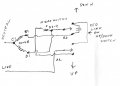
This is how I think the motor is wired.
281018.jpg

I think breaking the red link between the top right and bottom right terminals on the rocker switch in the hand unit will stop the motor running in the down direction. I will have to think about how to stop the down direction at the motor end of the cable. (To break the red link at the motor end of the cable would require an extra conductor in the cable.)

Les.
 

Thread Starter

VetteGS1

Joined Oct 16, 2018
18
Hi LesJones,
Going with your wiring descripion on how to stop the motor going in the down direction. When you mention "extra conductor" are you refering to putting in another microswitch to stop down direction? If so, I can get a micro switch and try the connection your mentioned. I'll figure a machanical way to trip the microswitch.

Another question on the wiring. Maxheadroom states the capacitor is for reversing the capacitor/winding switch on the motor or something to that affect. Would this be a concern going down? Or does either direction make use of that one capacitor?
 

MaxHeadRoom

Joined Jul 18, 2013
30,699
Another question on the wiring. Maxheadroom states the capacitor is for reversing the capacitor/winding switch on the motor or something to that affect. Would this be a concern going down? Or does either direction make use of that one capacitor?
The same capacitor is used for both directions, just the alternate winding is used to change direction.
Max.
 

LesJones

Joined Jan 8, 2017
4,509
The down direction could be disabled with either a microswitch contact or a relay contact. (Which one you use is dependent on the method used to detect the down limit position.) I suggest that you first confirm that breaking the red link in the hand unit by disconnecting it from the bottom right hand terminal on the rocker switch prevents the motor from running in the down direction. If this works then it suggests that I have worked out the schematic correctly. To break that connection at the motor end would require an extra conductor in the cable to the hand unit. A simpler solution would be to move the capacitor to near the motor. Doing this would remove the need for an extra conductor in the cable. I think the method I suggested in post #9 using a gearbox and cam would be the simplest method of detecting the down limit. If you decide to use the pulse counting method I can give you details of a unit I built to open and close a roller blind by counting pulses (It is a single pulse detector used in conjunction with the motor drive direction to avoid the use of a quadrature encoder.) It uses a PIC16C84 (As it was built many years ago.) but could be modified to use a more modern PIC.

Les.
 

LesJones

Joined Jan 8, 2017
4,509
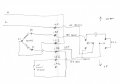
After looking at the wiring again I realise that the drawing I posted in post #12 is wrong. I will have to redraw it. This also means the that breaking the red link on the right hand side of the rocker switch will not disable the up down direction. sorry about these errors.

Les.
 

Thread Starter

VetteGS1

Joined Oct 16, 2018
18
I started work in the attic. But I'm still not ready to set up the winch motor so I have some time before I get to the motor. But I have more questions about wireless remote control and a down limit switch.
Les, thanks for the revised drawing of the wiring. I want to put a down limiting micro switch. Based on your drawing, I think I figured out where I would put in a NC micro switch. Take a look at the picture and let me know if it's looks right
https://drive.google.com/file/d/1Nhl0ijpHYZnuagYAC_xbFjUwn_HxYwHb/view?usp=sharing

I have a question about the wireless remote. ReloadRon suggested this one. I don't know enough about his, so excuse my ignorance. Wouldn't this type of remote only work on a DC motor?
https://www.amazon.com/dp/B01CCSG2Z...olid=1IOSV9ZJORMVE&psc=0&ref_=lv_ov_lig_dp_it

I found this other other one that says it's for 110v. Would this be the correct one to use instead, or is the first one ok to use?
https://www.amazon.com/dp/B074P7J37...olid=1IOSV9ZJORMVE&psc=0&ref_=lv_ov_lig_dp_it


Thread Starter

VetteGS1

Joined Oct 16, 2018
18
I think I missed an additional wire that might be required for the down circuit.
I noticed one of the wires(D1) coming from the motor, goes to the junction block (E) then splits off with one wire going to the micro switch (D2.1) and the other wire (D2.2) going to the up/down rocker switch.

If I splice in a micro switch for the down circuit, would I have to do something similar like on the B1 wire coming from the motor? So that another wire splits off from wire B2? If so, case I'm not sure where that B2.2 potential wire would splice into.
 
Top