Wireless power system project

Thread Starter

tpmcgovern42

Joined Mar 20, 2017
10
I'm trying to make a wireless power system based off of the schematic and parts list from this article: http://www.nutsvolts.com/magazine/article/august2013_Bates

I'm trying to build the transmitter.

I'm having trouble gettting a voltage of 12V AC at test point E in this schematic:


I have made a change to the circuit. Instead of the picaxe (IC1) I used a 555 timer with a frequency of 11,828 and a duty cycle of 54% (on paper at least, I don't have an oscilloscope). The frequency is supposed to be 12k with duty cycle of 50% but I think this is close enough.

Anyways, I'm getting a voltage of 5.08V at test point B, 2.23V at test point A. The values are supposed to be 5V and 2.5V but I think 2.23V is close enough because it's connected to the MOSFET with a Vth of 2 - 4V. However I'm only getting an AC voltage of 3.4V at test point E. I can't figure out what I'm doing wrong. Also, the MOSFET is getting pretty hot when I plug it in, so I try not to leave it plugged in for long.

Does anybody have any ideas of what I could be doing wrong? I can post pictures of the setup on my breadboard if that helps.
 

AlbertHall

Joined Jun 4, 2014
12,625
Did you make the coils exactly as described in the article?

The '555 output will not go right up to its positive supply voltage so there may not be enough voltage to fully turn on the MOSFET, You may need to use one with a lower threshold voltage or run the '555 from 12V rather than 5V (assuming the maximum gate-source voltage is at least 12V).
 

Thread Starter

tpmcgovern42

Joined Mar 20, 2017
10
Did you make the coils exactly as described in the article?

The '555 output will not go right up to its positive supply voltage so there may not be enough voltage to fully turn on the MOSFET, You may need to use one with a lower threshold voltage or run the '555 from 12V rather than 5V (assuming the maximum gate-source voltage is at least 12V).
I'm new to transistors so bare with me.

I made the coil very similar to the way it was done in the article. The only difference is that is used square cutouts of a plastic clipboard instead of acrylic boards.

What do you mean the 555 output will not go right up to its positive supply voltage? could you elaborate?

I'm having a little trouble understanding this part: The voltage threshold (gate to source voltage) for the mosfet is 2-4 volts and the 555 timer is putting out pulses of 5V which would be measured as 2.5 volts with a dc voltmeter. Since it's sending pulses of 5 volts, will that not damage the mosfet since the voltage threshold is 2-4 volts?

Also, my power supply is 12V @ 1amp

edit: here's the data sheet if you want to take a look: https://www.fairchildsemi.com/datasheets/FD/FDH055N15A.pdf
 
Last edited:

AlbertHall

Joined Jun 4, 2014
12,625
What do you mean the 555 output will not go right up to its positive supply voltage? could you elaborate?
You don't say exactly which version of the '555 you are using but for all of them, when the output is high it will be a volt or two below the supply voltage. With a 5V supply this means that the output voltage will be between, say, 3.5V and 4.5V.
edit: here's the data sheet if you want to take a look: https://www.fairchildsemi.com/datasheets/FD/FDH055N15A.pdf
This MOSFET has a maximum gate-source voltage of 20V so it would be perfectly happy with a 12V gate signal. The '555 will run happily on 12V. This would provide about 10V drive signal to the MOSFET which would ensure that it is fully turned on ensuring the full supply voltage is applied to the transformer and also keeping the power dissipation in the MOSFET to a minimum and keeping its temperature lower.
 

Thread Starter

tpmcgovern42

Joined Mar 20, 2017
10
You don't say exactly which version of the '555 you are using but for all of them, when the output is high it will be a volt or two below the supply voltage. With a 5V supply this means that the output voltage will be between, say, 3.5V and 4.5V.

This MOSFET has a maximum gate-source voltage of 20V so it would be perfectly happy with a 12V gate signal. The '555 will run happily on 12V. This would provide about 10V drive signal to the MOSFET which would ensure that it is fully turned on ensuring the full supply voltage is applied to the transformer and also keeping the power dissipation in the MOSFET to a minimum and keeping its temperature lower.
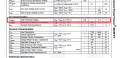
I'm not sure about which 555 timer it is. I'll check later. I must be confused about the gate to source voltage. I thought it was between two and four. What does this number from the datasheet mean? I've attached a picture of it.
 

Attachments

AlbertHall

Joined Jun 4, 2014
12,625
It is the voltage at which the MOSFET just begins to conduct. You can see in that line of the datasheet it says Vgs=Vds and Id=250uA and that is the expected drain current with the drain at the same voltage as the gate. So if you want something more like 1A with a very low drain voltage you need a higher gate voltage. In the very next line of the datasheet it shows ON resistance and that is specified with Vgs at 10V.
 

Alec_t

Joined Sep 17, 2013
15,117
What does this number from the datasheet mean?
Vgs(th) is the minimum voltage to start turning the FET on (with only 250uA drain current according to the datasheet). FETs vary a lot from one sample to another, and Vgs(th) could be as much as 4V according to the spec. You should design for the worst case. To turn the FET on fully you would need Vgs to be about 10V generally (but less if the FET is a 'logic level' type).

Edit: Albert beat me to it :)
 

Thread Starter

tpmcgovern42

Joined Mar 20, 2017
10
It is the voltage at which the MOSFET just begins to conduct. You can see in that line of the datasheet it says Vgs=Vds and Id=250uA and that is the expected drain current with the drain at the same voltage as the gate. So if you want something more like 1A with a very low drain voltage you need a higher gate voltage. In the very next line of the datasheet it shows ON resistance and that is specified with Vgs at 10V.
That makes complete sense. You have been very informative. I also didn't realize the 555 timer put out a couple volts less than it's input.

could you go into a little more detail on why the MOSFET gets so hot at a lower current? You said the power dissipation is lower with higher voltage. I thought the higher the voltage and current, the higher the power (P=V*I).
 

Thread Starter

tpmcgovern42

Joined Mar 20, 2017
10
Vgs(th) is the minimum voltage to start turning the FET on (with only 250uA drain current according to the datasheet). FETs vary a lot from one sample to another, and Vgs(th) could be as much as 4V according to the spec. You should design for the worst case. To turn the FET on fully you would need Vgs to be about 10V generally (but less if the FET is a 'logic level' type).

Edit: Albert beat me to it :)
So the original schematic says it measures 2.5V DC at test point A. I'm assuming that would be because it's a square wave function of 5 volts with 50% duty cycle. (0.5*5=2.5), but it still works because it is still hitting 5 volts (which is greater than 4) . Is this correct?
 

AlbertHall

Joined Jun 4, 2014
12,625
could you go into a little more detail on why the MOSFET gets so hot at a lower current? You said the power dissipation is lower with higher voltage. I thought the higher the voltage and current, the higher the power (P=V*I).
The higher the gate voltage, the lower the resistance between drain and source. The lower the resistance between drain and source the lower the power dissipation in the MOSFET (given the same drain current).
 

Alec_t

Joined Sep 17, 2013
15,117
it still works because it is still hitting 5 volts (which is greater than 4) . Is this correct?
It depends how you define "works". What the datasheet tells you is that at 4V you should get at least 250uA drain current. At 5V (which you won't get from the output of a standard 555 if you draw enough current to switch the FET on rapidly) you would expect a bit more than 250uA. But to drive your transformer you will need a LOT more than 250uA if you want to transfer significant power through it.
 
Top