OK, here is another instance of discomfort from the magnetic pulses. In my case there was no claustrophobic issue as I was quite interested in the mechanism of the operation, plus I don't do fear. So evidently really intense magnetic fields can affect the iron in our blood, at least for some folks and probably certain conditions. I was still very sore from a violent physical trauma, KISS was suffering from some sort of spinal issue, and so it might not feel the same to everybody. My whole point being that there is a magnetic effect even if it is not noticed.I had a few MRI's done recently. One came with horrific pain. They sent me home to try again. I pre-medicated with stuff I already had and designed the doses to peak at the time of the MRI. I also asked the tech to restrain my arm. It still hurt, but not as much. They were imaging the cervical spine and my arm hurt with very sharp pain. The non-oral med I used was a Lidocaine patch and some other oral Rx meds.
If you close your eyes before going into the chamber, the claustrophobicness goes away. Then it usually just the noise.
It's still a 'air-cored transformer' at resonance because the energy transfer is mainly by the magnetic field while the energy capture at the load coil is enhanced by the Q of the combined system. Our bodies are 'safe' in this type of magnetic coupling because they are only weakly ferromagnetic.Two things that nobody seems to have mentioned.
First, in the Qi charging common with mobile phones etc, there is communication between the transmitter and receiver. The transmitter doesn't start sending 'serious' power until it has established comms with the receiver. If you get in the way, that won't happen, so no power! In any case, the maximum gap between Tx and Rx is normally around 5-10mm - I'm not that thin!
Second, as I understand it, high-power wireless charging relies on resonant charging rather than the 'air-cored transformer' principle. This requires the receiving apparatus to be resonant with the transmitter - which a human body is unlikely to be. I suspect that this is how wireless charging of electric vehicles is likely to be done. Again, there is communication between sender and receiver, so just walking over a charging pad won't produce any result.
Thus I don't believe there is any problem in either case.
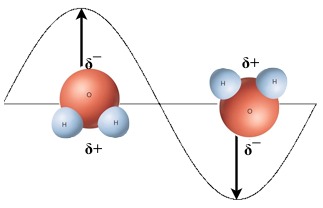
Actually it is. The microwave frequency is chosen to excite a specific vibrational mode in water molecules. This is why the containers are not heated except secondarily to the food in them.That food in the Microwave is not resonant
That's not true. It's a dielectric heating effect on molecules that can be polarized (dipole rotation).Actually it is. The microwave frequency is chosen to excite a specfic vibrational mode in water molcules. This is why the containers are not heated except secondarily to the food in them.
Bob
That's a very good book.The book Electromagnetics Explained, by Ron Schmitt states:
There is a popular myth that explains microwave ovens as operating at a special resonance of water molecules. In reality, this myth is just that, a myth. Referring to the Figure 15.2, you can see that there is no resonance of water at this frequency. The first resonant peak occurs above 1THz, and the highest loss occurs well into the infrared. There is no special significance of 2.45 GHz, except that it is allocated by the FCC as being allowable for microwave oven usage.
It's very common because it seems to be correct at first glance as the water dipole follows the electric field in some fashion.Okay. Must be a common myth I fell prey to since he took the effort to bust it.
Bob
Tough engineering problems related to the laws of physics. My guess is that it ran too hot because of poor transfer efficiency with three randomly placed devices.One and a half years after announcing a wireless charging mat for iPhones, Apple Watches, and AirPods called AirPower, Apple has unexpectedly canceled the accessory.
...
Behind-the-scenes scuttlebutt hinted that the release was delayed due to various charging issues, including Apple Watch-specific challenges and potentially long-term reliability of the entire charging system. Twenty-two separate charging coils were intended to be used in the system to facilitate “anywhere” placement of devices, increasing the potential for overheating.
This is why they ask you about metals in your body with an MRI machine.... !)I have a question about wireless charging. I know that wireless charging works by sending power through em waves, which cant be converted by the human body enough to feel any kind of shock, but what about if high power wireless charging were to become a thing? Would standing between the pathway of the charger and reciever of a high power wireless circuit send a lethal portion the electricity through you if the power were high enough? Or would the amount of power from the circuit being converted by the human body never become dangerous enough no matter how much power was being transferred wirelessly to the receiving end?
| Thread starter | Similar threads | Forum | Replies | Date |
|---|---|---|---|---|
| S | Charging a 4S Lipo with a wireless charger? | Homework Help | 4 | |
| Y | Wireless charging via flat and cylindrical coils | Wireless & RF Design | 26 | |
| A | Wireless charging Issue for TP4056 | General Electronics Chat | 0 | |
| K | Wireless charging | Power Electronics | 22 | |
| J | Wireless Charging - Controllers | General Electronics Chat | 12 |