Wireless charging via flat and cylindrical coils

Thread Starter

y_liosha

Joined Oct 9, 2024
9
Good day!

Has anyone had any experience developing wireless charging with a flat coil on the transmitter and a cylindrical coil on the receiver? It looks like it's working. With a gap of 1mm between the coils, I even got an efficiency of 57%. But with an increase in the gap, the efficiency drops significantly and after 5mm charging stops completely. Due to mechanical limitations, the gap between the coils in my project should be about 8-10 mm. And so, the questions. Is it really possible to get a working charger with such a gap? And what can be done to increase the power of the transmitter? At the moment, I am testing with TI chips (Qi 1.2), but I plan to switch to STWBC86 from ST. Thank you!
 

MrAl

Joined Jun 17, 2014
13,680
Good day!

Has anyone had any experience developing wireless charging with a flat coil on the transmitter and a cylindrical coil on the receiver? It looks like it's working. With a gap of 1mm between the coils, I even got an efficiency of 57%. But with an increase in the gap, the efficiency drops significantly and after 5mm charging stops completely. Due to mechanical limitations, the gap between the coils in my project should be about 8-10 mm. And so, the questions. Is it really possible to get a working charger with such a gap? And what can be done to increase the power of the transmitter? At the moment, I am testing with TI chips (Qi 1.2), but I plan to switch to STWBC86 from ST. Thank you!
Hi,

Since this looks like your first post, welcome to the forum.

The coupling between the coils is the largest factor for getting a transfer of energy from one coil to the other. Since the coupling is closely related to the distance between coils, the distance should be minimized. This distance however is on a turn by turn basis, and this cannot be easily generalized to a coil to coil distance when you are considering differing shapes for the coils. In other words, you need to consider the distance between each coil turn of the first coil to every coil of the second coil. That means if you had 10 turns on the first coil and 10 turns on the second coil, you would be considering 100 possibly different distances, where every one of those distances should be minimized. What this means for a flat coil and cylindrical coil is that the turns at the far end of the cylindrical coil will be much more distant to all the turns of the flat coil than what we would see with another flat coil instead. This is an application of geometry where you calculate all the distances for each case.
There is a name for the distances being talked about here it comes from inductor construction, but I can't remember what it is called now.

Another issue is wire resistance, so the longer the wire the higher the resistance. This weighs in with the turn to turn distances, and there would be an optimum somewhere that balances the resistance and coil dimensions for both coils, as well as coil positioning. However, you have already seen what happens when you move the second coil a small distance away from the first coil. It has a huge affect on the coupling, which changes the entire outcome. Because of that sensitivity to distance, the most important factor is that distance, and if wire resistance actually becomes a problem you may be able to increase the wire diameter.
It is also interesting that for a flat coil to flat coil, we have to also recognize that the inner-most coil of the first will be not so close to the outer-most coil of the second coil, although the inner turns will both be close as well as the outer turns, and the for the turns in between those turns will be closest to the turns right beneath them on the second coil also.

We can go through a calculation if you like and see what comes up.
 

Thread Starter

y_liosha

Joined Oct 9, 2024
9
Hi,

Since this looks like your first post, welcome to the forum.

The coupling between the coils is the largest factor for getting a transfer of energy from one coil to the other. Since the coupling is closely related to the distance between coils, the distance should be minimized. This distance however is on a turn by turn basis, and this cannot be easily generalized to a coil to coil distance when you are considering differing shapes for the coils. In other words, you need to consider the distance between each coil turn of the first coil to every coil of the second coil. That means if you had 10 turns on the first coil and 10 turns on the second coil, you would be considering 100 possibly different distances, where every one of those distances should be minimized. What this means for a flat coil and cylindrical coil is that the turns at the far end of the cylindrical coil will be much more distant to all the turns of the flat coil than what we would see with another flat coil instead. This is an application of geometry where you calculate all the distances for each case.
There is a name for the distances being talked about here it comes from inductor construction, but I can't remember what it is called now.

Another issue is wire resistance, so the longer the wire the higher the resistance. This weighs in with the turn to turn distances, and there would be an optimum somewhere that balances the resistance and coil dimensions for both coils, as well as coil positioning. However, you have already seen what happens when you move the second coil a small distance away from the first coil. It has a huge affect on the coupling, which changes the entire outcome. Because of that sensitivity to distance, the most important factor is that distance, and if wire resistance actually becomes a problem you may be able to increase the wire diameter.
It is also interesting that for a flat coil to flat coil, we have to also recognize that the inner-most coil of the first will be not so close to the outer-most coil of the second coil, although the inner turns will both be close as well as the outer turns, and the for the turns in between those turns will be closest to the turns right beneath them on the second coil also.

We can go through a calculation if you like and see what comes up.
Good day, MrAl

Yes, this is indeed my first post on this forum, so thank you for the warm welcome! I wasn't sure if anyone would be interested in this topic. I am not a good expert in the field of wireless charging. I tried to play with the resonance tank and inductance of the transmitter coil and at some point burned the eval board from ST. But as I understand from your answer, I am moving in a completely wrong direction. When you say that we can go through a calculation, what do you mean by that? And thank you so much for your help!
 

BobTPH

Joined Jun 5, 2013
11,484
What is the diameter of the coils? I am not an expert, but I believe larger diameter allows greater separation.
 

Thread Starter

y_liosha

Joined Oct 9, 2024
9
What is the diameter of the coils? I am not an expert, but I believe larger diameter allows greater separation.
Hi BobTPH,

Yes, I agree with you, the larger diameter should help improve it. But unfortunately in my project we are very limited in space and a flat ferrite coil cannot be larger than 43mm. I'm sorry I didn't mention this earlier. Right now I'm testing with a off-the-shelf ferrite and trying to make my own coil on it.
 

MrAl

Joined Jun 17, 2014
13,680
Good day, MrAl

Yes, this is indeed my first post on this forum, so thank you for the warm welcome! I wasn't sure if anyone would be interested in this topic. I am not a good expert in the field of wireless charging. I tried to play with the resonance tank and inductance of the transmitter coil and at some point burned the eval board from ST. But as I understand from your answer, I am moving in a completely wrong direction. When you say that we can go through a calculation, what do you mean by that? And thank you so much for your help!
What I meant by that calculation is we can calculate the total distance and the total squared distance between all the turns of any two coils using geometry. That would show us how one construction would fair as compared to another construction and thus give some information on the shape of the coils.

To get into it further and most succinctly, this would boil down to a mutual inductance calculation also based on the geometry of the two coils. The distance between every turn of the first coil to every turn of the second coil is considered along with some math that allows the computation of the mutual inductance. It's not an easy calculation though.

Then to get even further, each wire is considered to be made up of a huge number of very fine strands often referred to as filaments. Then the calculation involves the distances between every one of the filaments of every wire of the first coil to every one of the filaments of every wire in the second coil. This would be considered close to the ultimate calculation for the mutual inductance although going this far is probably not needed for most of these calculations because the geometry will not be ideal anyway.

The simplest case is two straight wires somewhat close to each other where we calculate the mutual inductance. The wires are considered to be straight, and current is fed in through wires that connect at 90 degree angles to the target wires so they do not contribute to the mutual inductance. This is similar to what we see with two coils with just one turn each although the geometry becomes more complicated because the wires are now circular.

Because these methods are so low level, you can also compute the mutual inductance between coils that are also at angles to each other, such as two flat coils where one is not orientated in the same plane as the first. With any of these nonsymmetrical constructions though the calculation becomes more involved.

I am not sure you want to get this deep into it, but that's the most general way to handle this kind of calculation. You are basically just calculating the mutual inductance which correlates to the degree of coupling just as with any transformer.
 

Thread Starter

y_liosha

Joined Oct 9, 2024
9
What I meant by that calculation is we can calculate the total distance and the total squared distance between all the turns of any two coils using geometry. That would show us how one construction would fair as compared to another construction and thus give some information on the shape of the coils.

To get into it further and most succinctly, this would boil down to a mutual inductance calculation also based on the geometry of the two coils. The distance between every turn of the first coil to every turn of the second coil is considered along with some math that allows the computation of the mutual inductance. It's not an easy calculation though.

Then to get even further, each wire is considered to be made up of a huge number of very fine strands often referred to as filaments. Then the calculation involves the distances between every one of the filaments of every wire of the first coil to every one of the filaments of every wire in the second coil. This would be considered close to the ultimate calculation for the mutual inductance although going this far is probably not needed for most of these calculations because the geometry will not be ideal anyway.

The simplest case is two straight wires somewhat close to each other where we calculate the mutual inductance. The wires are considered to be straight, and current is fed in through wires that connect at 90 degree angles to the target wires so they do not contribute to the mutual inductance. This is similar to what we see with two coils with just one turn each although the geometry becomes more complicated because the wires are now circular.

Because these methods are so low level, you can also compute the mutual inductance between coils that are also at angles to each other, such as two flat coils where one is not orientated in the same plane as the first. With any of these nonsymmetrical constructions though the calculation becomes more involved.

I am not sure you want to get this deep into it, but that's the most general way to handle this kind of calculation. You are basically just calculating the mutual inductance which correlates to the degree of coupling just as with any transformer.
Wow, it actually sounds very interesting! Could you please advise any books or articles where this is described in more detail, I want to visually see how the calculations go. And before we continue, what is your opinion, is it even possible to get a working prototype with good enough efficiency (+/-50%) with a combination of flat and cylindrical coils and 8-10mm gap between them? Thank you!
 

MrAl

Joined Jun 17, 2014
13,680
Wow, it actually sounds very interesting! Could you please advise any books or articles where this is described in more detail, I want to visually see how the calculations go. And before we continue, what is your opinion, is it even possible to get a working prototype with good enough efficiency (+/-50%) with a combination of flat and cylindrical coils and 8-10mm gap between them? Thank you!
Hello again,

It's hard to say what the efficiency of a construction will be without actually going through some calculations. The main factor is going to be the resistance of the wire because that dissipates energy as heat which without some sort of heat energy recovery technology will be completely wasted. This would mean a balance between wire length and wire diameter, and the limits on the size of the total construction, and possibly any forced cooling especially cryogenics. The calculation would involve how much energy is lost in the two coils which relates to the required energy input vs output just like any other transformer. There is also the chance that an iron core might help because that would focus the magnetic coupling better than just two air core coils. I haven't tried that though.

Here are some resources as drawings. Biot Savart is probably a good place to start as that should get you familiar with the relationships between the physical geometry and the math.
Attachments:
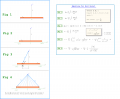
First there is Biot Savart and how it is applied to a single point away from a straight wire with a current in it.
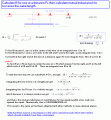
Second is a set of calculations for B at several points away from a wire. Along with that is a calculation for the mutual inductance of two wires spaced 1cm apart. The assumption is that the wire diameter is minimal and not of any significance. If the diameter is not small compared to the separation distance, then it has to be treated as set of filaments, or if the wire cross section is of a regular shape can be treated as a bundle of filaments which will have a general solution which will still allow it to be treated as one strand with the axial center possibly offset from that used in actual practice, and still without any approximation.

To find out more about this, a book you can check out is "Grover, Inductance Calculations", published by Dover. Quite a bit of information in that small book and it also has a lot of approximations to make things simpler. You will note that in the attachment with the calculation for the mutual inductance there are two integrations which makes the solution hard to calculate sometimes, and when we end up with variable distances it gets even more complicated, so we have to use numerical integrations.
I am not sure if this the same book but it's available online:
Grover, F. W. (nist.gov)
The physical book is available on Amazon for around $15 USD. It was written by Frederick W. Grover.

You're right though this is some pretty interesting stuff, and although it may not be easy sometimes it is certainly very interesting.
 

Attachments

Thread Starter

y_liosha

Joined Oct 9, 2024
9
Hello again,

It's hard to say what the efficiency of a construction will be without actually going through some calculations. The main factor is going to be the resistance of the wire because that dissipates energy as heat which without some sort of heat energy recovery technology will be completely wasted. This would mean a balance between wire length and wire diameter, and the limits on the size of the total construction, and possibly any forced cooling especially cryogenics. The calculation would involve how much energy is lost in the two coils which relates to the required energy input vs output just like any other transformer. There is also the chance that an iron core might help because that would focus the magnetic coupling better than just two air core coils. I haven't tried that though.

Here are some resources as drawings. Biot Savart is probably a good place to start as that should get you familiar with the relationships between the physical geometry and the math.
Attachments:
First there is Biot Savart and how it is applied to a single point away from a straight wire with a current in it.
Second is a set of calculations for B at several points away from a wire. Along with that is a calculation for the mutual inductance of two wires spaced 1cm apart. The assumption is that the wire diameter is minimal and not of any significance. If the diameter is not small compared to the separation distance, then it has to be treated as set of filaments, or if the wire cross section is of a regular shape can be treated as a bundle of filaments which will have a general solution which will still allow it to be treated as one strand with the axial center possibly offset from that used in actual practice, and still without any approximation.

To find out more about this, a book you can check out is "Grover, Inductance Calculations", published by Dover. Quite a bit of information in that small book and it also has a lot of approximations to make things simpler. You will note that in the attachment with the calculation for the mutual inductance there are two integrations which makes the solution hard to calculate sometimes, and when we end up with variable distances it gets even more complicated, so we have to use numerical integrations.
I am not sure if this the same book but it's available online:
Grover, F. W. (nist.gov)
The physical book is available on Amazon for around $15 USD. It was written by Frederick W. Grover.

You're right though this is some pretty interesting stuff, and although it may not be easy sometimes it is certainly very interesting.
Thank you very much! I will try to go through all this in the next few days and see where I end up. I also got eval board for wireless charging from ST, it is interesting to see what this chip can do.
 

MrAl

Joined Jun 17, 2014
13,680
Thank you very much! I will try to go through all this in the next few days and see where I end up. I also got eval board for wireless charging from ST, it is interesting to see what this chip can do.
BTW do you have any size constraints, or is this just a very general inquiry?
 

Thread Starter

y_liosha

Joined Oct 9, 2024
9
BTW do you have any size constraints, or is this just a very general inquiry?
Hah, good question. I would say yes and no. First I need to confirm that this concept will work (and also with a good efficiency), and on this stage I don't really care about size limitation. So, but for the project I have a limitation on the size of flat coil, it can't be more than 42mm in diameter (with ferrite included). Height of wiring is more flexible.
 

MrAl

Joined Jun 17, 2014
13,680
Hah, good question. I would say yes and no. First I need to confirm that this concept will work (and also with a good efficiency), and on this stage I don't really care about size limitation. So, but for the project I have a limitation on the size of flat coil, it can't be more than 42mm in diameter (with ferrite included). Height of wiring is more flexible.
Hi,

Oh, that's a significant limitation. The key to success there then is probably to go with both cylindrical coils and probably some magnetically active core material, maybe even silicon steel. The core material will make it look like most of the turns are on the facing surfaces, which should help a lot. Low wire resistance will always be an issue, so thicker wire would be better along with a frequency that does not start to incur skin effect losses. The thicker wire would also imply a more or less current operated device more than voltage. That would be lower voltage but higher current driving the transmit coil. There is still the resistance issue to keep in check though. When it comes to inductance and resistance, resistance is the energy eater which reduces efficiency.
 

MisterBill2

Joined Jan 23, 2018
27,315
Quite a few promoters are pushing the concept of wireless charging for battery powered vehicles, but there would certainly be some unfortunate consequences. If the transmission efficiency is 90%, then at least some of that other10% is radiated in some direction. That is not so terrible for a 100 milliwatt cell phone charger, but for a ten kilowatt EV charger that means that 100 watts is radiated and not collected. With 100 watts a HAM operator can talk ALL OVER THE WORLD. So there would certainly be a possibility of interference. Now imagine an office building with ten wireless charging spots, and next to it another office building, also with ten wireless charging spots. EACH parking lot radiating 1000 watts of electromagnetic interference. certainly all of the business computer systems will need good shielding, and hope nobody is sensitive to strong EMI fields.So there may possibly be an issue with wireless charging efficiency levels.
 

MrAl

Joined Jun 17, 2014
13,680
Quite a few promoters are pushing the concept of wireless charging for battery powered vehicles, but there would certainly be some unfortunate consequences. If the transmission efficiency is 90%, then at least some of that other10% is radiated in some direction. That is not so terrible for a 100 milliwatt cell phone charger, but for a ten kilowatt EV charger that means that 100 watts is radiated and not collected. With 100 watts a HAM operator can talk ALL OVER THE WORLD. So there would certainly be a possibility of interference. Now imagine an office building with ten wireless charging spots, and next to it another office building, also with ten wireless charging spots. EACH parking lot radiating 1000 watts of electromagnetic interference. certainly all of the business computer systems will need good shielding, and hope nobody is sensitive to strong EMI fields.So there may possibly be an issue with wireless charging efficiency levels.
Hi,

My biggest concern with wireless charging is the simple waste of energy. With the trend toward making high efficiency USB chargers that even turn off almost all the way when not being used, wireless charging just takes us the other way back into inefficiency land. It's quite a bit too I have done some of my own testing. The phone gets quite warm, in fact can get very warm, which indicates some watts of loss not just milliwatts. To add to that, it heats up the internal phone battery, which degrades the battery. Hence, after my tests I will not use wireless charging unless I happened to be in some situation where that's all that was available at the time.

I almost feel that I should be starting a campaign to get people to stop using this at least until it can come with much higher efficiency.
 

MisterBill2

Joined Jan 23, 2018
27,315
Certainly the issue of efficiency is a valid concern, but I have had the conversation ended by those who respond that it is so little power that it does not matter. The bad news is that wasted watts add up!!
And just wait until the wireless EV charging systems get going. Even at 99% efficiency, 1% of 10 KW is ten watts radiated.
 

MrAl

Joined Jun 17, 2014
13,680
Certainly the issue of efficiency is a valid concern, but I have had the conversation ended by those who respond that it is so little power that it does not matter. The bad news is that wasted watts add up!!
And just wait until the wireless EV charging systems get going. Even at 99% efficiency, 1% of 10 KW is ten watts radiated.
Hi,

Yes, that's what they used to say about the old style wall warts with the bigger line frequency transformer and rectifier diodes and filter cap. They would use maybe 5 watts when not being used but still plugged in. It was said by many that it was not that much power, but as you say, added up over millions of users, it' is a lot of waste. The new regulated ones do much better, and that was one of the reasons for going to those kind in the first place. If everyone goes wireless, we take a step backwards, which doesn't make that much sense.
It's not like it's that much more convenient either. The phone has to be placed on the charging pad just right or it does not charge. Instead, I recommend the magnetic connectors for charging. They are connectors that mate together with strong magnets so all you have to do is move the end of the cord near the phone USB C connector and it sticks right onto the adapter that you stick into the phone. I've been using them for years now. They came a long way since way back too, with higher quality connectors that can do 100 watts easy. Can get two complete cords with all needed connectors for maybe $20 USD. After that you never put any more wear on your phone USB C connector either because you only have to plug the adapter in for the first time.
 

MisterBill2

Joined Jan 23, 2018
27,315
I have seen those magnetic connectors and they certainly are impressive. BUT they are not the cheap junk that marketing wants to sell.
Unfortunately I am not aware of any magnetic connectors sold as items to be added to something, instead they have all been molded onto cords and built into devices to be connected.
 

MrAl

Joined Jun 17, 2014
13,680
I have seen those magnetic connectors and they certainly are impressive. BUT they are not the cheap junk that marketing wants to sell.
Unfortunately I am not aware of any magnetic connectors sold as items to be added to something, instead they have all been molded onto cords and built into devices to be connected.
Oh that's interesting as I have seen multiple models now, if you are talking about the same thing as I am.

What I am talking about is the kind where you get a cord with maybe a USB A connector to plug into your wall wart (could be USB C also) and then on the other end there is a magnetic connector that mates with an adapter you get with it that plugs into your phone permanently. To connect your charger then you just bring the end of the cord close to the adapter on the phone and it snaps into place due to the rather strong magnets. It then begins to charge normally. No real power wasted.

Now they do have the adapter type that are separate from any cords. You use your own cord, plug the USB C male into the adapter, and the adapter is magnetic that mates with the adapter you will plug into your phone. The one you plug into your phone can be USB C, USB micro, or USB mini, depending on what device you want to charge. The cord adapter comes with the USB C adapter for the phone but then you need your own cable, either A to C or C to C (USB) depending on what kind of wall wart you are using.
If you type in "magnetic charging adapter" you should see several models, but some of them will have one end attached permanently to a USB cable. The stand alone adapters are small.
 
Top