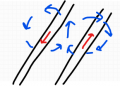
Wondering: If 10A is pushed through a copper wire in steel conduit versus a copper wire inside aluminum conduit, will the steel be more lossier because of it being ferrous and magnetic? Will the conduit heat up more than aluminum?
AC. The conductor will be shorted and induced with CT to push 10A. Therefore, m each wire will be in a loop. The goal is to start with aluminum and apply same settings to steel to see if it changes. What are your thoughts?AC or DC?
Does the return current flow back through the same conduit?
What are the ends of the conduit1 (electrically) connected to? Does this form a loop?

One wire will be in conduit for this experiment.Twisted pairs of current carrying conductors effects are self cancelling when twisted together.
One wire will be in the conduit for this so called experiment. In a magnetic conduit, what actually heats up? The wire itself or conduit due to hysteresis? Therefore, will the ampacity be affected?The NEC usually requires all current carrying conductors of the same circuit to be included in the same cable or conduit.
https://codes.iccsafe.org/s/ISEP201...de-nec-solar-provisions/ISEP2018-NEC-Sec300.3
View attachment 305534
The fields cancel away from the wire pair.
300.20 (B)
Where a single conductor carrying alternating current passes through metal with magnetic properties, the inductive effect shall be minimized by
(1) cutting slots in the metal between the individual holes through which the individual conductors pass or
(2) passing all conductors in the circuit through an insulating wall sufficiently large for all of the conductors of the circuit.
FPN: Because aluminum is not a magnetic metal, there will be no heating due to hysteresis; however, induced currents will be present. They will not be of sufficient magnitude to require grouping of conductors or special treatment in passing conductors through aluminum wall sections.
Do the experiment, tell us what happens. The NEC has rules for a reason, usually.One wire will be in the conduit for this so called experiment. In a magnetic conduit, what actually heats up? The wire itself or conduit due to hysteresis? Therefore, will the ampacity be affected?
I will perform! What do you think is going to happen? If I have a wire not inside a conduit, 10A through conductor, and place a steel pipe near it, will the steel pipe heat up? Will there be loses associated to the proximity of steel ferrous pipe?Do the experiment, tell us what happens. The NEC has rules for a reason, usually.
Why do you care what I think. The experimental data will show the effects, if any.I will perform! What do you think is going to happen? If I have a wire not inside a conduit, 10A through conductor, and place a steel pipe near it, will the steel pipe heat up? Will there be loses associated to the proximity of steel ferrous pipe?
I just want to see the loses for myself. I would like to see if there are ampacity and heat losses. I would like everyones input on the most efficient way of performing tests to achieving this. I plan on posting results.What do You expect the experiment to demonstrate ???
.
.
.
Sounds like homework,One wire will be in the conduit for this so called experiment. In a magnetic conduit, what actually heats up? The wire itself or conduit due to hysteresis? Therefore, will the ampacity be affected?
60Hz. So you saw the significant heating at higher frequencies?What’s the frequency. At 13.5 Megahertz, we had to remove any steel conduit and splice boxes as wires were burning up inside.
You wouldn't see it if they were twisted pairs.60Hz. So you saw the significant heating at higher frequencies?
Have you done the experiments yet ?60Hz. So you saw the significant heating at higher frequencies?