Will a Simulated Sine Wave UPS be an Issue?

MrAl

Joined Jun 17, 2014
13,720
With regard to the statement, "These are not recommended for power supplies that use active PFC", which is about using modified sine UPS systems with active PFC loads...

Do you have a good reference for that statement or is it just conjecture?
Hi,

I found two references. They both look credible, but that is always going to be under suspicion because there are details that usually do not come with any of the references. They might say "works" or "does not work" but that's not enough. We have to know what kind of active PFC circuit was being tested. Since there are so many different designs, it seems virtually impossible to predict beforehand if it will work or blow up the computer.

This means that using a non-true sinewave UPS system is always going to be a bit of a risk, even if there is no APFC. That's because there are other types of loads too that do not seem to like modified (single pulse per half cycle) since wave.

The other problem is most people do not know if they have an APFC or just a PFC or nothing at all, so their report good or bad cannot be validated.

One workaround may be to do some measurements, and hope nothing blows out on the first test. Test for input current spikes, and audio noise, and overheating of the power supply or other device.
Complaints are either load device failure, or unexpected computer shut down, as well as overheating of the load.

APFC's try to make the input current more sinusoidal, and that may be very hard to do with a pulsed waveform. They would be designed to correct the phase angle in most cases. It would be interesting though if a manufacturer would take this into account and make their APFC work with modified sine converters as well as pure sine.

You could look up some APFC designs and see what you think.
 

Ian0

Joined Aug 7, 2020
13,158
Hi,

I ran into the 'new' terminology just recently, more or less. They may say simulated sinewave because it may sound better to buyers. This was in the past few months.
Before that I only remember seeing 'modified sinewave', but it is the same thing and I proved it because I purchased one to test, and I even have the waveforms as I took a photo of the scope screen. It's just one pulse positive a zero period, then one pulse negative, then zero period again, then repeats that pattern. There is no time when it reaches say 1/2 of the full value of the positive pulse or negative pulse.

This is unfortunate, but it only works with certain types of loads and does not work well with others, and unfortunately there are so many different circuits out there there's almost no way to be sure it will work with a given device unless we know the internals of the device to be powered.
There are even a lot of different designs for an Active PFC, so it is possible one APFC will work while another one will not.
The complains range from device failure to computers shutting down when the mains power goes out and the UPS tries to power the computer (with the APFC) from its internal converter. There apparently is a gap in power which makes the computer shut down suddenly as if there was no UPS.
I’ve never liked the term modified sinewaves, it’s a rather extreme modification! Like saying that a VW Beetle is a modified Porsche.

The gap in the waveform could be confusing some computer power supplies, so that it is the gap rather than the PFC that is the problem.
 

Reloadron

Joined Jan 15, 2015
7,892
I’ve never liked the term modified sinewaves, it’s a rather extreme modification! Like saying that a VW Beetle is a modified Porsche.
I like that analogy. Looking at what is called a Modified Sine Wave on a scope it does not resemble anything sinusoidal at all. Go figure?

Ron
 

Ian0

Joined Aug 7, 2020
13,158
I like that analogy. Looking at what is called a Modified Sine Wave on a scope it does not resemble anything sinusoidal at all. Go figure?

Ron
It’s a well-modified sinewave. Just like the latest incarnations of the 911 Turbo don‘t bear much resemblance to 1967 beetle!

However, it does resemble a lot a slightly modified square-wave!
 

nsaspook

Joined Aug 27, 2009
16,340
This is more about economics than engineering. You could design a really good, robust, modified sinewave inverter, but it would cost more than the cheaper true-sine-wave inverters, so who would buy it?
That means that most modified sinewave inverters are, by the laws of economics, junk.
Junk here, yes because of economics and other factors. When you can make the transformer from scrap, with old equipment, using solar power and have near zero labor costs, they are still made, for mainly local use.
 

MrAl

Joined Jun 17, 2014
13,720
I’ve never liked the term modified sinewaves, it’s a rather extreme modification! Like saying that a VW Beetle is a modified Porsche.

The gap in the waveform could be confusing some computer power supplies, so that it is the gap rather than the PFC that is the problem.
Yes that's a good way to put it.

Yes the gap I think is the reason why it fools the APFC. Either get rid of the gap or get rid of the APFC, or both :)
 

Ian0

Joined Aug 7, 2020
13,158
Yes that's a good way to put it.

Yes the gap I think is the reason why it fools the APFC. Either get rid of the gap or get rid of the APFC, or both :)
It seems a bit over-zealous to me. I think most PSUs should have enough energy stored in capacitance to manage 3 or 4 mains cycles before it needs to shut down.
 

Reloadron

Joined Jan 15, 2015
7,892
It seems a bit over-zealous to me. I think most PSUs should have enough energy stored in capacitance to manage 3 or 4 mains cycles before it needs to shut down.
Note, the Intel Design Guides made changes over the years and were only a guide so there was really no compliance forced. Last revisions I was aware of were about 3.0.

From the old PSU Design Guide published by Intel:

3.2.11. Voltage Hold-up Time
The power supply should maintain output regulation per Section 3.2.1 despite a loss of input
power at the low-end nominal range—115 VAC / 57 Hz or 230 VAC / 47 Hz—at maximum
continuous output load as applicable for a minimum of 17 ms.

Just about 1 cycle of 60 Hz power or less than one cycle of 50 Hz power.

A Google of ATX PSU Design Guide should find a copy out there.


Ron
 

MrAl

Joined Jun 17, 2014
13,720
It seems a bit over-zealous to me. I think most PSUs should have enough energy stored in capacitance to manage 3 or 4 mains cycles before it needs to shut down.
Hi there,

Well I think the main problem with this kind of thing is there is too much guesswork and not enough evidence to support any beforehand determination of whether or not a given UPS will work with a given power supply. To add to that confusion, most people can't tell what they have so any reviews may be worthless because we won't know which ones are true and which ones are false, not because they lie about it but because they think they have something that they don't have. They might say their modified sine wave UPS works perfectly for years with their APFC power supply, but they may not actually have an APFC power supply it may be a passive PFC which changes the entire analysis. Someone reading that may think they can buy a Brand X UPS system for their computer or something because it was said to have worked well, yet it doesn't actually work well at all.

Then we have the advertisements changing the wording to "simulated" sine which then causes more confusion. A simulated sine could mean anything, so the only way to be sure is to see "pure" sine or not see "pure" sine. If we don't see "pure" sine then we have to assume it is a single pulse per half cycle. Back when I worked in that industry we call them "synthesized sine wave converters", but that may not be as descriptive as we want either. To us, that meant there was multiple pulses per half cycle, like maybe 10 or more, which simulated the voltage of a sine wave at several points along each half cycle. As we advanced the technology, we got around 1 percent THD, which brings us to another idea. If they were to publish the THD that would tell the whole story. A low THD=good, a high THD=bad, just like with audio :)

Then there is the risk factor. If we have an expensive computer, the risk is higher assuming the price is commensurate with our income. If we don't want to risk damage to the computer we may want to go with a more expensive UPS anyway. We might get a guarantee with it too, but I am not sure how hard it is to get reimbursed for damages caused by the UPS if it does happen.

The risk factor combined with the problem in determining the future success due to the confusing terminology means we probably want to go with a pure sine.

We could develop a risk factor formula that would tell us if we need to buy a pure sine UPS or not. This would be based on the load device cost, annual income, expected normal lifetime, etc. For example:
Risk=w1*sensitivity+w2*criticalness+w3*affordability+w4*longevity+w5*powerloss
Sensitivity: how sensitive the device to be powered is to a non-sine source
Criticalness: how critical is it to lose power to the device
Affordability: how affordable is it ... cost/income
Longevity: how long device is expected to last (like 3 years)
Powerloss: how likely is there to be a power outage in the area
The outcome of Risk would help us to determine the type of UPS to buy: pure or not pure sine.

Things like that, and we would adjust the weights wN. This would be personal so it may have to be adjusted on a case by case basis.
Some things can't be included because they are unknown, like the reliability of reviews on the products.
If we can't determine a parameter, then we might have to set it to some default value like 0.5 or something that indicates it is neutral.
 

Ian0

Joined Aug 7, 2020
13,158
The truth is that the world has one way of distributing electrical power, and that is a sinewave of between 45Hz and 65Hz, at (on a consumer level) a voltage of around 115V or 230V, and it has been so every since the days of the Parsons/Tesla/Westinghouse/Hopkinson and isn't likely to change any time soon. Any attempt to deviate from that tends ultimately to be futile.
 

MrAl

Joined Jun 17, 2014
13,720
The truth is that the world has one way of distributing electrical power, and that is a sinewave of between 45Hz and 65Hz, at (on a consumer level) a voltage of around 115V or 230V, and it has been so every since the days of the Parsons/Tesla/Westinghouse/Hopkinson and isn't likely to change any time soon. Any attempt to deviate from that tends ultimately to be futile.
Hi,

You mean in comparison to the modified sine ?
 

Futurist

Joined Apr 8, 2025
786
I use APC backup boxes in my home. One is for my ADSL adapter, the other - slightly larger - drives my big desktop PC and monitor. I've used these for years and never experienced any problem with PC, or the one before that which also was big (they each have a 1kW PSU in them).

Each has a " Step-approximated sine wave" when on battery. Granted I don't work on battery very often but I have, also these units self test every few days and when I hear that click in, my PC doesn't notice.

Does anyone have a picture of what such an approximated sine actually looks like? is the deviation visible?
 

MrAl

Joined Jun 17, 2014
13,720
Hi,

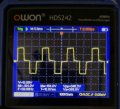
Here is a scope snapshot I took of a Cyberpower UPS, one of the smaller units about $50 USD. I wanted to see it first hand, no BS, no guesswork.

It's just a pulse for each polarity. Nothing even close to a sine wave. The THD could be 30 percent or more. Which harmonics are smaller depends on how wide the pulse has to be, which can depend on the state of the battery.
They call this a simulated sine and also call it a modified sine. The word "sine" has nothing to do with the waveshape however :)
If anything they should call it a "square wave used in place of a sine wave".

The real mains line can be pretty nasty. A 1 percent THD sine converter is much cleaner. The main issue is surge current which not many of them can stand unless you buy an overrated unit.
 

Attachments

Last edited:

Futurist

Joined Apr 8, 2025
786
Hi,

Here is a scope snapshot I took of a Cyberpower UPS, one of the smaller units about $50 USD. I wanted to see it first hand, no BS, no guesswork.

It's just a pulse for each polarity. Nothing even close to a sine wave. The THD could be 30 percent or more. Which harmonics are smaller depends on how wide the pulse has to be, which depends on the state of the battery.

The real mains line can be pretty nasty. A 1 percent THD sine converter is much cleaner. The main issue is surge current which not many of them can stand unless you buy an overrated unit.
The stack exchange post says that over a few years, the replacement batteries become the dominant cost, so buying a high end UPS at say twice the costs, kind of almost doesn't matter after several years, the total costs approach each other - so buy a very good one.
 
Top