Why do some fuel storage tanks lift?

nsaspook

Joined Aug 27, 2009
16,359
No not what I am referring.
I got nothing then.
The pictures you have posted all look like gas holder tanks of one type or other. I can't think of a good engineering reason to lift the entire tank from the bottom unless it was empty, unbolted from the bottom and the sides jack'd up for cleaning sludge off.
 

WBahn

Joined Mar 31, 2012
32,942
As a kid, there was a tank farm alongside the highway as we drove into Boston. I always anticipated coming on them, to see how high they were that day.

The one’s in Boston were constructed of three sections. The bottom level was stationary. It had an inverted U channel along it’s interior upper rim.

Each succeeding section had a U channel along its exterior lower rim and an inverted U channel on its upper rim. As @ericgibbs stated, the lower section was filled with water or some other liquid. As each section rose, it would trap this liquid in their U channel, which would catch the inverted U channel of the next section.

Thus, a seal was created between sections as the internal gas pressure rose. In a sense, these style tanks were an immense natural gas capacitor.
I understand the concept of that U-channel seal, but at first the details eluded me because it seems like the pressure would push the water right out of the seal unless the channels were extremely deep. But I was assuming that natural gas is maintained under some moderate pressure (say 20 to 50 psi). But in trying to find out what a typical storage pressure is, I ran across this:

https://en.wikipedia.org/wiki/Gas_holder

which states that the storage pressure in these systems is near atmospheric, so you wouldn't need deep channels at all.

But this should also mean that the pressure should vary quite a bit as the column moves up since the weight of the wall is probably a significant portion of the total weight.
 

djsfantasi

Joined Apr 11, 2010
9,237
I understand the concept of that U-channel seal, but at first the details eluded me because it seems like the pressure would push the water right out of the seal unless the channels were extremely deep. But I was assuming that natural gas is maintained under some moderate pressure (say 20 to 50 psi). But in trying to find out what a typical storage pressure is, I ran across this:

https://en.wikipedia.org/wiki/Gas_holder

which states that the storage pressure in these systems is near atmospheric, so you wouldn't need deep channels at all.

But this should also mean that the pressure should vary quite a bit as the column moves up since the weight of the wall is probably a significant portion of the total weight.
I understand your interpretation. But as a child, the tank intrigued me. My dad had three complete sets of various encyclopedias and many science books (he was a teacher). So all I can report on is what I saw and learned back in the early sixties.
 

Thread Starter

spinnaker

Joined Oct 29, 2009
7,830
I understand your interpretation. But as a child, the tank intrigued me. My dad had three complete sets of various encyclopedias and many science books (he was a teacher). So all I can report on is what I saw and learned back in the early sixties.

But what did you see? ;) That was what was unclear to me.
 

Ya’akov

Joined Jan 27, 2019
10,259
I remember fields of them along the New Jersey turnpike when I was a kid. This goes back to the mid 50s and early 60s. Mostly in Northern NJ leading to the George Washington Bridge. They may have had compressed natural gas in them, I don't recall. Anyway I do remember they were gas storage tanks and yes, they went up and down.

Ron
My parents, sister, and I were on the Jersey Turnpike when the Bayway Refinery in Linden exploded.
Memories of our frequent trips from Queens to where our new house was being built in NJ are punctuated with smells of Linden and Eiizabeth and sights of big flare stacks burning among the tanks and columns.
 

Thread Starter

spinnaker

Joined Oct 29, 2009
7,830
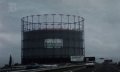
I know this is an old thread, but my son-in-law just posted this old video from 50 years ago. It captured the gas tank that I’ve referred to. Here’s a picture from the video!

View attachment 171971

https://www.facebook.com/5637143257/posts/10157351870113258/

Thanks that is exactly like the one I saw in the TV show. The whole tank lifts inside that frame. I did not see in the video where it was actually lifting. I guess the kids got stuck because the top of the tank lifted above the frame so they could not climb down on their own.
 

PatM

Joined Dec 31, 2010
86
Before natural gas usage, the gas was manufactured from coal. The Gas Holder would rise or fall depending on the amount being used vs the amount being manufactured . This was a storage facility that just adjusted to the amount of gas in storage at the time.
 

Thread Starter

spinnaker

Joined Oct 29, 2009
7,830
Before natural gas usage, the gas was manufactured from coal. The Gas Holder would rise or fall depending on the amount being used vs the amount being manufactured . This was a storage facility that just adjusted to the amount of gas in storage at the time.

But why? and from the TV show (not that you can put a lot of stock in that) the tank went up and down on a schedule. If it was based on use then it would likely not move on schedule.
 

djsfantasi

Joined Apr 11, 2010
9,237
But why? and from the TV show (not that you can put a lot of stock in that) the tank went up and down on a schedule. If it was based on use then it would likely not move on schedule.
It’s TV! My experience was that it wasn’t on a schedule, but may appear so because of a daily usage variations.
 

Reloadron

Joined Jan 15, 2015
7,893
My parents, sister, and I were on the Jersey Turnpike when the Bayway Refinery in Linden exploded.
Memories of our frequent trips from Queens to where our new house was being built in NJ are punctuated with smells of Linden and Eiizabeth and sights of big flare stacks burning among the tanks and columns.
Lived in Kew Gardens 50 to 53 born in Brooklyn. Then "out on the island". :) Yes, not just the sights but the smells along the NJ turnpike.

Ron
 

WBahn

Joined Mar 31, 2012
32,942
But why? and from the TV show (not that you can put a lot of stock in that) the tank went up and down on a schedule. If it was based on use then it would likely not move on schedule.
The tank moves up and down automatically in response to the amount of gas (as in gaseous gas, not liquid like gasoline gas) in it. If the pressure in the tank produces a force on the top that is greater than the weight of the lifted portion of the tank, then it rises. If it's less, it falls. Otherwise it stays the same. As the tank lifts, the weight of the lifted portion increases requiring a greater gas pressure, so that provides the negative feedback to keep the system stable.

It's nothing but a big accumulator. If you are familiar with hydraulic accumulators in which you have a gas chamber that gets compressed by the hydraulic fluid acting on it then the concept is very much the same. The accumulator serves to store the fluid under pressure and is like an electrical capacitor in that it can act as a short-term source of fluid in the absence of the normal power source. It also acts like a filter to smooth out the pressure fluctuations.

These tanks serve the same role. If there is a "schedule", it's indirect. The gas production facilities might operate on a schedule, particularly if the gas is produced as a byproduct of some other process. So when they are producing gas they need to produce more than is currently being consumed. That results in gas being pumped into the tank and the tank rising. When they aren't producing (or not producing as much as is being consumed), gas is being extracted from the tank to make up the difference and the tank falls.
 

WBahn

Joined Mar 31, 2012
32,942
If it were gasoline, I can see collapsing the tank might be a way to keep fumes down.
That's what I was thinking at first, but I couldn't see how they could seal it reliably. But these structures aren't used for liquids, only for gases and only at near atmospheric pressures. That makes the use of the U-channel water seals effective.
 

Thread Starter

spinnaker

Joined Oct 29, 2009
7,830
Lived in Kew Gardens 50 to 53 born in Brooklyn. Then "out on the island". :) Yes, not just the sights but the smells along the NJ turnpike.

Ron
I spent a lot of time working in Gutenberg. The drive to and drive the airport was a real experience. Of course we had our Neville Island. When the wind was right you could smell it at my house 2 or 3 miles away and there was a huge hill between my home and the island.
 
Top