Why Do Electronic Components Have Such Odd Values?

@WBahn
The value 9.19478686 would not have existed in any reasonable engineers notebook back when resistor values were set. The log tables would usually have been 4 digits, or, 9.195 - especially if they were only looking for 1% accuracy.

Now, round that one = 9.20
But this explanation fails for the case i=42.

Calculating the exact value of 10^(42/192) we get 1.6548171

Using 4 digit logs we would get 1.655 which would round to 1.66, but in fact the value commercially available is 1.65

I'm sure that the people who did these calculations wouldn't use 4 digit log tables, knowing that these tables of values would be used for many years. They would get out the 7 digit logs for this important job.
 

dl324

Joined Mar 30, 2015
18,327
I'm sure that the people who did these calculations wouldn't use 4 digit log tables, knowing that these tables of values would be used for many years. They would get out the 7 digit logs for this important job.
They wouldn't need more than 3 digits because E192 resistors only use 3 digits and a multiplier.

There is a discrepancy in the standard values and the formula supposedly used to generate them. If you look at the lower resolution series, you'll see many discrepancies.

That's the mystery.
 

dl324

Joined Mar 30, 2015
18,327
Calculating the exact value of 10^(42/192) we get 1.6548171

Using 4 digit logs we would get 1.655 which would round to 1.66, but in fact the value commercially available is 1.65
Why would you round twice? The number would round to 1.65. As mentioned earlier, there are no discrepancies in the E192 E48 or E96 values generated with the formula and rounded.

EDIT: Meant E48 above, as I had mentioned in post #10, not E192. As pointed out below, there is one discrepancy in E192.
 
Last edited:
Why would you round twice? The number would round to 1.65. As mentioned earlier, there are no discrepancies in the E192 or E96 values generated with the formula and rounded.
I was responding to post #20. The explanation for why the value 9.20 exists, fails for the other value I quoted in post #21

Personally I would not round twice. I mentioned in post #15 that students of numerical analysis know that rounding more than once can lead to bad results.
 
They wouldn't need more than 3 digits because E192 resistors only use 3 digits and a multiplier.

There is a discrepancy in the standard values and the formula supposedly used to generate them. If you look at the lower resolution series, you'll see many discrepancies.

That's the mystery.
The discrepancies in the lower resolution series are well known, but the E48, E96 and E192 series are from a later era and there is only one discrepancy, namely the one I pointed out in post #11. These high res values were calculated correctly from the power of ten formula for all the many values except one; a mistake was made.

The calculation for each value, that is, the evaluation of the expression 10^(i/192) for example (the E192 series), must be done with more than 3 digits to get the correctly rounded 3 digit result.
 

GopherT

Joined Nov 23, 2012
8,009
I'm sure that the people who did these calculations wouldn't use 4 digit log tables, knowing that these tables of values would be used for many years. They would get out the 7 digit logs for this important job.
Do you think some engineer at Ohmite in the 1930's was thinking about all the engineers in 2017 arguing about the stand are sizes? For all we know there was fly shit on the 4-digit log table he had pinned above his desk and he misread what was there. The rest is history. Do you have a better suggestion? Do you really suppose they were using 7- digit logs tables and they had a real reason for the mixup of some values? I like my fly spec theory.
 

WBahn

Joined Mar 31, 2012
32,836
But this explanation fails for the case i=42.

Calculating the exact value of 10^(42/192) we get 1.6548171

Using 4 digit logs we would get 1.655 which would round to 1.66, but in fact the value commercially available is 1.65

I'm sure that the people who did these calculations wouldn't use 4 digit log tables, knowing that these tables of values would be used for many years. They would get out the 7 digit logs for this important job.
Out of curiosity I pulled out my old algebra/trig book from high school that has both 4-place and 5-place tables in it.

The first question is how would they calculate 42/192. Would they do it by hand? With a slide rule? Using log tables?

Let's use log tables.

4-place tables

log(4.20) = 0.6232
log(1.92) = 0.2833

so

log(42.0) = 1.6232
log(192) = 2.2833

log(42/192) = 1.6232 - 2.2833 = -0.6601 = -1 + 0.3399

10^-0.6601 = 10^0.3399 / 10 ~= 2.185 / 10 = 0.2185

It actually falls between log(0.218) = 0.3385 and log(0.219) = 0.3404

So 0.2185 is a rough guess. My 4-place tables don't have proportional parts tables. But my 5-place tables do and if I use those I get 0.2187. But I'll stick with the 0.2185 to better be in the spirit of my 4-place tables.

Now I need 10^0.2185

log(1.65) = 0.2175
log(1.66) = 0.2201

Based on just the 4-digit tables, I'd probably conclude that it is closer to 1.65 than 1.66.

If I use the proportional parts tables, I would be looking for 10^0.2187 and would end up with 1.655 (actually, something just under it).

This is close enough to the split that I could easily see it going either way, but a better case can be made for rounding it down to 1.65.

For grins and giggles, let's see what the 5-place tables give (using the proportional parts tables)

log(4.20) = 0.62325
log(1.92) = 0.28330

so

log(42.0) = 1.62325
log(192) = 2.28330

log(42/192) = 1.62325 - 2.28330 = -0.66005 = -1 + 0.33995

10^-0.66005 = 10^0.33995 / 10 ~= 2.1875 / 10 = 0.21875

Now I need 10^0.21875 and I get 1.6548

So I'd definitely round it down to 1.65 in this case.

I was pleasantly surprised that I was able to figure out how to use the log tables, including the proportional parts tables, almost immediately. I had to look at them for just a few seconds to convince myself they were for numbers between 1.0 and 10.0 and to be sure I was putting the decimal point in the right place.

I don't think I've used log tables since 1982, so not too much rust after 35 years.

One thing that surprised me -- this text only has common logs and not natural logs. I would sworn it had both.
 

crutschow

Joined Mar 14, 2008
38,506
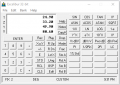
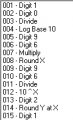
After all this discussion I had do a custom program (17 steps) for my virtual RPN programmable calculator to determine the closest 1% standard resistor value (bottom button, right bank) for any number from 10 to 99.
Below is a snapshot showing the program and the results in the stack for inputs of 25, 33, 50 and 80.

upload_2017-7-19_21-32-20.png upload_2017-7-19_21-37-40.pngupload_2017-7-19_21-41-27.png
 
Do you think some engineer at Ohmite in the 1930's was thinking about all the engineers in 2017 arguing about the stand are sizes? For all we know there was fly shit on the 4-digit log table he had pinned above his desk and he misread what was there. The rest is history. Do you have a better suggestion? Do you really suppose they were using 7- digit logs tables and they had a real reason for the mixup of some values? I like my fly spec theory.
The E48, E96 and E192 series did not exist in the 1930s, and when it did come into existence, the values weren't determined by some engineer at Ohmite. The values were determined by committee after WWII, around 1948. They became a published standard in 1963. The people who did the calculations in the 1940s didn't have calculators or computers for the job; it was slide rule or log tables. They knew the work was important and exercised due care. I would have used more than 4 digit log tables, and undoubtedly they did too.

I've already given you my suggestion for the source of the error. Out of 336 values calculated, one rounding error was made.
 

WBahn

Joined Mar 31, 2012
32,836
Do you think some engineer at Ohmite in the 1930's was thinking about all the engineers in 2017 arguing about the stand are sizes? For all we know there was fly shit on the 4-digit log table he had pinned above his desk and he misread what was there. The rest is history. Do you have a better suggestion? Do you really suppose they were using 7- digit logs tables and they had a real reason for the mixup of some values? I like my fly spec theory.
If you have information/evidence that the table in the IEC 60063:1952 standard was adopted directly without change from a chart done by a single engineer at Ohmite in the 1930's, please share it. It would answer the very question I asked.

While not entirely impossible, I find it a bit hard to believe that a standards committee would do this -- though if a somewhat quixotic table had become extremely widely used in practice, they might. But I've never been able to find any hint that that's what happened, either.

I haven't been able to find a copy of the 1952 standard, though the 2015 standard both states that the progression is geometric using nth root of 10 and that the preferred values predated the original standard. The best I have been able to find is that the big push toward standardization occurred in WWII by the military production board. But I've never been able to track down any table that arose out of their efforts, so I don't know how close they are to the final values and/or have the same discrepancies.
 
The reason why the values in the E12 and E24 series don't fall on the exact log spaced values is economics. During the first half of the 20th century, resistors were mainly carbon composition resistors. At that time the production processes yielded a large variance in the product values. The manufacturers wanted to sell all that they produced, so they wanted a series of values such that their tolerance bands overlapped.

For example, suppose a manufacturer was trying to make 12 ohm, 10% resistors, but their production yielded a batch of resistors with values ranging from 11 ohms to 15 ohms.

A resistor whose value was between 9.9 ohms and 12.1 ohms could be sold as an 11 ohm, 10% resistor.
A resistor whose value was between 10.8 ohms and 13.2 ohms could be sold as a 12 ohm, 10% resistor.

Notice that a resistor whose value was between 10.8 ohms and 12.1 ohms could be sold as either an 11 ohm or a 12 ohm resistor. A resistor whose value was between 9.9 ohms and 13.2 ohms could be sold as an 11 ohm resistor at one end of the range, or a 12 ohm resistor at the other end of the range. No resistor in that 9.9 to 13.2 ohm range would have to be rejected--it could be sold.

This is because the values in the range of 11 ohms plus as much as 10% higher, overlaps the range of 12 ohms minus 10% lower. The video here: http://www.resistorguide.com/resistor-values/ talks about this a little.

But, now consider the 12 ohm and the 15 ohm resistors. 12 ohms plus 10% is 13.2 ohms; 15 ohms minus 10% is 13.5 ohms. A resistor manufactured which was 13.3 ohms, for example, is more than 10% greater than 12 ohms, and also less than 10% smaller than 15 ohms--it can't be sold as either a 12 ohm, 10% resistor, or as a 15 ohm, 10% resistor. It's out of tolerance for either of those standard values.

The manufacturers in those days chose the values of their standard series of 10% resistors so there would be very small zones where the resistance values wouldn't be within 10% of a standard value, and therefore not saleable.

The E12 series has only 2 such zones, the one I already mentioned between 12 and 15 ohms, and a smaller zone between 22 and 27 ohms. The output of their manufacturing process could always be sold as some standard 10% value except for the few whose value fell in one of those two zones. The existence of these zones is a result of the resistance values having only two digits, whereas the exact logarithmic values of 10^(i/24) need more than two digits to express their values. They decided to use 12 values per decade, rather than 10 values per decade because that gives more overlap of the tolerance bands.

The reason they chose 27 ohms as a standard value rather than 26 ohms is that having chosen 27 ohms, the rest of the values are such that the "undesirable" zones are minimized.

The same maximum overlapping of tolerance bands was wanted for 5% resistors too, with the additional requirement that values in the E12 series should also be present in the E24 series.

I passed on some old references that discuss this to WBahn, and after he looks into the copyright considerations, we may post parts or all of some of them.
 

WBahn

Joined Mar 31, 2012
32,836
I got your e-mail. I'll try to look things over, but I don't know when.

What you say in your last post makes quite a bit of sense and it's something I thought of a long time ago, but never really explored it. At some point I'll determine what fraction of a uniform distribution of resistors would have needed to be discarded under the nominal values and the adopted values.

One thing that I will point out, however, is that the number of values per decade is right what you would expect.

For the 10% range you would want the borderline between two adjacent values to be 10% greater than the lower value and 10% less than the upper value. So you want the ratio of two adjacent values to be 1.1/0.9. The number of steps you need in order to cover a decade is then

10 = (1.1/0.9)^N

N = 1/log10(1.1/0.9) = 11.47

You would want to round this up specifically to avoid gaps, so you would use 12.

For 20% you want 5.68 values/decade, so you go with 6.

For 5% you want 23.01 values/decade. This one you might be willing to live with 23, but there is a compelling reason to go with twice the number of values as the series before it -- you can use the same values and just insert a new value in between each pair, so you go with 24.

But for 2%, you want 57.56 values/decade. So you have a quandary. You can really only play the doubling game when the tolerance is cut in half. So do you go with 58, or do you double the number of values and go with 48? Obviously, they went with 48. But now you can't just use the values from the E24 and add a new value in between pairs -- that just ain't gonna work out well. So you need a new series entirely and you're going to have gaps, probably between every pair. As you go to the 1% and 0.5% you are halving the tolerance, so you can get away with doubling the number of values and inserting new values between prior values again.
 

shortbus

Joined Sep 30, 2009
10,050
We use the same rules for rounding that other disciplines use.
Not really. You as engineers do things in (and I'm probably going to use the wrong term again because I don't know the "engineering or mathematical" term) theoretical probabilities. I was in the practical every day make it work side of things. When trigging out a dimension that wasn't given on a blueprint. But one that was actually needed to either make a part or set it up in a machine to make the part. Many times the engineer didn't even have a clue what dimension is actually needed to make what he designed.
 
I got your e-mail. I'll try to look things over, but I don't know when.

What you say in your last post makes quite a bit of sense and it's something I thought of a long time ago, but never really explored it. At some point I'll determine what fraction of a uniform distribution of resistors would have needed to be discarded under the nominal values and the adopted values.

One thing that I will point out, however, is that the number of values per decade is right what you would expect.

For the 10% range you would want the borderline between two adjacent values to be 10% greater than the lower value and 10% less than the upper value. So you want the ratio of two adjacent values to be 1.1/0.9. The number of steps you need in order to cover a decade is then

10 = (1.1/0.9)^N

N = 1/log10(1.1/0.9) = 11.47

You would want to round this up specifically to avoid gaps, so you would use 12.

For 20% you want 5.68 values/decade, so you go with 6.

For 5% you want 23.01 values/decade. This one you might be willing to live with 23, but there is a compelling reason to go with twice the number of values as the series before it -- you can use the same values and just insert a new value in between each pair, so you go with 24.

But for 2%, you want 57.56 values/decade. So you have a quandary. You can really only play the doubling game when the tolerance is cut in half. So do you go with 58, or do you double the number of values and go with 48? Obviously, they went with 48. But now you can't just use the values from the E24 and add a new value in between pairs -- that just ain't gonna work out well. So you need a new series entirely and you're going to have gaps, probably between every pair. As you go to the 1% and 0.5% you are halving the tolerance, so you can get away with doubling the number of values and inserting new values between prior values again.
After WWII, production processes improved a lot, and, of course, modern techniques produce resistors with much less variance in batches (laser trimming, etc.), so the values in the E48, E96, E192 didn't need to be adjusted to minimize any "undesireable" gaps. They could sell all the resistors they made because their production didn't result in any that fell in the gaps--they were all in tolerance.

The committee just used the calculated 10^(i/48), 10^(i/96), or 10^(i/192) values, properly rounded (with the one mistake; maybe someone got tired).
 

MrAl

Joined Jun 17, 2014
13,704
Hi,

It seems rather obvious that there is no systematic error in the E192 values, so it must have been due to human error or perhaps some whim of the first person or group to specify these values. Depending on how we view this error though it may look very insignificant or very very insignificant.

If we look at the error in 9.20 hat should have really been 9.19 we see the error is about 0.1 percent, which is pretty small. But if we look at what it would take to get to that kind of error we find that it only takes an error of about 0.003 percent, and that is just 3 thousandths of one percent. So if someone made an error that small before rounding, we end up with 9.20 instead of 9.19, which of course ends up looking worse.

If that's the only error then it might be just an offset error, but if there is another error (i think i read here) and that error is negative, then we might have to assume an accumulative error that follows the value of N itself, so that larger N produces larger error, and for some N less than M it could be a negative offset. What good this would really do us i dont know though, because it seems like a problem that should be solved by history alone.

I've seen simple human errors like this in other tables. One i remember well is the 1 percent tolerance thermistor Radio Shack used to sell about 20 years ago, and they may still sell it. It came in a small package with a card backing, and on the back of that card they had a table printed out for the values of resistance at various temperatures. It was interesting because if we used a regular thermistor formula to calculate the resistances over various temperatures we got a very very good fit, except for one value. That one value put a spike on top of the otherwise smooth curve, and so there was no choice but to assume it was not correct.
In curve fitting these values are usually called "outliers" and are often simply discarded. In the case of the thermistor there was no choice but to disregard the bad value and go with the calculated value instead.

For the resistor values it's different of course because these off values are kind of set in stone. For the companies that make resistors though there's no reason why they cant make a 9.19 value resistor they may just not like being a little different.
 

WBahn

Joined Mar 31, 2012
32,836
After WWII, production processes improved a lot, and, of course, modern techniques produce resistors with much less variance in batches (laser trimming, etc.), so the values in the E48, E96, E192 didn't need to be adjusted to minimize any "undesireable" gaps. They could sell all the resistors they made because their production didn't result in any that fell in the gaps--they were all in tolerance.

The committee just used the calculated 10^(i/48), 10^(i/96), or 10^(i/192) values, properly rounded (with the one mistake; maybe someone got tired).
I know that the ability to manufacture to spec as opposed to manufacture and then measure to mark became the norm -- which is why you used to be pretty much guaranteed that a 10% resistor was NOT within 5% of the marked value (because, if it had been, it would have been sold as a 5% resistor), while now the distributions are a lot more bell-like.

But while the gaps don't matter from a manufacturing standpoint, they would seem to matter more for tighter-tolerance values than looser values.

If I've decided that I can live with 10% and the nominal value were to fall in a gap between value tolerances, there's a fair change that I can live with either choice (or that I can pick which side is best to err on) and accept 10% around a slightly wrong value (or up to ~20% away from the nominal value).

But if I'm needing a value within 1% or 2%, it's very possible because I've determined I need a value within 1% or 2% of the nominal value (of course, it's also possible -- and the better design if you can do it -- to not need the value to be accurate so much as you need whatever it is to be precise). But if I need accuracy and my nominal value falls in a gap, I have bigger problems.

I wonder to what degree the committee considered that. Since these committees tend to be heavily populated by component manufacturer's representatives, I wouldn't be at all surprised to discover that the attitude was, "yeah, well, that is a shame and, if it happens, then they may need to spend the money to go to a tighter-tolerance resistor to get within the looser tolerance of a value in the gap." Like my original question though, it would be nice to know what the actual story was -- maybe it's addressed in those documents you sent me.
 
But if I'm needing a value within 1% or 2%, it's very possible because I've determined I need a value within 1% or 2% of the nominal value (of course, it's also possible -- and the better design if you can do it -- to not need the value to be accurate so much as you need whatever it is to be precise). But if I need accuracy and my nominal value falls in a gap, I have bigger problems.

I wonder to what degree the committee considered that. Since these committees tend to be heavily populated by component manufacturer's representatives, I wouldn't be at all surprised to discover that the attitude was, "yeah, well, that is a shame and, if it happens, then they may need to spend the money to go to a tighter-tolerance resistor to get within the looser tolerance of a value in the gap." Like my original question though, it would be nice to know what the actual story was -- maybe it's addressed in those documents you sent me.
You either use a trimpot or one of those little software apps that tell you the best series/parallel combination of available standard resistors to get you an accurate value in a gap. :)

I didn't see anything in the documents about this problem.
 
Top