Why am I experiencing instantaneous capacitor discharge?

MrSalts

Joined Apr 2, 2020
2,767
Actually, to avoid having an excessive voltage drop during the momentary power loss, the capacitor value should be quite a bit more. I am guessing that the acceptable drop is less than ten percent. And one more consideration is that the load must be able to operate on DC, because that is what the cap will be supplying.
And I just now noticed that I don't see a reference to what the 460 ohm load voltage is and wants to be maintained at. I had guessed that it was the mains voltage but now I am seeing that is probably not the case. So just what voltage does the TS want to hold for a second or a few seconds, when the mains power fails?? That matters quite a lot.
No, the OP said he is simply doing experiments. The OP said 24 volts dc. But thanks for imposing your imaginary constraints on his project. Discharging AC current from a charged capacitor would be a fun trick to see. Maybe you can start your own thread in that one.
 

MisterBill2

Joined Jan 23, 2018
27,659
It is important to declare all of the constraints and limitations when offering a price quote on a project, and that habit stays with a person. Getting the job done and accepted first time requires knowing and stating just what will be provided. It seems that words do matter a whole lot. And really, holdover when the power fails can be done without huge complications some times. One power supply for a friend would keep his radio talking for almost a minute after the power went off.
 

MrSalts

Joined Apr 2, 2020
2,767
It is important to declare all of the constraints and limitations when offering a price quote on a project, and that habit stays with a person. Getting the job done and accepted first time requires knowing and stating just what will be provided.
Yup, and I never even look at the quote from a vendor that doesn't listen to me when I talk. I can tell they are not listening because they start filling in the parts of the story they missed with their own suggestions and imagined details. Even more special, when they send back a list of "open questions" that were in the specification and were specifically discussed at the kickoff meeting. I may have ignored one of your quotes (hopefully I didn't even address your list of open questions so you never bothered to send a quote).
 

Reloadron

Joined Jan 15, 2015
7,892
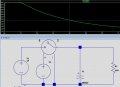
Ron: R1 will limit the current. The bulb may not light. The cap will hardly charge because the bulb will drain it faster than it can charge.
Tony, without R1 as I drew the circuit what will be the cahrge time of the capacitor? Make the capacitor 1,000 uF. Personally with what I now see the OP wants I would just place a large cap across the load and not worry about any RC network. Problem is the thread starter has yet to actually define a load?

Ron
 

MisterBill2

Joined Jan 23, 2018
27,659
It seems as though the load has been defined as 460 ohms, probably just resistive, not inductive.. At 24 volts DC it is obviously not directly mains powered, and so if there is a rectifier power supply of some current capacity then the fix is simple, but not really cheap. Just adding an adequate amount of capacitance across the supply output will solve the problem. The load current is a bit less than 50 milliamps and so the capacitor value to allow a drop of 10% voltage in whatever outage time is selected can be calculated with the RC time constant formula, using 460 ohms to get the exact number.
One serious caution is that it might be that a diode is needed, if the supply circuit can draw current when the output is powered and the input is not. Some regulator circuits will do that.
 

Tonyr1084

Joined Sep 24, 2015
9,744
From post #7.
koya-47 said:
the circuit is supposed to maintain power to a device during momentary power losses (device will be in place of the bulb). The device has a resistance of about 460 ohms
Problem is the thread starter has yet to actually define a load
No definition on what the load is. OK, it's about 460Ω. But what does that mean? An incandescent bulb will have a cold resistance (as already discussed). But its working resistance is far different from its cold resistance. And Mister Bill said:
It seems as though the load has been defined as 460 ohms, probably just resistive, not inductive
"Probably resistive, not inductive". Probably but not necessarily. This is why so many of us ask for more details. An experimenter doesn't come with a pre-set body of knowledge. An "Assumed" resistance is just that; an assumption. Even if measured, we still don't know what type of load it is. Is it a transformer? Is it an inductive load? Is it purely a resistive load? This is why I said in post # 18
Without knowing what the device is and its characteristics you can't get an answer to your question.
 

MrSalts

Joined Apr 2, 2020
2,767
An "Assumed" resistance is just that; an assumption. Even if measured, we still don't know what type of load it is. Is it a transformer? Is it an inductive load? Is it purely a resistive load? This is why I said in post # 18
Are you really asserting that a "bulb" may be a transformer? Or that we should not "assume" that a bulb is a resistive load?

Sure people can claim they didn't read all the posts but I'd assume you would at least read the first sentence of the first post.
 

Tonyr1084

Joined Sep 24, 2015
9,744
Are you really asserting that a "bulb" may be a transformer? Or that we should not "assume" that a bulb is a resistive load?

Sure people can claim they didn't read all the posts but I'd assume you would at least read the first sentence of the first post.
My intention is to heighten the suspicion that the TS might not fully understand the differences. When I was young to electronics I thought I could read the resistance of a device (as yet unspecified) and assume it to be a resistive load. I can read the resistance of the primary of a transformer, but we all know that is not the right way to approach transformers. And if we ARE discussing a DC circuit there can still be inductive controls in the project circuit. An inductor will change the reading of the project circuit from cold resistance testing versus live circuit testing.

I'm not convinced the TS fully understands the differences. I certainly didn't when I was new to electronics. In fact, inductance is still somewhat a mystery to me. OK, probably an easy learn, but one I've never pursued. I've always messed with transistors, capacitors, diodes and resistors (so to say). IC power is possibly a different set of circumstances, but I don't know that for a fact. Really, I'm a novice novice. Not even just a simple novice. I know a little. That's often why I get into trouble with posts and with projects. Simple stuff - I'm OK with. More complex - - - .
 

djsfantasi

Joined Apr 11, 2010
9,237
Are you really asserting that a "bulb" may be a transformer? Or that we should not "assume" that a bulb is a resistive load?

Sure people can claim they didn't read all the posts but I'd assume you would at least read the first sentence of the first post.
The bulb is just being used as a test. It is not the final load. Read post #7 again.

EDIT: Added quote of post being replied to.
 
Last edited:

Tonyr1084

Joined Sep 24, 2015
9,744
The bulb is just being used as a test. It is not the final load.
I've known that from the beginning. Now, IF the bulb is a good representative of the final load then we can discuss this in further detail. But if not - and this is what we DON'T know. The "Final Load". What is it?
 

Tonyr1084

Joined Sep 24, 2015
9,744
I have a battery powered electronic fly zapper. It starts with DC but that is changed into an oscillating voltage that charges a high voltage capacitor. A 1.5V battery drives circuitry that produces 5KV (or something like that). Measuring the resistance of the input voltage (not the battery) will not give a good model of the final load. That transistor needs to switch on and off depending on the capacitors charge state. I think! Nevertheless, substituting a bulb for the circuit will not produce the same results.
 

ElectricSpidey

Joined Dec 2, 2017
3,336
The resistor in the circuit does nothing but create an instant voltage drop across the load, when the power is removed.

To keep the load voltage above 8 volts the following values can be used.

2200uf...aprox 1 second
4700uf...aprox 2 seconds
6800uf...aprox 3 seconds

AAC_Power_Drop.JPG
 

MisterBill2

Joined Jan 23, 2018
27,659
This is why I stated that it will take a lot of capacitance. Really, the TS needs a set of the ulracapacitors good for 24 volts. But that is indeed a big deal.
And if the load is inductive then it is possible to shunt it with a diode and keep it energized for at least one LC time constant. I have done that with noisy power contactors used to switch lighting arrays, One diode shunting the coil and another diode, opposite polarity, in series with the mains feed to the coil. two diodes in anode-to-anode connection with the coil across one of them.
 
Top