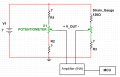
Wheatstone bridge design

Thread Starter

beedees

Joined Mar 29, 2015
37
Hi everybody! :)
I have to realize a Wheatstone bridge to measure strain with a strain gauge. I have a 120 ohm self temperature compensated strain gauge, so I would like to build a quarter bridge configuration i.e. the strain gauge is one of the four resistors.
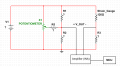
Immagine senza nome.png

The maximum deformation is 500 microstrain and my idea is to use a microcontroller (MCU) with a 10 or 12 bit ADC.
But the biggest problem is to choose completion resistors (tolerances, ppm/°C,...) in order to obtain a high sensitivity and at the same time an acceptable precision.
In a few words I have to size all bridge's elements (resistances, tolerances, ...).
I don't expect you tell me everything, but if you can give me some advice to do this project!
I think to start calculating the maximum initial unbalance i.e. a worst case analysis, but I can do it if I know tolerances!
Any idea?
Thank you!!
 

Thread Starter

beedees

Joined Mar 29, 2015
37
It is a linear Strain Gauge, the measuring grid material is costantan and the lenght is 3 mm. The nominal resistance is 120 ± 0.35% ohm. I don't know the exact value of gauge factor but it is approx. 2 ± 1% and its temperature coefficient is aprox. (115 ± 10) · 10^-6. The reference temperature is 23 °C. I have to install it on a ferritic steel support so the temperature response is 10.8 · 10^-6 1/K.
I don't understand why you use two potentiometer. Is better than one in parallel to the bridge? Because I know that you can use Pulse Width Modulation and a RC filter instead of a potentiometer. Sorry, but I haven't said before:rolleyes:
 

ScottWang

Joined Aug 23, 2012
7,501
It is a linear Strain Gauge, the measuring grid material is costantan and the lenght is 3 mm. The nominal resistance is 120 ± 0.35% ohm. I don't know the exact value of gauge factor but it is approx. 2 ± 1% and its temperature coefficient is aprox. (115 ± 10) · 10^-6. The reference temperature is 23 °C. I have to install it on a ferritic steel support so the temperature response is 10.8 · 10^-6 1/K.
I don't understand why you use two potentiometer. Is better than one in parallel to the bridge? Because I know that you can use Pulse Width Modulation and a RC filter instead of a potentiometer. Sorry, but I haven't said before:rolleyes:
Since the important thing in a Wheatstone bridge is the balance, so the resistors of top two must be the same values when it keep balance, the bottom two also the same, the potentiometer of the right one just to do a little adjust when the Strain Gauge can't flows though too mach current, you may remove it.

How many volts of the V1, 3.3V,5V?
How many mA does the Strain Gauge could afford it?
 

Thread Starter

beedees

Joined Mar 29, 2015
37
I don't know the maximum current the strain gauge could afford it, but in the datasheet there is the maximum permissible effective bridge excitation voltage that is 3.5 V. It reports that only half the voltage may be applied to the individual strain gauge so I deduct the maximum current is 3.5/(120+120)= 14.6 mA. So I think to use V1 = 3.3 V.
To obtain the highest sensitivity of the bridge I have to use 120 ohm completion resistors, because the strain gauge is 120 ohm, right? I don't know if it's better to use other values of completion resistances, for example to limit the current flow in bridge's arms. But if V1=3.3V I think that it isn't a problem because I install the strain gauge on a steel support so on material featuring excellent heat conduction characteristics!
However i have to use resistors characterized by small tolerances and small ±ppm/°C, right? But if I null the bridge and then I measure the strain is it a big problem if I use resistors characterized by different or high tolerances?
During the measure the temperature could change hence I should choose small TCR values and usually TCR is ±ppm/°C or +ppm/°C or -ppm/°C. If the temperature changes the resistance changes too, so bridge's output isn't null anymore. But if the resistances of an arm are characterized by the same TCR there should be no problem, ideally. Am I right?
Sorry for my English!:rolleyes:
 

ScottWang

Joined Aug 23, 2012
7,501
The balance things that we should care about are the top two resistors should be equal and the bottom two also the same, so you may not necessary to use the same values of R3 with strain gauge as 120Ω.

Using the maximum current is 3.5/(120+120)= 14.6 that was what I thought in the beginning, but I was concerned about the unknow current of strain gauge, although I didn't talking about it, but I added the pot to protect it, that's why you asked why I need two pot.

Do you have the datasheet of strain gauge?
What is the full name of TCR, I think it is related with the temperature?
I thought about the output polarity of Wheatstone bridge, the output could be changing the polarity, it also affecting the input of amplifier, so what is the circuit of amplifier?

I just think that does the output of Wheatstone bridge needs to adding two 1N4148 to guiding the polarity?

What kind of uC are you using, and the Vcc?
 

Thread Starter

beedees

Joined Mar 29, 2015
37
Do you have the datasheet of strain gauge?
I have attached the datasheet, but some parameter is specified on each package and unfortunately I haven't it.

What is the full name of TCR, I think it is related with the temperature?
Temperature Coefficient of Resistance (or tempco) indicates the temperature dependence of resistance.

I thought about the output polarity of Wheatstone bridge, the output could be changing the polarity, it also affecting the input of amplifier, so what is the circuit of amplifier?
I just think that does the output of Wheatstone bridge needs to adding two 1N4148 to guiding the polarity?
What do you mean? Yes the output voltage could be positive or negative, for example positive is traction and negative is compression of the steel. I think to use a simple instrumentation amplifier.

What kind of uC are you using, and the Vcc?
I have an Arduino or I can use a PIC microcontroller or a STMicroelectronics microcontroller with 10 or 12 bit ADC. Do you think I have to choose it before build this circuit?
 

Attachments

Top