What's wrong with my 556?

Thread Starter

cmartinez

Joined Jan 17, 2007
8,759
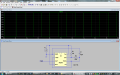
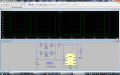
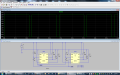
So I modeled this circuit, which is a very simple two 555s in tandem (sorry @MikeML, I haven't been able to make the 556 that you gave me work yet, but I will soon). The first 555 (labeled as Lapse) is supposed to trigger the second 555 (labeled as Spray). And both timers are supposed to be independently adjustable, depending on the values of Ra and Ca, and Rb and Cb.

In the end, this circuit is supposed to behave exactly like a PWM, but something is wrong with it. Every time I try to raise the value of Ca above 0.2uF the circuit stops working. Raising that value is supposed to make the cycle of Lapse last longer, but it doesn't. Funny thing is that if I raise the value of Ra then there's no problem at all.

I want to be able to tweak those values (Ra and Ca, and Rb and Cb) independently so I can adjust for much longer cycles. I'd like to make Lapse (Out1) last a minimum of 30 seconds and a maximum of 4 minutes, while Spray (Out2) would last a minimum of three seconds, with a maximum of 45 seconds.

I'd be doing that by substituting Ra and Rb with potentiometers, of course. But I just can't make this thing work the way I want in the simulator in the first place.

What am I doing wrong?


Untitled.png
 

Attachments

MikeML

Joined Oct 2, 2009
5,444
Here is a way of making time-high and time-low independently adjustable. No interaction between the two timing resistors.

A Bipolar 555 is a bit marginal at Vcc=5V; can you run it on a higher voltage? If not use the CMOS version...
 

Attachments

Thread Starter

cmartinez

Joined Jan 17, 2007
8,759
Here is a way of making time-high and time-low independently adjustable. No interaction between the two timing resistors.

A Bipolar 555 is a bit marginal at Vcc=5V; can you run it on a higher voltage? If not use the CMOS version...
Yeah... I can run it at 12V, no problem... I normally use 5V in my circuits to make it compatible to most others I've done.
Let me play with this generous gift of yours, and then I'll get back to you.
 
Last edited:

Thread Starter

cmartinez

Joined Jan 17, 2007
8,759
Here's my final tweak of your circuit. I found out that it has the very slight disadvantage of its turn on - turn off times not being completely independent, that is, both cycles are dependent on C1, and therefore there's a range limit that applies to this design. But thankfully, I was able to adjust its values so that the ranges work Ok for what I want to do, and using commercially available components. R2 and R5 will be pots in my final assembly.


Timer Tocayo 03.png

I'm definitely going to use this circuit because of its sheer simplicity... I perfectly understand the purpose of the diodes here... but I'm not sure what they're doing in your circuit in post #2. are they aiding the discharge of C3 and C5 so as to correctly trigger the timers?

Many, many thanks!
 

Attachments

MikeML

Joined Oct 2, 2009
5,444
...I perfectly understand the purpose of the diodes here... but I'm not sure what they're doing in your circuit in post #2. are they aiding the discharge of C3 and C5 so as to correctly trigger the timers?...
When the output of the upstream 555 switches from low-to-high, the voltage at the trigger pin shoots up to twice Vcc, which violates the absolute max voltage allowed per the data sheet. The diodes clamp the voltage on the trigger pin to one diode drop above Vcc. I dont think this was the cause of your mistriggering...

I made the trigger coupling capacitor bigger at the same time. I think the triggering pulse was too short with 10K and 1nF. I think that is what fixed your original problem.
 

Brownout

Joined Jan 10, 2012
2,390
cmartinez said:
I found out that it has the very slight disadvantage of its turn on - turn off times not being completely independent, that is, both cycles are dependent on C1, and therefore there's a range limit that applies to this design.
The circuit isn't intended to have independent control of high and low times. Rather, it's intended to do this:

cmartinez said:
this circuit is supposed to behave exactly like a PWM,
 

MikeML

Joined Oct 2, 2009
5,444
Since in the circuit of post 6 I am not using a pot (which makes one resistor smaller at the same rate the other gets bigger), then the oscillator I presented is not a like pwm, where the sum of on time and off time stays (period is almost) constant.


So how asymmetrical do you want the high/low times to be? Since the timing resistor can vary from a minimum of ~2K up to several meg, the asymmetry could be easily be +-1:1000
 

Brownout

Joined Jan 10, 2012
2,390
Since in the circuit of post 6 I am not using a pot (which makes one resistor smaller at the same rate the other gets bigger), then the oscillator I presented is not a like pwm, where the sum of on time and off time stays (period is almost) constant
This is true. And now that I look a second time, neither is the circuit in post #8. If the TS wants independent control of on/off times, he may employ two pots, one for each path to the timing capacitor. This will provide independent control of on/off times, even though both use the same capacitor, the RC constant will be independent. If he wants PWM, he can employ a single pot connected in a differential manner.

One thing I always wanted to try was to substitute MOS transistors in place of the pots so that a voltage could control the duty cycle. Never took the time though.
 

Thread Starter

cmartinez

Joined Jan 17, 2007
8,759
...One thing I always wanted to try was to substitute MOS transistors in place of the pots so that a voltage could control the duty cycle..
Voltage-controlled duty cycle, very interesting... Maybe that could be more easily done if a triangle wave were generated first, and then connected to one input of a comparator, and the second input to the voltage doing the control?
 

Brownout

Joined Jan 10, 2012
2,390
Maybe that could be more easily done if a triangle wave were generated first, and then connected to one input of a comparator, and the second input to the voltage doing the control?
That's a more conventional way. But there are a couple reasons you might want to use a timer. For one, the same thing can be accomplished with one IC instead of (at least) two. You can use the timer's built-in hysterisis along with its tight thermal coupling. And, you might want the pulse to start at the same time, regardless of the duty cycle, if for example, you are synchronizing the pulse to some other event.

And sure, there are lots of other ways to do the same thing. I just prefer to work at a lower level for non-commerical, non-professoinal projects.
 
Last edited:

Thread Starter

cmartinez

Joined Jan 17, 2007
8,759
That's a more conventional way. But there are a couple reasons you might want to use a timer. For one, the same thing can be accomplished with one IC instead of (at least) two. You can use the timer's built-in hysterisis along with its tight thermal coupling. And, you might want the pulse to start at the same time, regardless of the duty cycle, if for example, you are synchronizing the pulse to some other event.

And sure, there are lots of other ways to do the same thing. I just prefer to work at a lower level for non-commerical, non-professoinal projects.
Yup, simpler is always better... and my proposal is more complicated, though easier to understand (at least for me ;))
Let's say I wanted to use a DC motor back EMF to regulate it's speed through PWM, and there's a sudden change in load. Which approach do you think would work best?
 

Brownout

Joined Jan 10, 2012
2,390
From the persepctive of controlling the speed of a DC motor, any method that produces a clean PWM would work equally well.
 

Brownout

Joined Jan 10, 2012
2,390
Back in the day, we used to bench test flip flops setup and hold time by delaying a signal in the "D" input to just before and just after the clock signal. The input signal was nothing more than a vairable duty cycle pulse, synchronized to the flip flop 'clock' signal.
 
Top