What's the difference between the CD4060BE Chip and the HEF4060B Chip

Thread Starter

ConstantineOfTexas

Joined Jun 27, 2017
45
In the HEF4060B product data sheet [ https://assets.nexperia.com/documents/data-sheet/HEF4060B.pdf ], Section 12.1 on pages 7-8 state

The oscillator frequency is mainly determined by Rt  Ct, provided Rt << R2 and R2 * C2 << Rt * Ct.
.
.
.

The recommended values for these components to maintain agreement with the typical oscillation formula are: Ct => 100 pF, up to any practical value, 10 kOhm <= Rt <= 1 MOhm.
In other words:
1) Rt << R2
2) R2 * C2 << Rt * Ct
3) Ct => 100 pF

4) 10 kOhm <= Rt <= 1 MOhm

Further, in Bright Hub [ https://www.brighthubengineering.co...imer-oscillator-circuits-using-a-single-chip/ ], we have:

The resistor at pin #11 can be considered as some sort of clamping or reference resistor whose value must be ideally 10 TIMES more than the resistor connected at pin #10 (combined value of the pot and the fixed series resistor).
Or:
5) R2 = 10* Rt

A rather troublesome set of parameters. Ideally, I would lime to make Q9 roughly an hour or 3600 seconds. A 10 kOhm Resistor with a 0.000001 Microfarad Capacitor will give me only 2226 seconds.I do have a 100 kOhm Resistor but I doubt that a 0.0000001 Microfarad Capacitor is even on the market.

My only hope is that the CD4060BE Chip and the HEF4060B Chip are sufficiently different so that these "Laws" do not apply.
 

MrChips

Joined Oct 2, 2009
34,630
In the HEF4060B product data sheet [ https://assets.nexperia.com/documents/data-sheet/HEF4060B.pdf ], Section 12.1 on pages 7-8 state

The oscillator frequency is mainly determined by Rt  Ct, provided Rt << R2 and R2 * C2 << Rt * Ct.
.
.
.

The recommended values for these components to maintain agreement with the typical oscillation formula are: Ct => 100 pF, up to any practical value, 10 kOhm <= Rt <= 1 MOhm.
In other words:
1) Rt << R2
2) R2 * C2 << Rt * Ct
3) Ct => 100 pF

4) 10 kOhm <= Rt <= 1 MOhm

Further, in Bright Hub [ https://www.brighthubengineering.co...imer-oscillator-circuits-using-a-single-chip/ ], we have:

The resistor at pin #11 can be considered as some sort of clamping or reference resistor whose value must be ideally 10 TIMES more than the resistor connected at pin #10 (combined value of the pot and the fixed series resistor).
Or:
5) R2 = 10* Rt

A rather troublesome set of parameters. Ideally, I would lime to make Q9 roughly an hour or 3600 seconds. A 10 kOhm Resistor with a 0.000001 Microfarad Capacitor will give me only 2226 seconds.I do have a 100 kOhm Resistor but I doubt that a 0.0000001 Microfarad Capacitor is even on the market.

My only hope is that the CD4060BE Chip and the HEF4060B Chip are sufficiently different so that these "Laws" do not apply.
You have two different values of capacitance stated in your post.
0.000001μF = 1pF
0.0000001μF = 100fF

What is your question?
 

Thread Starter

ConstantineOfTexas

Joined Jun 27, 2017
45
In my first reference about the HEF4060, page 7, Fig. 6, there are two Capacitors:
Ct = 0.000001μF = 1pF
C2 = 0.0000001μF = 100fF , a value which probably does not exist. I spent this afternoon looking for one from Electronics Parts Suppliers.

I notice that C2 is not used in some of the Circuits using the CD4060BE, i.e. C2 = 0, making condition 2 above automatically fulfilled.

I also notice that the same diagram uses 2.3 in the formula Fosc = 1 / (2.3* Rt* Ct) instead of 2.5, like everybody else.

Are the CD4060BE Chip and the HEF4060B Chip the same Chip,equivalent Chips, or different Chips???
Circumstantial evidence implies they could be different.
 

eetech00

Joined Jun 8, 2013
4,704
In my first reference about the HEF4060, page 7, Fig. 6, there are two Capacitors:
Ct = 0.000001μF = 1pF
C2 = 0.0000001μF = 100fF , a value which probably does not exist. I spent this afternoon looking for one from Electronics Parts Suppliers.

I notice that C2 is not used in some of the Circuits using the CD4060BE, i.e. C2 = 0, making condition 2 above automatically fulfilled.

I also notice that the same diagram uses 2.3 in the formula Fosc = 1 / (2.3* Rt* Ct) instead of 2.5, like everybody else.

Are the CD4060BE Chip and the HEF4060B Chip the same Chip,equivalent Chips, or different Chips???
Circumstantial evidence implies they could be different.
Hi

I looked at the page and I don't see any reference to the values you mentioned anywhere on the page.

The specs for both chips look very similar (except max voltage is 20v for the TI part) so I would say you could interchange them.
There gonna be a difference in the tolerances of the part that could affect timing, but the RC circuit should be designed so its tuneable anyway, so that shouldn't be an issue.

eT
 

Thread Starter

ConstantineOfTexas

Joined Jun 27, 2017
45
Hi

I looked at the page and I don't see any reference to the values you mentioned anywhere on the page.

The specs for both chips look very similar (except max voltage is 20v for the TI part) so I would say you could interchange them.
There gonna be a difference in the tolerances of the part that could affect timing, but the RC circuit should be designed so its tuneable anyway, so that shouldn't be an issue.

eT

Firstly, Mohan uses 2.5 . He isn't the only one, just the first example I could find.
Secondly, I am beginning to think that eetech00 is correct about the specs being similar, if not interchangeable. I am going to solve the problem by deleting C2, i.e. C2 = 0.

eetech00 bears bad news from my point of view, but I think I found a workaround and I'm going to stretch the rules.
 

Alec_t

Joined Sep 17, 2013
15,105
A 10 kOhm Resistor with a 0.000001 Microfarad Capacitor will give me only 2226 seconds.
Then use a higher value capacitor. 1pF is totally impractical, as it is (a) outside the datasheet recommended range and (b) in the same ball-park as stray capacitance, so likely to be drastically affected by the environment.
 

Thread Starter

ConstantineOfTexas

Joined Jun 27, 2017
45
Then use a higher value capacitor. 1pF is totally impractical, as it is (a) outside the datasheet recommended range and (b) in the same ball-park as stray capacitance, so likely to be drastically affected by the environment.


My last circuit didn't work, so I'll take your suggestion. Right now in the prototype stage, getting it to work is the priority. Tweaking comes later.
 

AnalogKid

Joined Aug 1, 2013
12,054
You can ignore C2. It is not on the original Motorola datasheet.

You don't say which you want for Q10, a period of 1 hour or an on-time of 1 hour.

Let's go with an on-time of 1 hour.

That is a cycle period of 2 hours, or 7200 s. That is a frequency of 0.00013888 Hz.

Multiply by 1024 (2^10) to get the clock frequency, 0.14444 Hz.

Start with an arbitrary Rt value of 100K just to see where we are.

Using the datasheet equation, Ct = 30.57 uF.

That's pretty large for this kind of circuit. Consider using the Q14 output. This reduces Ct to 1.9 uF, a much more reasonable value.

Next, adjust the capacitor value to a real-world value such as 1.5 uF or 2.2 uF and recalculate for a new value of Rt.

If you are stuck with using Q10, consider adding another counter chip after the 4060 to get your output. The more counter stages there are, the smaller Ct gets. A small value for Ct is better, because large capacitors have leakage current, as if there is a large value resistor in parallel with the capacitor. This means it takes a longer time to charge the capacitor up to a specific voltage value, so the oscillator will run slower than calculated. A 30 uF electrolytic capacitor definitely will leak more than a 2.2 uF ceramic.

Now, about R2. B series CMOS devices have ESD (static electricity) protection circuit on input pins. The circuit includes two diodes, one to each power rail. Each time the oscillator changes state, a voltage of approximately *twice* the chip's power supply voltage (Vdd on pin 16) appears on pin 11. This spike is clipped by the internal diodes, R2 limits the current to a safe value, and all is well, but that clip draws extra current through R2. This charges or discharges Ct a bit faster than the equation indicates, raising the oscillator frequency. The larger R2 is, the less the freq deviates from the equation. The 10:1 rule of thumb is a convenient and correct starting point for R2, but it is not an iron-clad rule. You can do things like Rt = 1 M to get Ct even smaller, and R2 = 1 M so you don't have super-large resistors causing noise problems, as long as you understand the consequences.

ak

NOTE - updated with more detail.
 
Last edited:

AnalogKid

Joined Aug 1, 2013
12,054
I think you learn more if you read the data sheet, follow its application advice, build it, measure it, see the differences, and figure out what is going on.

ak
 

Thread Starter

ConstantineOfTexas

Joined Jun 27, 2017
45
I have been scouring the data sheets looking for clues as well as the Schematic of the CD4060 project that I consider to best follow the KISS Principle, i.e. the Mohan Article previously cited. . I used Excel to create a table of the resistors and capacitors I have, resisters in Rows, Capacitors in Columns to calculate the times of each combination of resistors and capacitors. I used: C1 = .0001mF; R1 =10KOhms; R2=`100KOhms. This was my first success with the CD4060. This set of resistors and capacitors are consistent with Rules 3,4,and 5 above. I am glad to report my initial success.

I did learn that the various articles often contradict each other I now need to slow down the blinking, which will be my next task. I do read the specs, but they are not always clear to me. After all, I cited 3 or 4 references in this thread. As things develop , I plan to post my results.
 

Thread Starter

ConstantineOfTexas

Joined Jun 27, 2017
45
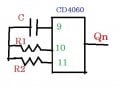
I now know the highly simplified Question I should be asking. The CD4060 has two major inputs, Pin 9 & Pin 10. (Pin 11 is 10 x Pin 10, making this pin dependent on another and therefore not major.). We have several Q outputs, Q3-Q9, Q11-Q13, but I will summarize down to one pin, Qn. I want to do Time Calculations, paying special attention to the calculation and units of the Time Delay Output. Proceeding like a Mathematician to set up the problem, we start with a simplified diagram:

Cd4060.jpg


First, let n =F(Qn), i.e. a function to give us the index of Q, a unit-less pure number.
C = Farad Value of Pin 9
R = Ohm value of Pin 10


T = 2^n /(2.3*C*R)

Are we dealing with that RC = τ Time Constant???

Are we dealing with, after all the cancellations between micros and millis with the kilos and megas to just get plain old vanilla "ohms times farads" ???
 

MrChips

Joined Oct 2, 2009
34,630
You are on the right track, almost.
R2 in your diagram is also Rs in some datasheets. This does not affect the period as much as R1.

Your forumla is not correct.

The period of the oscillator is

T ≈ (2.3RC)

Hence if
R = 1MΩ
C = 1μF

T ≈ 2.3 seconds
f = 1 / T = 0.43 Hz

The period at Qn is
2^n x T = 2^n x (2.3RC)

Make sure that your capacitor C is not electrolytic.
 

Thread Starter

ConstantineOfTexas

Joined Jun 27, 2017
45
You are on the right track, almost.
R2 in your diagram is also Rs in some datasheets. This does not affect the period as much as R1.

Your forumla is not correct.

The period of the oscillator is

T ≈ (2.3RC)

Hence if
R = 1MΩ
C = 1μF

T ≈ 2.3 seconds
f = 1 / T = 0.43 Hz

The period at Qn is
2^n x T = 2^n x (2.3RC)

Make sure that your capacitor C is not electrolytic.

The M and the μ cancel , which is the point. The point about Electrolytic vs. Non-Electrolytic is a topic I am deferring to a different thread.
 
Top