I'm a bit concerned for your safety, working with hundreds of volts and asking questions like this do not make me confident that everyone will still be healthy tomorrow.
Be careful and remember that a real professional can be hired to check out what you plan to do for a much lower price than a hospital bill or a funeral.
Dear, thank you very much for your sincere feelings for me,can u pl. tell me my answer for very low voltage rating diode which ever you know 1N4001 of which i have attached data sheet. pl. reply for this part no.
once again thanks for my sincere care.
I would test it at about 10% above its PIV rating. That way, anything you ship to a real customer will meet their acceptance test. Anything that fails the test, ship to China so they can sell it as a counterfeit part on EBay!
Dear, thank you very much for your sincere feelings for me,can u pl. tell me my answer for very low voltage rating diode which ever you know 1N4001 of which i have attached data sheet. pl. reply for this part no.
once again thanks for my sincere care.
50V is just the borderline into the danger for humans.
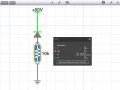
Here is a simple circuit for the 1N4001. I recommend that you measure current INDIRECTLY. This means, measure the voltage across a resistor and calculate the current.
Test it at 50V DC per the datasheet.
For the safest test, connect everything including volt meter with power supply turned off.
Then, with one hand in your pocket, turn on power supply.
Volt meter should be connected across the 10k resistor.
If volt meter shows more than 0.3V, then you have more than 30 micro Amps of leakage (spec).
50V is just the borderline into the danger for humans.
Here is a simple circuit for the 1N4001. I recommend that you measure current INDIRECTLY. This means, measure the voltage across a resistor and calculate the current.
Test it at 50V DC per the datasheet.
For the safest test, connect everything including volt meter with power supply turned off.
Then, with one hand in your pocket, turn on power supply.
Volt meter should be connected across the 10k resistor.
If volt meter shows more than 0.3V, then you have more than 30 micro Amps of leakage (spec).
dear gopher,
i really appreciate your care for me & thanks for ur detailed answer.
it concludes like these ~
0) if we give 50 vdc in reverse bias to diode & corresponding mili amp. reading should not be more than 30 micro amp..Than the diode is ok in reverse bias test.( here we simply connect + of 50 volt dc to K & - of 50 to A thr' series connection of mili amp. meter)
1) pl. tell me how much dc volt we have to give in forward bias test? (here we connect +ve of DC to A & - of dc to K)
am i correct for reverse bias test. if yes than is is ok.or pl.make the req. correction.
same way yet i am not clear with ur reply for forward bias test.pl. make it more easy to make me understand it correctly.
0) if you only give a fraction of the max reverse voltage you may test to a lower current. Do not use 50 volts, use the largest voltage you can obtain.
Yes, this is a dangerous test so observe proper precautions.
1) the way I would do this is to set the current limit to the desired current (here the max of 4 amps), then turn the voltage to zero. Now connect to the device under test and turn the voltage up till the current limit is reached. Read the resulting voltage, disconnect, connect the next device. repeat till the entire lot is complete.
I have a question regarding the 320umr60 diode, what is the application where it will be used?
If it is rectifying 230 V RMS and there is a filter capacitor that can store the peak value of 325 V, then the diode will need to withstand twice that value repeatedly. That's approximately 650V peak. The max for that diode is 600 VDC or 600 VRRM. In this case the 320umr80 diode would be a better choice. However if the load is non-capacitive then the 320umr60 is good.
I have a question regarding the 320umr60 diode, what is the application where it will be used?
If it is rectifying 230 V RMS and there is a filter capacitor that can store the peak value of 325 V, then the diode will need to withstand twice that value repeatedly. That's approximately 650V peak. The max for that diode is 600 VDC or 600 VRRM. In this case the 320umr80 diode would be a better choice. However if the load is non-capacitive then the 320umr60 is good.
it is used in railways diesel locomotives in which it allows current to pass in one direction only ie it is a bridge between battery & generator of locomotive & the diode is fixed on heatsink with axial capacitor of 1mfd 400 volt.
0) if you only give a fraction of the max reverse voltage you may test to a lower current. Do not use 50 volts, use the largest voltage you can obtain.
Yes, this is a dangerous test so observe proper precautions.
1) the way I would do this is to set the current limit to the desired current (here the max of 4 amps), then turn the voltage to zero. Now connect to the device under test and turn the voltage up till the current limit is reached. Read the resulting voltage, disconnect, connect the next device. repeat till the entire lot is complete.
0) so i as i have maximum 230volt dc faciltiy i can go upto 230 vdc for reverse bias, of course with due precaution.
it is very clear to me that for reverse current test Vrrm is 600 vdc & Irm is 12 mA.
so suppsed some one has 600 vdc capacity than we can apply 600 vdc for this test & the result sholud not be more than 12mA. Right?
1) but yet i am not clear reg. forward current test, that how much current should it come at what applied voltage?
pl.tell me both volt & current value for this test.
1) If you had 320 amps available you could do the specified test to a max of 1.65 volts. Since you only have 4 amps available you need a lower limit, but no hard numbers are specified for lower currents. Figure 1 gives curves for many values, but these are typical values. At 4 amps the device has about a .7v drop typically. You will have to determine your own maximum.

 Facebook
 Google
 GitHub
 Linkedin