what limits current capabilities of switching PS's?

Thread Starter

Rocky_circuits

Joined Nov 1, 2011
57
Hello!

I'm trying to understand how controller operated switching power supplies have a maximum current rating. As far as I can tell, the output current capability is only limited by the proper spec of the Inductor, MOSFET, Diode, and Cout. When I use WEBENCH, I can't seem to increase the current rating of this schematic above 2A. I'm confused why I can't go higher? Maybe all of this is a WEBENCH issue.

If that's the case, how do I increase the current capability of the schematic below?

To setup the question,
I'm trying to make a really bright light using an LED with these specs:
  • Vf = 69.4 V
  • Inom = 1710 mA
  • Imax = 3420 mA

To operate this light, I want to use an LM3478 to boost my voltage, and a separate chip to act as current regulation (analogue & PWM dimming)
Using WEBENCH from Texas Instruments, the following is a schematic for these specs:

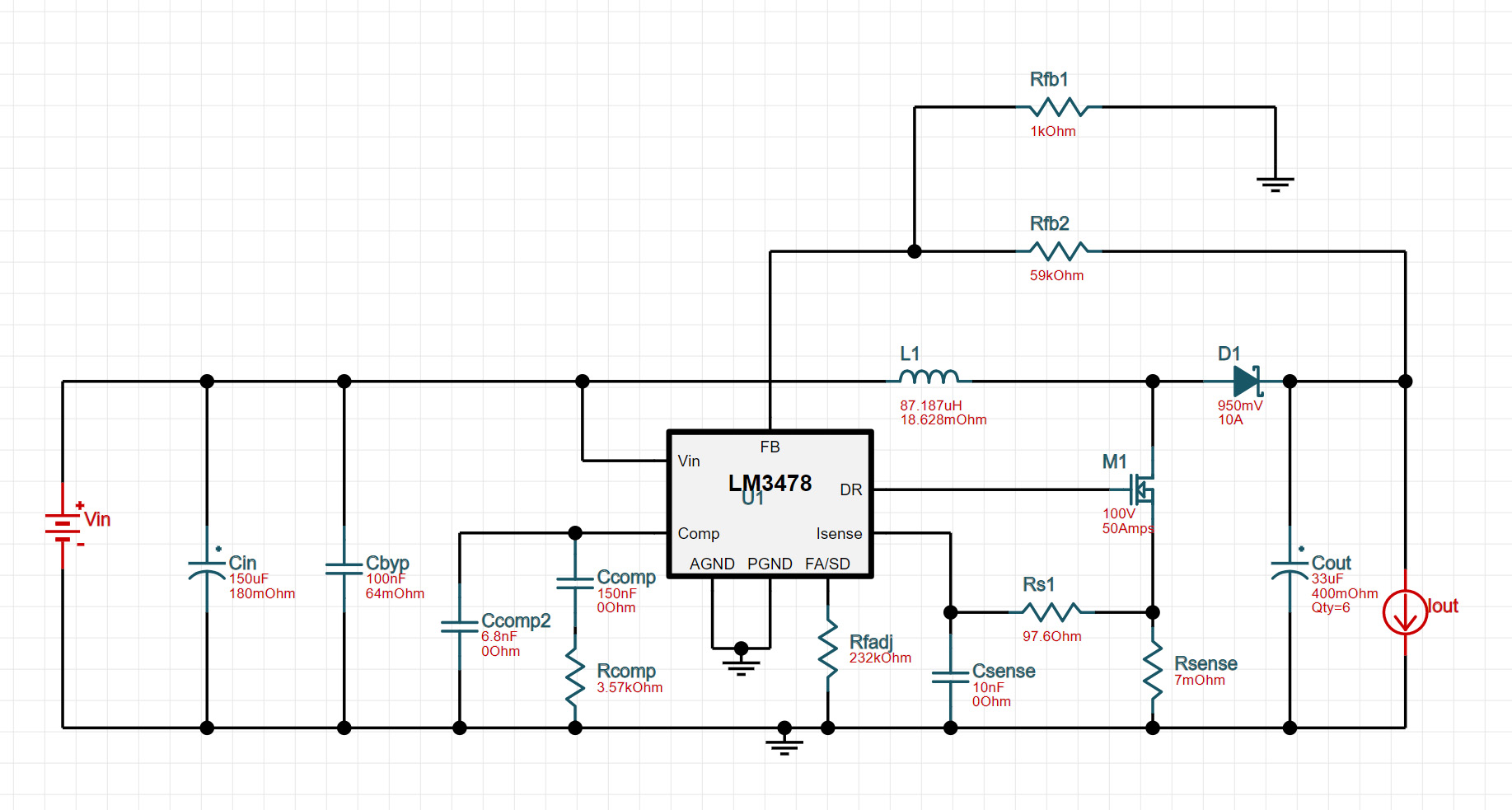


To reiterate, this is the power supply that I would then feed into a current regulator (such as the LM3409HV)
If you noticed above, the LED that I want to use has a rating listed up to 3420mA (assuming proper heat sink of course). So with that in mind, I'd like to make the schematic above capable of, say, 5A for some headroom.

What would I have to changed in the schematic above to allow for an I-out = 5A capability?

If there's any other information I can provide, please let me know! I'm always learning and want to know the best way to go about these things. I'm almost done with my comp. sci. major and have found a greater fascination in electronics, and the greatest of interest in combining them together. I digress, I appreciate any and all information from you :)
 

ebp

Joined Feb 8, 2018
2,332
I only have a minute for now, so a very brief answer:

Rsense sets the peak current in the FET which is equal to the peak current in the inductor. The ratio of peak current to average current, for a given input to output voltage ratio and switching frequency, depends on the inductance. Low inductance will make the peak to average ratio high. I haven't looked at the data for the controller, but typically the maximum voltage threshold at the current sense input is under a volt. A "current mode" controller will regulate by controlling the current in the inductor directly. A "voltage mode" controller will simply use the current sense as a means of protecting everything from excessive current (not quite true in a boost because of the direct input to output path through the inductor and diode.
 

-live wire-

Joined Dec 22, 2017
959
I think a CC boost converter would make a lot more sense. It would mean less components required, cost less, take up less space, and be a lot more efficient.
 

ebp

Joined Feb 8, 2018
2,332
OK, I've had a brief look at the datasheet. Was the 7 milliohm sense resistor calculated by WEBENCH? For 2 A or 5 A?

The first example circuit in the datasheet is for 2A out and has a 25 milliohm sense resistor. Your boost ratio is somewhat higher, but overall (without actually doing all the calc's) 7 milliohms does not seem unreasonable for 5 A output. For 5 A output at 75 V, the average input current would be 15.3 A at 100% efficiency. If the peak current is 15% higher, 7 milliohms would yield about 123 mV, which again is not an unrealistic value (see datasheet Figure 30).

I suspect you may be right that WEBENCH is not doing something right - a 5 does look a bit like an upside down 2 ;). Since the datasheet covers all of the calculations and those for the switching frequency, inductor and sense resistor should be fairly simple in terms of values, I suggest checking the calc's using the datasheet formulae. Some people are big on single equations that yield "final" results. I prefer what is usually the easier way, especially with a spreadsheet, of calculating intermediate values because they are often instructive in terms of what is actually going on and are often useful in other ways.
It is worth gaining some understanding of the one equation to rule them all in switchers:
Δi/Δt = V/L - the differential of current in amperes with respect to time in seconds is equal to the voltage across the inductor in volts divided by the inductance in henries. From this equation, you can derive the equations for duty cycle, provided the current never drops to zero (called "continuous current operation"). It describes the slopes of the current in the inductor. Slope is a big deal in switchers. You'll also run across talk of "volt-second product" which is sort of the end point of a slope.

A warning - switchers can be miserable things to make work properly. Layout is critical and noise can cause all sorts of grief. Fortunately, DC (as opposed to rectified AC mains) input boost converters are one of the easiest to probe with an oscilloscope because you can use circuit common ("ground") as the scope reference for everything. The good thing with lots of the newer controllers, especially those with the switch built in is that the manufacturers will show you a recommended layout. When you get into higher powers that require more physical space for the parts and heatsinks for power semiconductors, it can get nasty.
 

Thread Starter

Rocky_circuits

Joined Nov 1, 2011
57
@-live wire- I would love to use something such as that, however I could not find a component that can operate at 75v & limit up to 3.4A. I am still unsure what the best solution to this is, but for now I'm looking at the LM3409HV, post boost.

@ebp Wow! You are a wealth of knowledge, thank you! Perhaps I'm over-stretching my abilities with this project, but I must give it a try :)
I will create a spreadsheet with the equations, this would definitely be nice just to get a better understanding of the operation and so that I'm putting in some of that design work myself too. The more I look into this, the more I realize how incredible it is people design these beasts.

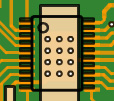
Luckily WEBENCH provides the PCB layout that I can copy. I'll prioritize the datasheet recommendations as I fear WEBENCH is causing additional confusion. Side question, what are the many via like dots that are placed underneath some components?

I'd like to read up on that

So from what I gather thus far, I'm switching a ton of current through the inductor, mosfet and power diode. Let's say I calculated and found components that can handle the specs, the LM3478 chip I showed above should have no problems right? I'm hesitant because WEBENCH says it can't handle the current, but the chip itself never sees that type of current so I am confused. Maybe it's because finding an inductor and diode that can handle that level of current isn't practical or efficient.


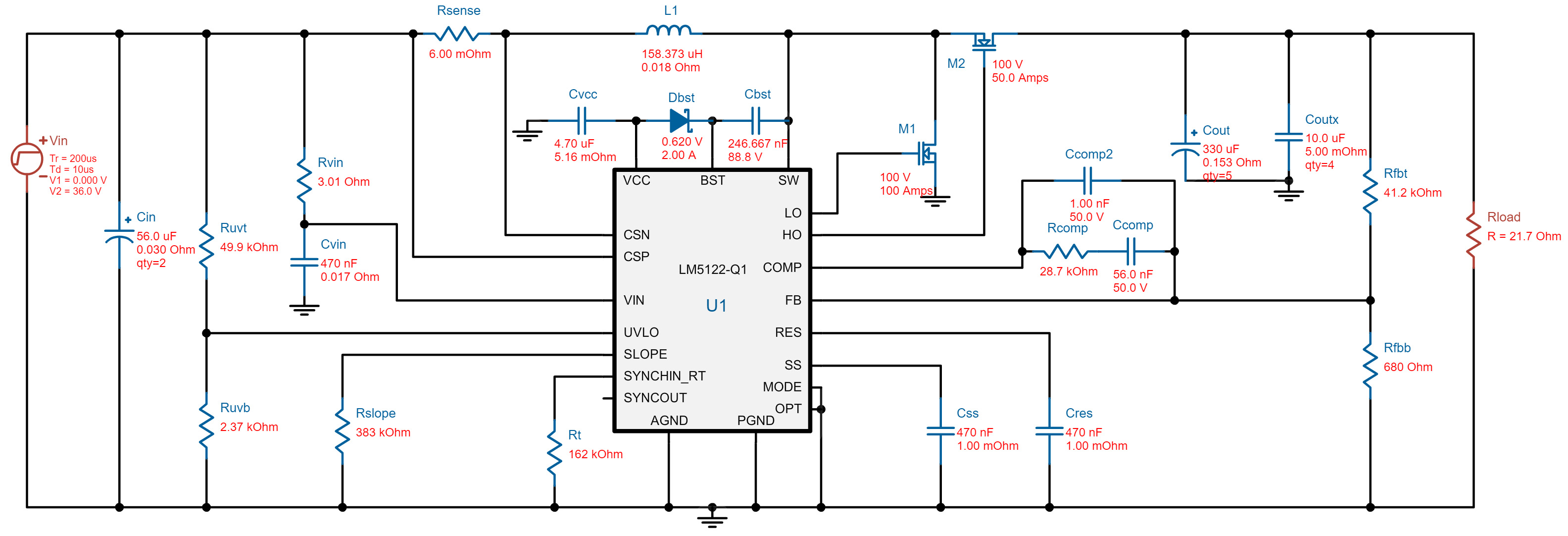
If the LM3478 solution doesn't make sense, TI offers the LM5122. It has an internal switch, you mentioned that would be very beneficial to prevent layout issues. Here's a schematic with that chip:


It has a higher BOM count unfortunately, but that's ok.

To think that this is just to generate the power for my LED... I still need to figure out the adjustable Constant Current regulation after this! :dizzy:
It's gonna be so cool though!! btw if you're curious, this is to create an exceptionally powerful photography light that I can use during sunset
 
Last edited:

ebp

Joined Feb 8, 2018
2,332
I can see no reason why the controller shouldn't be used for any arbitrary amount of power. Since the power devices are entirely external, the sole limitation is the amount of gate drive that can be provided by the IC which limits the size of FET that can be driven. Although it introduces a little extra delay, that can be solved by using a separate gate driver that can handle more current. The delay is of no consequence in normal operation because the feedback loop compensates for it. The only time the extra delay could be an issue is with overcurrent when it can add a little time between detection of overcurrent and switching off the FET. Normally even that wouldn't be a issue with any design that is the least bit conservative in component ratings. There are also many newer FETs that have substantially lower gate charge requirements than older parts, so a well-chosen FET could eliminate the need for a driver - and probably improve overall efficiency in the bargain.

With current mode control, the power rating of the current sense resistor can become an issue, but the sense voltage required for this controller is decently low.

These days it is possible to find a wide array of inductors off the shelf. When you are working with higher voltages the inductance required can be moderately high, and if the switching frequency isn't quite high it can also mean a physically larger inductor. These factors do narrow the choices quite dramatically. I haven't designed a switcher for a few years (and intend to return to the molecules whence I came without ever doing another) so I haven't looked at what's available recently. You are unlikely to find exactly the value your first-round calculations arrive at, so it is normal to pick something close then go back verify how well it "fits." Many power inductors that are operated with "DC bias" (as is the case here) drop significantly in inductance due to that bias. This is generally quite workable, but another consideration. Different core materials behave differently in this regard.
You can design and wind your own inductors, but that is rather involved and means procuring suitable cores and wire.

An array of vias under a surface mount power part is used for thermal management. The vias would connect to a large area of foil on the opposite side of the board. A solid copper slug in the package solders to the pad on the top of the board - which makes soldering with an iron essentially impossible.
 
Top