What kind of cordless drill should I get?

Thread Starter

Macnerd

Joined May 22, 2014
67
Macnerd, no offense meant, but have to ask this. How does someone get to retirement age(from your original post) and never own a drill? And again no offense, but this is seeming more and more like you are trolling us.
Up until now, believe it or not, I've never had a need for a drill. I don't even have a soldering iron. My dad had a Craftsman soldering gun. Since I'm retired, I'm on a fixed income so I can't afford a super-duper drill or soldering iron. Ditto for a multimeter which I also need.

I've got some screwdrivers, pliers, & hex wrenches, but that's the extent of my tools.

So, basically I'm starting my electronics hobby from scratch.

I'm sorry that I'm asking so many questions.

Do I need different kinds of drills for plastic, metal, wood, etc. or does one kind work for metal, plastic, wood, etc.?
 

cmartinez

Joined Jan 17, 2007
8,881
Do I need different kinds of drills for plastic, metal, wood, etc. or does one kind work for metal, plastic, wood, etc.?
A drill capable of giving you up to 2,000 RPMs should work for most materials. Also, make sure that you buy good quality HSS (high-speed steel) bits.
 

Thread Starter

Macnerd

Joined May 22, 2014
67
A drill capable of giving you up to 2,000 RPMs should work for most materials. Also, make sure that you buy good quality HSS (high-speed steel) bits.
I saw that on a YouTube video. The narrator said that carbide bits are brittle & will break when dropped. Sure enough, a bit broke when he dropped it on the floor. The tungsten (or is it titanium) bits are just steel coated with tungsten. He recommended HSS bits.

What's the clutch for on a drill? Is it like a torque wrench - you set the clutch to slip when a certain torque is exceeded?
 

nerdegutta

Joined Dec 15, 2009
2,689
I've worn out my share of cordless drills:

Bosch, gear box jammed
Makita, motor started to smoke
DeWalt, fell apart in my hands...!
Panasonic, housing cracked

I ended up with a Hilti. Some colleagues are sworn Milkwakee fans, but I'm a Hilti guy.

I've never tried Festool, because I think some of the models looks awkward. Now that's a valid reason. :rolleyes:
 

shortbus

Joined Sep 30, 2009
10,049
I saw that on a YouTube video. The narrator said that carbide bits are brittle & will break when dropped. Sure enough, a bit broke when he dropped it on the floor. The tungsten (or is it titanium) bits are just steel coated with tungsten. He recommended HSS bits.

What's the clutch for on a drill? Is it like a torque wrench - you set the clutch to slip when a certain torque is exceeded?
The tungsten drills your talking about are a waste of money for around the house use. TIN(the tungsten) is a coating put on a HSS drill or other tool. If you need to sharpen it, no more coating on the cutting surface, only about one molecule thick. TIN, tungsten nitride really, is something they came up with to keep the metal that's being cut from welding to the tool, from the heat and speed in a CNC machine. For normal manual machining it's a waste of money. Because it's not possible to machine at the same speed as a CNC. I was a die maker for ~50 years and still do my own machining in my home shop.

The clutch isn't very accurate, not like a torque wrench. But can be set to drive screws. Don't use it my self, just keep mine set on the drill setting.
 

Thread Starter

Macnerd

Joined May 22, 2014
67
A drill capable of giving you up to 2,000 RPMs should work for most materials. Also, make sure that you buy good quality HSS (high-speed steel) bits.
I've seen drill/driver. I assume that driver refers to screwdriver? I have a "manual" screwdriver with different types of bits, but it sure would be nice to have the option of using an electric "screwdriver"!
 

MaxHeadRoom

Joined Jul 18, 2013
30,871
If you look for Driver Bit Sets, you can get a hex to square fitting for the chuck that takes all kinds of screwdriver formats including Allen Screw bits, very handy for machines screws that are long in the thread.
You could probably use the ones you have in it.
Max.
 

cmartinez

Joined Jan 17, 2007
8,881
What's the clutch for on a drill? Is it like a torque wrench - you set the clutch to slip when a certain torque is exceeded?
That's exactly what it is. And it's intended for use as a screwdriver. For drilling purposes, you normally set it to non-slip, full clutch.
 

wayneh

Joined Sep 9, 2010
18,181
...I can't afford a super-duper drill or soldering iron. Ditto for a multimeter which I also need.
Here are my choices for soldering iron and multimeter. I use them both for household handyman stuff, car repair, DIY and hobbyist projects. They exceed my needs for this type of work. I'll spend more if/when I ever need to, but I don't see that happening.

The infamous Harbor Freight multimeter, often available free with any purchase with a coupon. (I have a half dozen of these around the house, never paid for any of them).


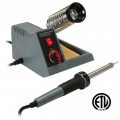
My Stahl soldering station from Parts-Express (and other places):
Screen Shot 2017-02-21 at 11.56.40 AM.png

Don't forget that you'll need solder, such as this. Wire strippers are also a godsend if you need them. I've used the crappy ones and will never go back, now that I've got these. They're still fairly cheap, but infinitely better than the absolute cheapest ones.


Do I need different kinds of drills for plastic, metal, wood, etc. or does one kind work for metal, plastic, wood, etc.?
The short answer is no, one drill and one (good) set of bits is good for all. But if you find yourself doing a lot of projects in one material, more specialized bits can be helpful. A drill press will usually have at least 3 speed settings, and you would prefer high speed for metal and low speed for plastic. Hand drills often have variable speed control, but most people just squeeze the trigger to max and go with it.
 

ErnieM

Joined Apr 24, 2011
8,415
The TS has a right to know there is not universal love for this tool. :p
Infamy does not nor should not imply love or even acceptance.

That said I too have this meter and oft use it when it is appropriate, most notably when any sort of voltage indication is far better than my own wet finger used as a probe.
 

wayneh

Joined Sep 9, 2010
18,181
I think this depends on the metal type (cast iron, steel and aluminium), and the size of the drill bit. When drilling in metal, I always use "cutting oil", and take my time. The drill bits will also stay sharp longer.
There is an ideal speed and advance rate for every combination of material, drill type and size. There are even published tables for some of the combinations. Most homeowners end up just use the one drill bit they have that is the right size and set the drill on or off. And yeah, I always use oil for metal drilling also. If nothing else, it slows down the shrapnel.
 

#12

Joined Nov 30, 2010
18,224
I've been repairing machines since before battery operated drills were invented. They save a lot of time when you have to take out 18 screws to get inside a TV or an air conditioner. The clutch is for putting the screws back in without stripping the substrate. Nobody wants 10 stripped screw holes in the back of their TV or half a dozen stripped screws trying to hold the cover on their air conditioner.

Full force from a good battery drill will strip any sheet metal screw and any wood screw less than an inch long. Use the clutch and you can go fast without ruining the screw holes.
 
Top