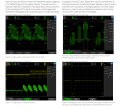
To synchronize the oscilloscope trace at either the field rate or at the line rate of an analog video signal by locking at either the vertical sync or horizontal sync respectively.
It has circuitry to separate the horizontal sync from the vertical sync on an NTSC analog video signal.
Otherwise it would be generally not possible to display the horizonal line video signal as a stable display.
Thanks. Does 'TV' trigger mean Television Video trigger or something else ? Can video on a digital ATSC on 8VSB / DVB-T television be monitored with an oscilloscope ?
Not with the TV sync mode, as those digital signals are completely different, generally requiring specialized test equipment to decode and view them.
That mode is just for viewing the video format of the old NTSC analog signal, so basically it's now an obsolete setting.
Thanks. Does 'TV' trigger mean Television Video trigger or something else ? Can video on a digital ATSC on 8VSB / DVB-T television be monitored with an oscilloscope ?
All that is old school analog video. TV sync should work. Many very old and low-cost scopes have TV sync.
There is more than one type of TV sync. Some scopes allow you to look at just line 47, example, in the picture. But many analog scopes have a very simple TV sync function. On most scopes you can filter the trigger on the scope. There is likely a high frequency reject button (20mhz), a DC block function (AC), etc. I just looked at my 465 scope and it has an AC, DC, HF reject, LF reject. It also has a way to sync to the power line. (50 or 60hz) Some scopes, for TV sync, adds a filter to pass 50/60hz signals for vertical sync. (25 to 120hz) and also a filter to pass 14khz to 32khz for H. sync. No real smarts there.
I do have scopes built for video where I can lock the sync and pull out any line or part of a line. There is a knob or button to program in what parts of the picture I want to look at. This is not common.
All that is old school analog video. TV sync should work. Many very old and low-cost scopes have TV sync.
There is more than one type of TV sync. Some scopes allow you to look at just line 47, example, in the picture. But many analog scopes have a very simple TV sync function. On most scopes you can filter the trigger on the scope. There is likely a high frequency reject button (20mhz), a DC block function (AC), etc. I just looked at my 465 scope and it has an AC, DC, HF reject, LF reject. It also has a way to sync to the power line. (50 or 60hz) Some scopes, for TV sync, adds a filter to pass 50/60hz signals for vertical sync. (25 to 120hz) and also a filter to pass 14khz to 32khz for H. sync. No real smarts there.
I do have scopes built for video where I can lock the sync and pull out any line or part of a line. There is a knob or button to program in what pars of the picture I want to look at. This is not common.
That is old.
HDMI is digital. Which is something like analog for timing. There is sync, the video is not analog.
Broadcast TV and internet video is heavy compressed. There is no need for sync. If you saw how much is lost to compression you would be upset.
Only if it seriously degrades the displayed video resolution or gives visible motion artifacts.
There is much redundancy between displayed video frames, which can be safely eliminated.
Only the parts of the picture that have changed need to be transmitted.
And even if there is some reduced resolution of the parts of the picture with motion, the eye/brain does not perceive it.
Part of the confusion is "today's broadcast video" is not the same as "HDMI" which is not the same as "analog video" and I never know which we are talking about.
When video compression was new, I spent time evaluating video. My first look was at Sony where we were sending low resolution video over phone lines. Before the broadcast standards were in stone, we watched too many action videos looking for artifacts, caused by our compression formulas. I just about can't stand broadcast sports (on TV) because I know where the compression does not work well. Most people are watching the ball or players. I am watching big pieces the background fall out then come back. Or I am watching a block of video that has not been updated to a long time.
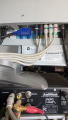
The VIDEO (yellow) connection is still NTSC composit video, just like the video from your VCR. (3 connectors, Left, Right, and Video) the same video format as back in 1964. The other connectors with more pins carry different formats. The HDMI connector out of the cable box or DVD player is not the same, I don't think.
Certainly you can "monitor the signal", BUT it will not be useful for most of us.
Part of the confusion is "today's broadcast video" is not the same as "HDMI" which is not the same as "analog video" and I never know which we are talking about.
Yes, HDMI is just standard signal format and connector/cable design to transmit HD digital video between devices.
Once the digital signal leaves the broadcast studio it does not turn back into any form of analog until somewhere inside the TV receiver, and that analog format to drive the LCD display is likely not standardized, so would differ between different TV receiver manufacturers.
There is a standard digital HD TV format , but there is no analog signal standard like the NTSC one for standard def TV.
So the answer to the question in post #1 is "Usually Not Much."
My investigations of "fairly recent" television receivers reveal a small set of PCB modules, a tuner of some kind, a processor PCB with a custom processor, and a power supply. None of them built to be serviceable, except possibly the power supply and the wires to the I/O connectors. And possibly the power supply for the backlight LEDs. Maybe.

 Facebook
 Google
 GitHub
 Linkedin