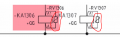
Perfect, cheers MaxHeadRoomIt is a VDR, Voltage Dependent Resistor, used for suppression purposes.
AKA Varistor
Hi MisterBill2,INDEED!! The symbol is for a varistor, which usually is a breakdown device, meaning that above some voltage it switches on and conducts quite well, until the voltage is removed and the current stops flowing. The really bad news is that some of them do not shut off when the current supply is switched off.
In some cases a device called a snubber is connected across the coil , which a snubber consists of a capacitor and a resistor in series. That also is used to suppress voltage surges, They have a benefit of not failing in a short circuit mode.
Hi MaxHeadRoom,The capacitor will conduct on pulses that may occur on power switching, DC.
R/C suppression snubbers are often fitted directly across the load.
In the case of switching high current DC loads, there are relays with arc blow-out magnets close to the contacts themselves for arc suppression..
Correct on the RCD assumption, however why never use the diode in the configuration as surely it's adding some benefit?RCD? Do you mean Res,Cap,Diode?
I never use a diode in this configuration, either diode alone or just R/C.
When the DC collapses when turning off a inductive device, the induced power is opposite to the applied power.
Ok, so because it can charge the capacitor this is the same as shunting it through a diode, so why use the RC snubber on DC rather than a diode (with or without the resistor). Or should the snubber only be used on DC as a last resort and if possible stick to the diode?Actually, the capacitor does not conduct, but it does accept a charge, and that does allow a current in the resistor, which does dissipate much of the transient's energy.
Putting a resistor in series with the suppressor diode also dissipates energy that would otherwise slow the collapse of the magnetic field. It also slows the relay or solenoid release time quite a bit. You can prove this to yourself by putting a diode in series with a DC relay and then powering the circuit with AC. The relay will buzz noisily. Now add a diode across the relay coil to block the current from the other diode. The relay will operate very well with no capacitor at all to smooth the current. It will also release a bit slower.
But the capacitors on the snubbers aren't that big, unless that's because they are not adequately rated? Yes the diode is smaller, but I've seen very small snubbers encapsulated into small packages before? I mean from that are we saying the packaged snubbers used on AC coils/contacts you buy from say RS are not actually rated properly? Also why does the snubber include that diode in the RCD setup?The diode is used because it is MUCH SMALLER than an adequately rated capacitor, and also because it costs a whole lot less. AND a diode can be hidden inside a small relay housing, which can give an unknowing person a very hard time getting a circuit to function correctly.
| Thread starter | Similar threads | Forum | Replies | Date |
|---|---|---|---|---|
| E | Multi-Device Communication on same bus | Microcontrollers | 12 | |
| S | Paying someone to design pcb + casing for an electronic device | Jobs & Career Advising | 38 | |
| Y | passive device S-parameters logic | Wireless & RF Design | 0 | |
|
|
Does this device exist ? | Off-Topic | 5 | |
| S | voltage across nonlinear device | Homework Help | 3 |