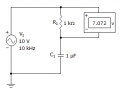
Sorry, I got a little carried away. I'll let the formulas stay, but take away the numbers.
This looks like a typical homework assignment, I don't think output impedance is to be considered in this case.
I don't doubt there is something wrong with my calculation but it would be nice if you could point out exactly what for me. Maybe I can learn something too.
You're correct. I didn't notice the extra voltages. There are two many numbers in that problem making it inconsistent. You have to discard one of the numbers.
I don't think you can ignore the output impedance of a voltage source.
Assuming it is infinity does not correspond to a standard voltage source and any real world voltage source does not act that way (e.g. a lab power supply).
If the homework solver is supposed to assume that without any instruction to that effect then the homework is incorrect.
I don't think you can ignore the output impedance of a voltage source.
Assuming it is infinity does not correspond to a standard voltage source and any real world voltage source does not act that way (e.g. a lab power supply).
If the homework solver is supposed to assume that without any instruction to that effect then the homework is incorrect.
Remember I had tasks like this in school, and output impedance was always omitted. You are right though, in a real world situation (and theoretically of course) it will matter.
The voltage across the resistor will be 7.072 V a couple of times during one cycle. I think the task wants you to find the voltage across the capacitor at these moments.
The voltage across the resistor will be 7.072 V a couple of times during one cycle. I think the task wants you to find the voltage across the capacitor at these moments.
Are you kidding me ? How can voltage be equal 7.072V a couple of times during ONE cycle ?
So this 7.072V is not a RMS value? And V1 is not a sine wave ?
Also do you know the II Kirchhoff's law ??
Are you kidding me ? How can voltage be equal 7.072V a couple of times during ONE cycle ?
So this 7.072V is not a RMS value? And V1 is not a sine wave ?
Also do you know the II Kirchhoff's law ??
V1 is surely a sine wave. It will be 7.072 V on the way up to the positive peak and on the way down from the positive peak. A small amount of voltage will stay across the capacitor, so the source signal will have a slightly higher potential than 7.072 V in these moments. That's what I meant.
Didn't think about RMS, but that number is just too close to be a coincidence.
You're correct. I didn't notice the extra voltages. There are two many numbers in that problem making it inconsistent. You have to discard one of the numbers.
You can't just discard one of them. Which one would you discard? Why that one?
Assuming that the voltmeter across the resistor is displaying RMS, then you have an overconstrained problem that MIGHT be inconsistent. If it is, then it is and the problem has no defensible solution (i.e., one that would satisfy all of the given information). But it might well be consistent with ALL of the given data, even though it is overconstrained. If so, then that's fine.
In this case the impedance of the capacitor is so small that nearly all of the RMS voltage will appear across the resistor, making it inconsistent IF that meter is displaying RMS. But if it is supposed to be displaying the instantaneous voltage across the resistor, then it is effectively just a clock telling you what moment in time, relative to the source sine wave, that the instantaneous voltage is to be taken across the capacitor.
It would be nice if the OP would let us know what that meter is supposed to be measuring.
I don't think you can ignore the output impedance of a voltage source.
Assuming it is infinity does not correspond to a standard voltage source and any real world voltage source does not act that way (e.g. a lab power supply).
If the homework solver is supposed to assume that without any instruction to that effect then the homework is incorrect.
Why would you think that someone is assuming the output impedance of that source to be infinity? I didn't see that suggested, only that, as a homework problem if nothing else and with the information given, that the expectation might be that the source impedance not be taken into account.
We ignore source impedances all the time. On paper they are often ignored for problems and in practice they are ignored all the time provided the output impedance of a voltage source is low enough to have a negligible effect on the result. Surely if you were figuring out how much current would flow in a 12kΩ resistor connected to a 12V lab power supply you wouldn't go digging through the manuals trying to find the output impedance. Even if you knew that supply had a 50Ω output impedance (meaning it was probably a signal generator and not a power supply), most people would safely ignore that given a 12kΩ load. Even if the load was known to 1%, the uncertainty in the resistance is twice the output impedance. The output voltage probably isn't actually known to the fraction of a percent that would be needed to make ignoring the output impedance have any noticeable effect.
Why would you think that someone is assuming the output impedance of that source to be infinity? I didn't see that suggested, only that, as a homework problem if nothing else and with the information given, that the expectation might be that the source impedance not be taken into account.
We ignore source impedances all the time. ....................................
If you want to include R1 in the calculation then you need to ignore the voltage source impedance (which makes it infinity).
Of course we ignore voltage source impedance but only when a low source impedance has little effect on the measurement. Here a low source impedance has a big effect on the circuit. An ideal zero source impedance removes R1 from the circuit.
Thus I don't see how you can ignore it. Certainly it's very bad engineering practice to do so and will lead a student to ignore the source impedance when he shouldn't.
If you want to include R1 in the calculation then you need to ignore the voltage source impedance (which makes it infinity).
Of course we ignore voltage source impedance but only when a low source impedance has little effect on the measurement. Here a low source impedance has a big effect on the circuit. An ideal zero source impedance removes R1 from the circuit.
Thus I don't see how you can ignore it. Certainly it's very bad engineering practice to do so and will lead a student to ignore the source impedance when he shouldn't.
How does ignoring the voltage source impedance make it infinity? It makes it ZERO! If you assume it's infinite then you have no current at all. Remember, the source impedance for a voltage source is in series with the source and load.
Why do you need to ignore the voltage source impedance if you want to include R1 in the calculation?
How does an ideal zero source impedance remove R1 from the circuit?
If you want to add a source impedance to the circuit, go ahead. Call it Rs. Then work out the voltage across the capacitor and see how Rs affects the result compared to ignoring it (i.e., making it zero) and you'll see that it has to be quite large in order to have a significant effect.
........................................
How does ignoring the voltage source impedance make it infinity? It makes it ZERO! If you assume it's infinite then you have no current at all. Remember, the source impedance for a voltage source is in series with the source and load.
Why do you need to ignore the voltage source impedance if you want to include R1 in the calculation?
How does an ideal zero source impedance remove R1 from the circuit?
..............................
I can see we are talking in circles.
I'm not talking about the voltage sources impedance effect on the voltage from the source. I'm taking about its effect on the effective impedance of R1 as seen by V1.
If both source impedances are zero then there is an effective AC short across R1 so all V1 sees is the impedance of C1. This means the AC voltage across C1 is 10VAC with an average value of -7.072VDC.
That's what both a Spice simulation and a real world circuit would show.
Just apply simple KVL, U have 3 voltages , two of them are known and one is unknown and the sum of the voltages would equal zero.
I think It's very easy, U only need to take care of applying KVL and the sign of each voltage!!!
I can see we are talking in circles.
I'm not talking about the voltage sources impedance effect on the voltage from the source. I'm taking about its effect on the effective impedance of R1 as seen by V1.
If both source impedances are zero then there is an effective AC short across R1 so all V1 sees is the impedance of C1. This means the AC voltage across C1 is 10VAC with an average value of -7.072VDC.
That's what both a Spice simulation and a real world circuit would show.
Could you please sketch a schematic, because I can't picture what you have in mind. Now you are talking about two sources. Where is this second source coming from? Are you thinking that the meter across R1 is a voltage source?

 Facebook
 Google
 GitHub
 Linkedin