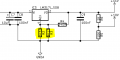
At the adjust pin(pin 4) of the IC there are 2 resistors. But i feel the desired output voltage could have been achieved with a single resistor equivalent to the combination of R2 and R3. Can someone help me understand ?
Hi Eric, Thanks for the reply.
My question is , the designer could have used a single resistor of 1850ohms instead of 2 resistor to make up that resistance value. Either way the output voltage should be same? Am i right?
Yes. Look at a chart of 1% resistor values and NOTICE that 1.85 kΩ is NOT a standard value. Using two resistors is a really cheap way of getting exactly the value you want.
Half right. 2.32K is a standard 1% value, while 9.13K is not.
However, 9.31K *is* a standard 1% value, and it raises the calculated output value to 10.92 V. Typo?
Separate from that, another reason to put two or more resistors in parallel is for permanent adjustment in final test. For high volume products back in the through-hole days, you have the main resistor in parallel with several much higher value ones. In final test, you clip out the trim resistors to reach the desired circuit parameter. After that there is nothing for anyone to adjust.
IF
resistors cost pennies
trimpots cost quarters
manual adjustment during final test is required
field adjustment is not required
THEN
this is a much cheaper way to go
Different classes of resistors have different values. For example, carbon-film resistors will have values that metal-film resistors do not and/or vice-versa.
hi AK
I guess you have encountered the same problems with the spread of the LM317K d/s tolerances.
Even when built using close tolerance resistors to get a precise Vout, when the LM317 fails in service,a replacement is most likely no longer in Vout spec.
Also when manufacturing a number of LM317 PSU's tight spec resistors are a pain.
That's why I prefer a low value trimmer.
hi,
For ref only,
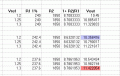
Using 240R 1% resistor, 1850R and using the d/s Vref range of 1.2V thru 1.3V, this shows the possible error in Vout, using those values.
This is why I prefer the trim pot, I know that it is extra cost, but does simplify manufacture and repair.
E
For long term reliability, particularly in harsh environments, fixed resistors are a lot better way to go. Pots are easier to get your wanted voltage though. And most times, the actual voltage is not that important. A few % either way is quite ok.
It could be that he doesn't stock resistors that are sufficiently close to 1.85 kΩ. While this is not a standard value, 1.8 kΩ is and that would likely have been good enough. But it might have been a part he didn't stock. I'm not fond of that explanation in this case because the parts he is using are from a much finer sequence and if he stocks these he probably stocks something close to 1.85 kΩ. The values 232 and 931 (not 913 -- typo?) are in the E96 sequence while 187 is in the E48 sequence and, additionally, 182 is in the E96 sequence.
A more likely possibility is that the design is generic and the basic design uses one of the two resistors and if you want a lower voltage then you do that by adding an appropriate resistor in parallel using an unpopulated pair of pads for that purpose.
Another likelihood is similar to the above but in this case the default resistor is chosen specifically to place the voltage a bit too high so that, on a unit-by-unit bases, a relatively high value trim resistor (5x to 10x the base resistor value) is added to park the actual voltage very close to the target value.
The calculator app has a 240 ohms resistor which is used on a more expensive LM117. An LM317 usually needs 120 ohms.
Every circuit and the graphs in the datasheet use the 240 ohms for the LM117.
With 240 ohms then the output voltage rises if the load current is low and you can kiss your new low current Cmos circuit goodbye.
But this circuit has a 10mA voltage divider on its output so 240 ohms is fine.

 Facebook
 Google
 GitHub
 Linkedin