What is the rms voltage of this waveform?

Thread Starter

Hymie

Joined Mar 30, 2018
1,347
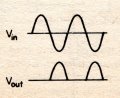
Within the attached diagram:-

Vin is a 240Vrms sine wave.

Vout is a half-wave rectification of Vin (with no voltage losses due to rectification).
(actually the negative portion of Vin rectified - but that has no bearing on the result)

What is the rms voltage of the Vout waveform?


Suggest you calculate your answer before revealing what others have posted.
Half wave rectification.jpg
 

WBahn

Joined Mar 31, 2012
32,706
Within the attached diagram:-

Vin is a 240Vrms sine wave.

Vout is a half-wave rectification of Vin (with no voltage losses due to rectification).
(actually the negative portion of Vin rectified - but that has no bearing on the result)

What is the rms voltage of the Vout waveform?


Suggest you calculate your answer before revealing what others have posted.
View attachment 150424
If you understand what the meaning of rms voltage (or, more to the point, "effective voltage), then the answer should be apparent by inspection.

Even if you can't, understanding why we call it "rms" should also quickly lead to an answer without actually doing an integration.

So if the answer isn't apparent from those hints, start by describing what either (or both) of those means and we can go from there.
 
Last edited:

Thread Starter

Hymie

Joined Mar 30, 2018
1,347
It's quite simple.
Is this supposed to be a trick question?

It’s not a trick question – I’m willing to bet most would respond with an incorrect value.

Please respond with your answer (along with any calculations used to reach that answer)
 

Thread Starter

Hymie

Joined Mar 30, 2018
1,347
The effective power is obviously cut in half so what does that do to the RMS voltage?
In my experience, most persons respond to the question with the answer of 120Vrms, on first inspection of the problem (myself included) – my maths teacher clearly has a lot to answer for.
 

george4657

Joined Apr 12, 2016
15
rms Voltage is (Peak Voltage)/root 2
Peak Voltage in = 240 * root2 = 240 * 1.41 = 339 volts
You were given rms in so rms out = (rms in) / 2 = 120
or (339/1.41)/2 = 120
rms is the average abs voltage over time so peak voltage out would still be 240 * root2 = 339 but this is no longer a sine wave so rms volts is cut in half by the diode
 

Thread Starter

Hymie

Joined Mar 30, 2018
1,347
rms Voltage is (Peak Voltage)/root 2
Peak Voltage in = 240 * root2 = 240 * 1.41 = 339 volts
You were given rms in so rms out = (rms in) / 2 = 120
or (339/1.41)/2 = 120
rms is the average abs voltage over time so peak voltage out would still be 240 * root2 = 339 but this is no longer a sine wave so rms volts is cut in half by the diode
Looks like george4657 is agreeing with my first analysis (although my estimation was purely based on half the waveform not being present).
 

crutschow

Joined Mar 14, 2008
38,322
You were given rms in so rms out = (rms in) / 2 = 120
or (339/1.41)/2 = 120
rms is the average abs voltage over time so peak voltage out would still be 240 * root2 = 339 but this is no longer a sine wave so rms volts is cut in half by the diode
RMS is not the average value of the abs voltage over time. It's the square-root of average squared voltage over time.
You forgot that RMS is the equivalent heating power of the waveform into a resistive load, and that's proportional to the square of the voltage. so the RMS value of the rectified wave is is 240/√2 not 240/2.
 

Thread Starter

Hymie

Joined Mar 30, 2018
1,347
RMS is not the average value of the abs voltage over time. It's the square-root of average squared voltage over time.
You forgot that RMS is the equivalent heating power of the waveform into a resistive load, and that's proportional to the square of the voltage. so the RMS value of the rectified wave is is 240/√2 not 240/2.
For those who cannot grasp what crutschow is saying – I offer this circuit as proof that the half wave rectified voltage of a 240V sine wave is 240V/√2 and not 240V/2.

The circuit is based on what crutschow is trying to explain.

Assume that the input voltage is 240Vac and that each of the three resistors is 240 ohm.

The power dissipated by R1 will be 240W.

The power dissipated by each of resistors R2 and R3 must be half that of R1.

Since power = V squared/R; we get 120W = V squared/240R

Transposing gives V = √(120 x 240) = 169.7V (or 240/√2)

Half wave rectification voltage-power.jpg
 

ebp

Joined Feb 8, 2018
2,332
The general case where "pulses" of known RMS value, regardless of waveshape of the pulse, are separated by periods of zero amplitude is
overallRMS = √d x pulseRMS where d is duty cycle (ratio of pulse period to full cycle period)​

For the case in question, d is 0.5 so overall RMS = √0.5 x pulse RMS

And of course this is nothing more than a shortcut that applies both the weighting for calculating the mean of the squares and the square root of the mean of the squares in a single step.
 

WBahn

Joined Mar 31, 2012
32,706
Well, it’s not blindingly obvious to me that the rms voltage of Vout is Vin/root 2.

Perhaps I’m in the wrong profession.
This is why I was suggesting to start with what the RMS voltage is and where it comes from.

The "effective voltage" of a voltage waveform is the DC voltage that would result in the same average power dissipation in a purely resistive load.

It's that simple.

So what is the average power dissipated in a purely resistive load by a voltage waveform?

\(P_{avg} \; = \; \frac{1}{T}\int_{T_0}^{T0+T} \frac{v^2(t)}{R} dt \)

Next we just set the average power expressions for a DC voltage of magnitude Veff and for the arbitrary waveform equal.

\(\frac{1}{T}\int_{T_0}^{T0+T} \frac{V^2_{eff}}{R} dt \; = \; \frac{1}{T}\int_{T_0}^{T0+T} \frac{v^2(t)}{R} dt \)

The left hand side we can evaluate immediately.

\(\frac{V^2_{eff}}{R} \; = \; \frac{1}{T}\int_{T_0}^{T0+T} \frac{v^2(t)}{R} dt \)

Since R is a constant, we can factor it out of the integral and cancel it out completely.

\(V^2_{eff} \; = \; \frac{1}{T}\int_{T_0}^{T0+T} v^2(t) dt \)

Next we can take the square root of both sides.

\(V_{eff} \; = \; \sqrt{\frac{1}{T}\int_{T_0}^{T0+T} v^2(t) dt} \)

At this point we have the formula for the effective voltage of any voltage waveform. We can see that it consists of taking the Root of the Mean of the Square of the waveform, hence why we call it RMS.

Now, in the special case of a periodic waveform we need to take the integral over an integer number of periods. In the further special case of a sinusoidal waveform, we can write this as

\(V_{eff} \; = \; \sqrt{\frac{1}{2\pi}\int_{0}^{2\pi} V_0^2 \sin^2 \(\theta\) d\theta} \)

Note that the above incorporated a change of variables from time to angle.

V0 is the amplitude of the sinusoid and it is a constant.

\(V_{eff} \; = \; \sqrt{\frac{V_0^2}{2\pi}} \sqrt{\int_{0}^{2\pi} \sin^2 \(\theta\) d\theta} \)

At this point we can use a trick because we know that sin²(θ) + cos²(θ) = 1 and because we know that an integral of sin²(θ) over a complete period is going to be the same as an integral of cos²(θ) over a complete period. Hence

\(V_{eff} \; = \; \sqrt{\frac{V_0^2}{2\pi}} \sqrt{\frac{2\pi}{2}} \)

No just simplify and you have FOR A PURE SINUSOID,

\(V_{eff} \; = \; \frac{V_o}{\sqrt{2}}\)

So you can see that there's no magic and it doesn't need to be obvious -- just do the math.
 

MrChips

Joined Oct 2, 2009
34,628
Another way of looking at it, voltage and wattage are not linearly related.

Suppose you have voltage applied across a 1Ω resistor.

1V gives 1W
2V gives 4W
3V gives 9W
4V gives 16W
:
240V gives 57,600W

To get half the wattage, i.e. 57600/2 = 28,800W, you need 169.7V not 120V.
 

MrChips

Joined Oct 2, 2009
34,628
You can work out the integral as demonstrated by @WBahn.

Assuming a sine wave of a.sin(θ)
You need to find the area under the curve of (a.sin(θ)) squared.

The area from θ = 0 to π/2 (one quadrant) is a^2 x π/4

For a full cycle from 0 to 2π, total area is a^2 x π (four quadrants)
Mean = a^2 x π / 2π = a^2 / 2
RMS = a / √2

For 0 to 2π for half-wave, total area is a^2 x π/2 (two quadrants)
Mean = a^2 x π/2 / 2π = a^2 / 4
RMS = a / 2

note that a = amplitude = (Vinput rms) x √2
Hence VRMS = Vinput x √2 / 2
 

Thread Starter

Hymie

Joined Mar 30, 2018
1,347
This is why I was suggesting to start with what the RMS voltage is and where it comes from.

The "effective voltage" of a voltage waveform is the DC voltage that would result in the same average power dissipation in a purely resistive load.

It's that simple.

So what is the average power dissipated in a purely resistive load by a voltage waveform?

\(P_{avg} \; = \; \frac{1}{T}\int_{T_0}^{T0+T} \frac{v^2(t)}{R} dt \)

Next we just set the average power expressions for a DC voltage of magnitude Veff and for the arbitrary waveform equal.

\(\frac{1}{T}\int_{T_0}^{T0+T} \frac{V^2_{eff}}{R} dt \; = \; \frac{1}{T}\int_{T_0}^{T0+T} \frac{v^2(t)}{R} dt \)

The left hand side we can evaluate immediately.

\(\frac{V^2_{eff}}{R} \; = \; \frac{1}{T}\int_{T_0}^{T0+T} \frac{v^2(t)}{R} dt \)

Since R is a constant, we can factor it out of the integral and cancel it out completely.

\(V^2_{eff} \; = \; \frac{1}{T}\int_{T_0}^{T0+T} v^2(t) dt \)

Next we can take the square root of both sides.

\(V_{eff} \; = \; \sqrt{\frac{1}{T}\int_{T_0}^{T0+T} v^2(t) dt} \)

At this point we have the formula for the effective voltage of any voltage waveform. We can see that it consists of taking the Root of the Mean of the Square of the waveform, hence why we call it RMS.

Now, in the special case of a periodic waveform we need to take the integral over an integer number of periods. In the further special case of a sinusoidal waveform, we can write this as

\(V_{eff} \; = \; \sqrt{\frac{1}{2\pi}\int_{0}^{2\pi} V_0^2 \sin^2 \(\theta\) d\theta} \)

Note that the above incorporated a change of variables from time to angle.

V0 is the amplitude of the sinusoid and it is a constant.

\(V_{eff} \; = \; \sqrt{\frac{V_0^2}{2\pi}} \sqrt{\int_{0}^{2\pi} \sin^2 \(\theta\) d\theta} \)

At this point we can use a trick because we know that sin²(θ) + cos²(θ) = 1 and because we know that an integral of sin²(θ) over a complete period is going to be the same as an integral of cos²(θ) over a complete period. Hence

\(V_{eff} \; = \; \sqrt{\frac{V_0^2}{2\pi}} \sqrt{\frac{2\pi}{2}} \)

No just simplify and you have FOR A PURE SINUSOID,

\(V_{eff} \; = \; \frac{V_o}{\sqrt{2}}\)

So you can see that there's no magic and it doesn't need to be obvious -- just do the math.

Doh, no wonder people were asking whether this was a trick question – when all I needed to find the answer were these half a dozen or so simple equations.

I could kick myself.
 
Top