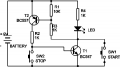
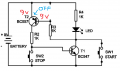
It is a pull-up resistor, its job is to ensure that T1 will be OFF when you power the circuit.
And is some cases T1 will also need a pull-down resistor.
But can you define the value of a base voltage in this case? The base is "floating".
So the base voltage is not well defined in this case, and this is why we are adding R1 resistor.
Hi Jop.
R1 as you have it connected between the emitter and base of a PNP transistor is effectively a pull down resistor.
So that in order to turn on T2 sufficient current, or greater has to flow through R3 to generate 0.65V.
That is I= 0.65/10k =65uA.
This should only happen when SW1 is pressed.
Without R1, any leakage current through T1 and R3 will be sufficient to turn On T2 and make T1 conduct and turn On the LED.
E

 Facebook
 Google
 GitHub
 Linkedin